Short answer: Agentic commerce lets AI software help a shopper find products and move a purchase through a supported checkout. Prepare by checking your product information, platform eligibility and order controls, rather than assuming you need a new store. Enable a channel only after you have tested its actual purchase and support flow.
The Agentic Commerce Protocol, ACP, and Universal Commerce Protocol, UCP, describe ways for agents and merchants to exchange commerce information. Neither name guarantees that your account can accept an order from every assistant. Treat protocol support, channel access and operational readiness as separate questions before changing a setting.
What Is Agentic Commerce, in Plain English?
Agentic commerce moves an assistant beyond describing a product toward helping carry out a transaction. A useful way to picture it is a shopper asking for an item, an assistant checking available options, and a merchant system receiving a structured checkout request. The exact boundaries depend on the integration.
OpenAI's commerce documentation describes ACP as a connection between merchants and shoppers in ChatGPT, including structured catalog information and inventory. Discovery is one part of the journey. Seeing your product in an assistant's answer does not prove that the same assistant can place an order with you.
For a small business, the useful question is specific: can this channel accurately represent what we sell and pass an authorized order into the systems our team already uses? That question produces a better preparation list than a general promise to become an AI store. You can improve product information while checkout access remains undecided.
What Can an AI Shopping Agent Actually Do at Checkout Right Now?
In a supported integration, an assistant can exchange checkout information with the merchant and display the resulting order status. OpenAI's ACP key concepts describe approved-partner access to Instant Checkout and a flow where the merchant validates the order, handles payment with its processor, and accepts or declines it.
Do not turn that into a promise about every ChatGPT user, product or country. Ask your platform to demonstrate your particular channel and account. A product recommendation, a link to your website and an embedded checkout are different outcomes, even if all three appear under an AI shopping label.
During the demonstration, watch where the customer confirms the order. Record the item, variant, quantity, delivery choice and final total shown at that point. Then compare them with the order your team receives. If the assistant only hands the shopper to your website, describe that accurately as a handoff rather than an in-chat purchase.
What Is the Agentic Commerce Protocol, and Who Built It?
ACP was developed by OpenAI and Stripe. Stripe's agentic commerce documentation explains its role in connecting agent purchases with payment infrastructure. That does not mean every ACP transaction must move onto Stripe as the merchant's processor.
OpenAI describes product feeds, checkout handling and delegated payments as distinct parts of its integration. A delegated payment request can restrict the amount and expiry, while a payment service provider returns a token used to complete the purchase. The merchant remains responsible for accepting the order.
For your preparation, ask who maintains each piece. Your commerce platform might supply the connection, an integration provider might do it, or your developer might need to implement it. Owning a payment account alone is not evidence that the catalog, checkout and channel approval work is complete. Request a demonstration using a test product before treating an integration as ready.
What Is the Universal Commerce Protocol, and How Is It Different?
Shopify and Google co-developed UCP. Shopify's engineering explanation describes a protocol where merchants and agents advertise their capabilities and determine which ones they both support. Those capabilities can include checkout, orders and catalog functions, with extensions for additional requirements.
UCP is not a replacement card network. Support from payment companies does not make ordinary card acceptance equivalent to agent checkout support. The practical comparison is about the commerce capabilities available between a particular agent and merchant, not which logo appears on the customer's card.
Shopify also describes human handoffs when a transaction requires something the agent cannot complete. That matters for a shop with special delivery instructions or products requiring extra review. Ask what happens when your required information is missing. A working handoff can be more useful than an apparently automatic flow that silently skips a condition of sale.
Agentic Commerce Protocol vs Universal Commerce Protocol: What Actually Changes for You?
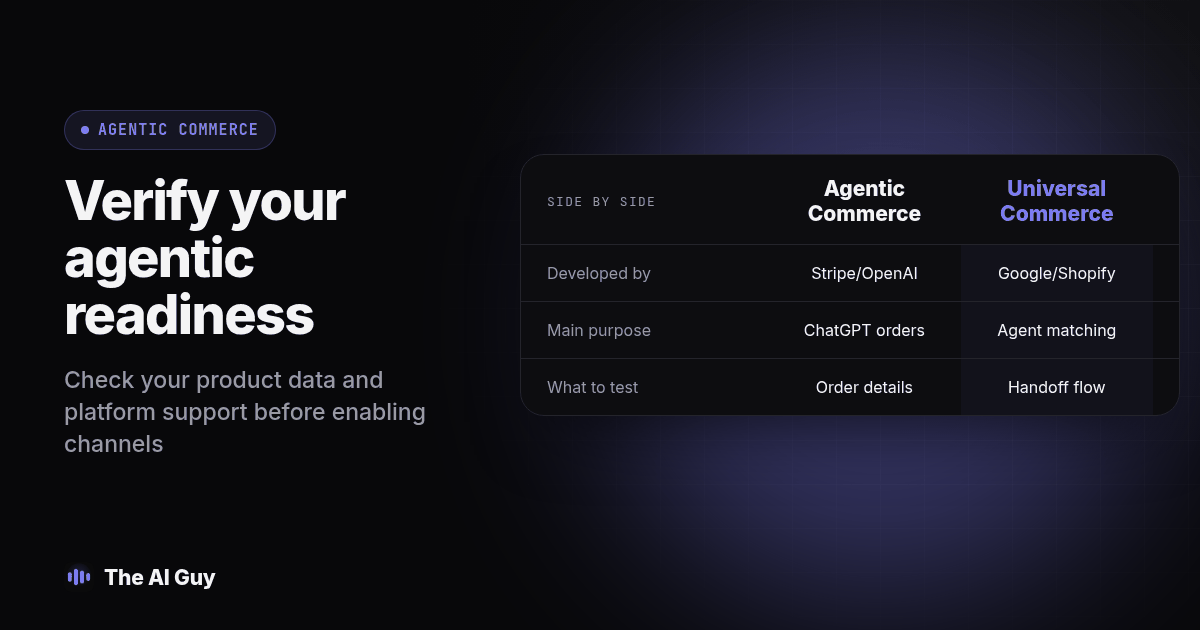
Use this table as an orientation based on the documentation above, not a promise that either option is enabled in your account. The final column is only useful once your platform confirms the supported channel and purchase flow.
| Question | Agentic Commerce Protocol (ACP) | Universal Commerce Protocol (UCP) |
|---|---|---|
| Developed by | OpenAI and Stripe | Shopify and Google |
| Main connection described here | Merchant catalog and checkout integration with ChatGPT | Negotiated commerce capabilities between agents and merchants |
| Payment arrangement | Merchant and its payment service provider handle payment | Payment handling is part of the supported integration, not a new card network |
| What a merchant verifies | Feed quality, checkout implementation and channel approval | Supported capabilities, extensions and buyer handoffs |
| What to test with a shopper | Order details, approval and confirmation | Order details, required input and completion or handoff |
| What you build from scratch | Depends on what your platform already implements | Depends on what your platform already implements |
For a small team, choose the next action from the evidence available to you. If your platform provides a documented connection and a test environment, evaluate it. If support only has a roadmap announcement, record the limitation and improve the catalog first. You do not need to select a winning protocol to do that work.
What Changes for a Small Business That Sells on Shopify?
If your store runs on Shopify, the platform is doing most of the preparation work already, since it maintains the structured product data both protocols read from behind the scenes. Confirm your account's channel access before assuming the remaining work is only a settings review. Check that your product titles, prices, variants and inventory counts are accurate, because an agent reading a stale feed will confidently offer a shopper something you cannot actually fulfill.
Also look at your return policy and shipping rules with fresh eyes. Do not rely on either a shopper or an assistant to resolve ambiguous policy language correctly. Tighten the wording before orders arrive through a channel that will not phone to ask.
Finally, check how the team handles incomplete orders, repeated attempts and changed inventory. Use a hypothetical out-of-stock variant as a test case: the channel should explain the problem instead of creating an order you cannot fulfill. Save the result with your normal operational review notes.
What Changes for a Small Business That Just Takes Card Payments?
If you are not on Shopify and simply take card payments through a processor, start by asking your commerce provider and processor which agent checkout integrations they support for your account. Card acceptance alone does not supply a catalog or checkout integration. Get a written answer that names the channel, required components and any account restrictions instead of relying on a general marketing page.
Until your processor confirms support, nothing about your checkout changes. A shopper still buys from you the way they always have, by calling, visiting, or filling out your existing payment form. An AI agent can still describe your business to someone asking for a recommendation, a separate and already-live concern covered in our piece on customers using AI instead of hiring you.
It helps to think of agentic checkout as a bigger version of a pattern you may already use. A business that has given an AI assistant a scoped permission to take one specific action on its behalf, like Beam's setup for letting a custom GPT action send a text message instead of a person typing it, already runs a lighter version of the same trust model: the AI does one narrow thing inside a boundary a person defined first. Agentic checkout extends that boundary to a purchase instead of a message.
What Should You Verify Before You Turn On Any AI-Agent Checkout Toggle?
Copy this list into your own notes before you click "enable" on anything labeled agent checkout, AI shopping, or similar, inside your storefront or processor dashboard.
- Confirm which protocol, if either, your platform or processor actually supports today, by name, not by a vague "AI ready" claim.
- Pull up your live product feed and check titles, prices, variants and in-stock counts against reality, not against what they were when you last edited them.
- Read your current return and refund policy as if a machine, not a person, will be the one relying on its exact wording.
- Ask who holds liability for a disputed charge that originated from an agent rather than a person typing their own card number, and get that answer from your processor in writing.
- Decide whether any products should be excluded from agent checkout entirely, such as age-restricted items, custom orders, or anything that needs a human conversation before a sale makes sense.
- Test the full purchase flow in a sandbox with fictional customer details. Run a successful order, an unavailable variant, a canceled confirmation and a repeated submission. Compare the approved details with the order record, check that canceled attempts produce no order, and verify that a retry does not create a duplicate. Save the results before any customer sees the channel.
- Set a short review window, a week or two, where you personally check every order flagged as agent-initiated before trusting the volume to run unsupervised.
- Confirm your fulfillment and customer service team know this channel exists, so a question about an agent-placed order does not land on someone who has never heard of it.
If a step produces an unclear answer, treat that as your answer for now: wait until it is clear, rather than flipping the toggle and finding out the hard way.
Where Does This Overlap With the AI Agents Already Running in Your Business?
If you have already read our guide on what makes something an AI agent instead of a chatbot, agentic checkout will look familiar. It is the same underlying pattern: a system decides which tool to call next based on what it just learned, rather than following one fixed script. Here the tool happens to be a checkout API instead of a calendar lookup or a CRM update.
That means the same buying questions apply. Ask what the agent can do on its own, what it writes into another system, and what happens when it hits something outside its defined scope, before treating a checkout integration any differently than an AI scheduling tool or a support chatbot. Our piece on whether your small business needs an AI chatbot at all covers the same scoping exercise from the customer-service side.
The label on the feature matters less than what it is actually allowed to do, and what happens the moment it is wrong.
What FAQs Do Small Business Owners Ask About Agentic Commerce?
Does turning on agent checkout cost our business anything extra?
Do not assume agent checkout has the same commercial terms as your existing website. Ask the platform and processor for the terms that apply to your account and channel, including transaction charges, refunds and disputes. Separate those terms from the engineering work needed to connect your store. A public protocol specification does not tell you what a particular provider will charge for its implementation.
How long does it actually take to set this up?
There is no reliable setup time that applies to every small business. A supported platform connection may reduce implementation work, but catalog cleanup, eligibility checks and order testing still need an owner. A custom store may also need development. Ask for a list of prerequisites and a test environment before accepting a launch estimate, and measure readiness by completed checks rather than a promised number of days.
Will this work with the point of sale and invoicing tools we already use?
It depends on the integration offered for your particular tools and account. Ask whether the supported channel can create the order, pass the necessary customer details and reconcile the payment with your existing records. A processor's general AI announcement is not enough. Request a specific demonstration and confirm how refunds and failed transactions appear in the tools your team actually uses.
Is letting an AI agent complete a purchase a compliance or liability problem?
A protocol does not settle your business's compliance or liability obligations. Tokenized payment designs can limit how credentials are used, but you still need to review the implemented payment flow, customer authorization, fraud controls and dispute process with your provider. Ask who handles each responsibility and retain the answer with your account documentation. Do not treat an AI checkout badge as a compliance certification.
What happens if we never turn this on? Do we lose sales to competitors?
Not enabling a new channel does not itself disable your existing checkout. Whether waiting affects sales depends on your customers and the channels they use; this guide cannot predict that for your store. Keep your product information accurate, watch customer questions and referral evidence, and revisit supported integrations when you have a concrete reason to test them. Avoid buying an integration solely because a competitor mentions AI.
What Should You Do Next?
Start with the checklist above, not the toggle. Pull your product feed, your return policy, and a call to whichever processor handles your card payments, and get a written answer on where they stand with either protocol before you touch a single setting.
If you want a second opinion on whether your setup is ready for an agent to read it accurately, contact us and describe how you take payments today. We will tell you plainly whether there is anything worth doing now, or whether this is still wait-and-watch for your setup.