TL;DR: Some of your customers are already doing parts of your job themselves with ChatGPT or Claude instead of paying you, and a 2025 survey found roughly one in four business owners have lost business to exactly that. The fix isn't a lower price or a panic pivot. Put AI to work behind your business on the highest-frequency, lowest-judgment task first, then build one visible AI-assisted capability that still sells your judgment as the part no prompt can replace.
If a customer told you this month that they "just used AI" instead of calling you, you're not imagining a trend. You're seeing an early, measurable part of it. The response that actually protects your revenue isn't to match the AI tool on speed or price, since you can't, it's to move AI into your own operation first so your time gets spent entirely on the judgment calls a tool still can't make, then show customers that capability directly.
Is This Really Happening to Businesses Like Yours?
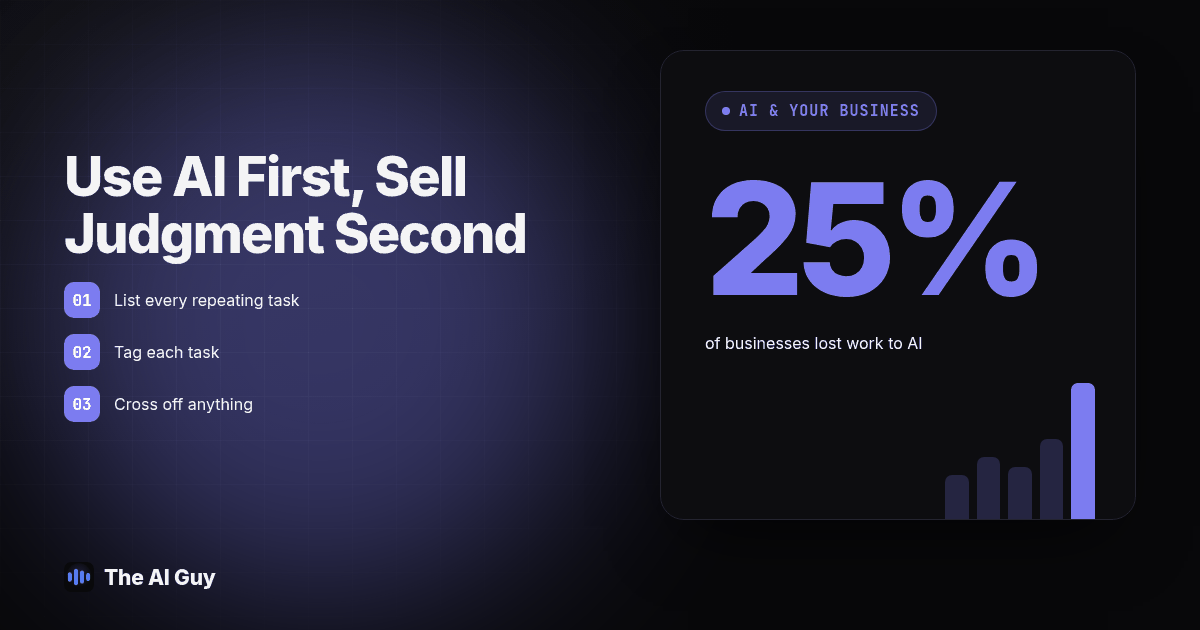
Yes, and it's measured, not just anecdotal. A survey published in December 2025 covering 1,000 U.S. adults by UPrinting, run through the Pollfish panel, found that 25% of business owners said they had lost business in the past year because a customer used an AI tool instead of paying for their service, according to reporting on the survey's findings. The 1,000 respondents included owners, managers, and other adults; they were not all business owners. The report does not give the owner subgroup size or establish a rate for your industry. Use the finding as a signal to investigate, not a forecast of your own losses.
Treat the survey as a reason to investigate your own sales, not proof of why a particular customer disappeared. Review lost quotes and separate confirmed AI substitution from budget delays, changed priorities, and jobs awarded to another provider. Record the customer's actual explanation. An unanswered follow-up is an unknown outcome, not an AI loss. That distinction keeps you from redesigning an offer around a cause you have not established.
Why Does Losing Work to AI Feel Different From Losing It to a Competitor?
Losing a bid to a competitor stings, but it confirms the market still values what you sell. Losing it to a customer who typed a prompt instead hits differently, because it questions whether the task itself was ever worth paying for. Neither conclusion is quite right. The customer didn't decide your judgment was worthless. They decided the specific, narrow piece of output they needed, a logo file, a first-pass blog outline, a basic lease summary, was cheap enough to produce themselves that paying you for just that piece stopped making sense.
That distinction matters because it tells you exactly where to fight and where not to. Don't fight to keep the narrow, commodity piece of the job. Fight to make sure the customer still needs you for the judgment wrapped around it: knowing which output is actually usable, catching the mistake a prompt won't flag, and standing behind the result with your name on it. A tool can produce a draft. It can't take responsibility for whether that draft is right for this customer's specific situation, and that gap is where your business still lives.
Should AI Go in Front of Your Customers or Behind Your Business First?
Most owners who feel threatened by customer-facing AI react by rushing to put AI in front of customers too, usually as a chatbot, hoping to match the speed customers are already getting elsewhere. That's the wrong first move. Our guide on whether your business actually needs a chatbot walks through why a customer-facing tool built before you've scoped it tends to create more trust problems than it solves, especially if it answers questions outside what it can actually get right.
Put AI behind the business first, supporting your staff and your existing offers, before you ever put it in front of a customer. Behind-the-scenes AI has a forgiving failure mode: if a draft is wrong, a staff member catches it before a customer ever sees it. Customer-facing AI has an unforgiving one: if it's wrong, the customer sees it immediately and now distrusts you more than before you added it. Build the muscle where mistakes are cheap, then graduate the capability to something customer-visible once you've tested it on your own team first.
Which Task Should You Automate First Behind the Scenes?
Pick by two variables only: how often the task happens, and how much judgment it requires to call it done correctly. The task you want sits in the high-frequency, low-judgment corner. Resist the pull toward whatever task looks most impressive to automate; impressive and useful are not the same thing.
| Frequency | Low judgment required | High judgment required |
|---|---|---|
| High | Automate first | Automate the draft, keep a human review step |
| Low | Automate later, low payoff | Leave with a person |
Work through the task selection in this order:
- List every repeating task your team did last week, not a hypothetical list, a real one pulled from calendars, inboxes, and call logs.
- Tag each task with a frequency count: how many times it happened in the last 30 days.
- Tag each task with a judgment score: does finishing it correctly depend on one documented rule, or does it depend on reading a specific customer's situation?
- Cross off anything with a judgment score above "one documented rule." Those stay with a person regardless of frequency.
- Rank what's left by frequency alone. The top of that list is your first automation candidate.
- Name one person who owns reviewing the AI's output for the first 30 days, even on a low-judgment task, since every new process needs a break-in period.
- Set a 30-day checkpoint to confirm the task is actually freeing up time rather than just moving the same work into a different inbox.
Our breakdown of which business tasks to automate with AI first goes deeper on scoring candidate tasks if your list has more than two or three contenders. And if what you actually need is something that takes an action rather than just drafting text, booking, routing, or updating a record, read the difference between an AI agent and a plain automation tool before you pick a platform, since the two solve different problems.
How Do You Build a Visible AI Capability That Still Sells Your Judgment?
Once one task is running behind the scenes and you trust the output, build a second, customer-facing capability deliberately, not as a reaction to losing a bid. The goal isn't to prove you "have AI too." It's to show a faster first step that still ends with your judgment, not a customer's unsupervised prompt, deciding what's correct.
A useful pattern: let AI produce the first draft a customer can see quickly, then put your name and a specific check on the version that actually ships. A bookkeeper who uses AI to pull a first-pass expense categorization, then reviews and corrects it before the client sees it, is selling something a free AI tool doesn't offer: someone who catches what the tool missed and stands behind the number. State that plainly to customers instead of hiding it, since 65.5% of business owners in that same UPrinting survey said they worry AI will make their business feel less personal, which means the businesses that are transparent about where AI stops and a person starts will stand out by contrast, not blend in with the free tools.
Copy this short worksheet and fill it in before you announce anything to customers:
- Task AI will draft first:
- What a customer could do with free AI alone (be honest):
- What you add after the draft (the specific check, the judgment call):
- How you'll say this to a customer in one sentence:
- Who reviews the first 20 real outputs before this goes live:
What Do You Say When a Customer Tells You They Used ChatGPT Instead?
Don't argue with the result; ask about the gap. A simple response works better than a defensive one: "That's a good starting point. Want me to tell you what I'd check or change before you use it for something this important?" That question does two things at once. It respects that the customer already got value for free, and it invites them to find out, on a low-stakes example, exactly what a prompt missed that your experience catches.
Keep a short, real list of the mistakes you've actually caught in customer-generated AI output, not hypothetical ones. A contractor who's seen three AI-drafted scopes of work miss a permit requirement has a concrete, honest example to offer, not a vague warning about "AI isn't always right." Specific beats general every time a customer is deciding whether your judgment is worth paying for on top of a draft they already have for free.
How Do You Test Whether the Automation Actually Freed Up Your Judgment Time?
Running the task through AI once and feeling relieved isn't a test. Run this short procedure after 30 days before you call the first automation a win. The sample sizes and checkpoints below are an editorial starting point, not validated accuracy thresholds. A small sample can reveal problems but cannot prove that future outputs will be correct. Keep human approval on customer-facing work, and stop on any serious error regardless of the count.
- Compare the hours logged on the task before and after, using whatever time tracking you already have, even a rough estimate from a calendar.
- Ask the person who used to do the task by hand whether they're spending the recovered time on judgment work, or whether it quietly got absorbed by more of the same low-value task at higher volume.
- Pull five recent AI-drafted outputs and check them against the standard a customer-facing version would need to meet.
- Count how many of those five needed a real correction, not a stylistic preference change, a correction that would have mattered to the customer.
- If more than one of five needed a real correction, the task isn't ready to go customer-facing yet, even if it's saving internal time.
- Confirm the 30-day owner is still checking output, not just assuming it stayed accurate since week one.
- Decide, in writing, whether this task is ready to become the visible capability from the previous section, or whether it should stay behind the scenes a while longer.
If your team is also weighing whether to build a fuller AI-assisted sales process around this, not just one task, MetaTechAi's breakdown of building an automated sales funnel for a service business covers the stages worth automating from first inquiry through a booked job.
What FAQs Do Small Business Owners Ask About Losing Work to AI?
How do I know if I'm actually losing work to AI, or if it's just a slow stretch?
Pull your last 90 days of lost quotes and ask the ones who ghosted you why they didn't move forward. If more than one mentions doing it themselves with ChatGPT, Claude, or a design or writing tool, you have a pattern worth responding to, not a coincidence.
Should I drop my price to compete with free AI tools?
No. A lower price competes on the thing AI already does for nearly nothing. Compete on judgment, accountability, and the finished result a customer can hand off without checking it, and let your price reflect that instead of chasing a tool's marginal cost.
Which task should I automate first if I've never used AI in my business before?
Pick the single task your team does most often that requires the least judgment call to call it finished correctly, not the task that feels most impressive to automate. Frequency times low judgment is the formula, not novelty.
How long before a visible AI capability actually brings in work?
There is no established timeline for winning work from this change. As a planning exercise, reserve the first 30 days for internal testing, then review customer responses over the next 60 days. Those checkpoints are suggestions, not a promise of a sale or a measured industry benchmark.
What Should You Do Next?
Start with the task list, not the announcement. Spend this week pulling the frequency and judgment tags described above, pick one task, and name the person who reviews it for 30 days. Skip the temptation to tell customers anything until the behind-the-scenes version is solid, since a visible capability built on an untested process tends to create the exact trust problem you're trying to avoid.
If you want a second set of eyes on which task to pick first, or how to frame the visible capability once it's ready, talk to our team. Bring your task list, a sample output, and the customer objection you keep hearing so the conversation starts with your actual work.