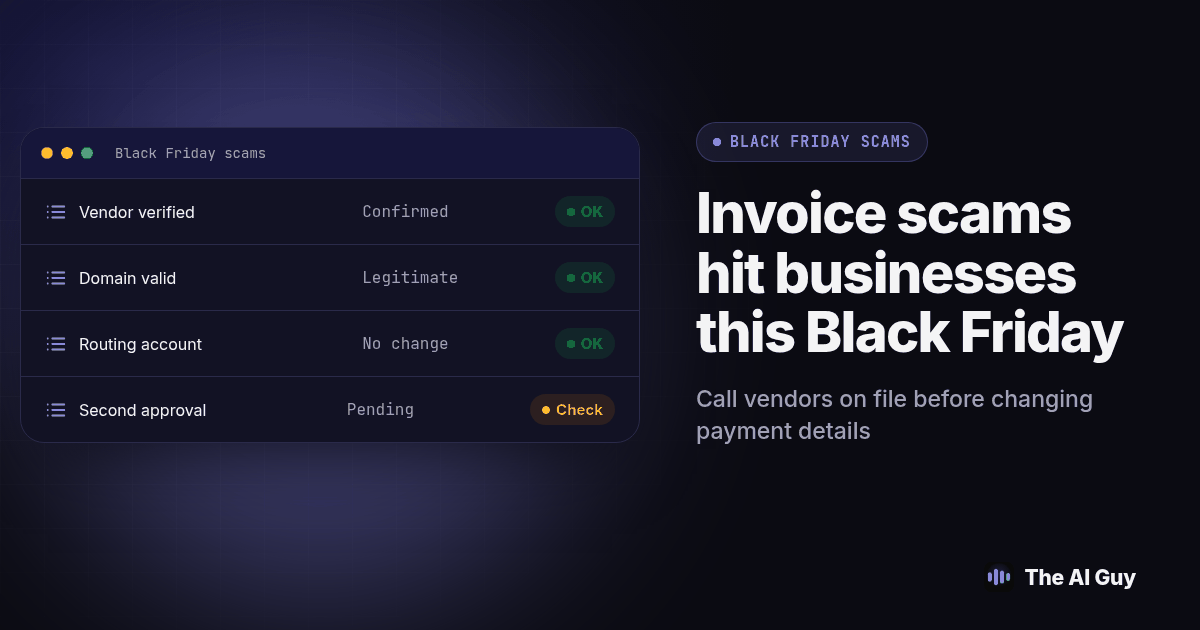
TL;DR: Scammers are not only cloning your voice to con your customers or flooding your listings with fake reviews this Black Friday week. Some are impersonating your own suppliers, payment processor, or software vendors, using AI-written emails and fake invoices to redirect a real payment to an account they control. Before you pay anything this week, call the vendor back on a number you already had on file, never the one printed in the message, and require a second person to approve any change to payment or banking details.
We already warned readers about scammers cloning a business owner's own voice to scam customers, and about AI-generated fake reviews showing up overnight. This week's question is the reverse: what happens when the scam is aimed at you, the owner, instead of your customers? Your accounts payable inbox and your phone are both targets right now, and Black Friday week is exactly when your team is least likely to slow down and check.
Nothing about a good fake invoice looks unusual. That is exactly the point.
How Is This Different From the Scams We Already Warned You About?
Our guide on AI voice cloning scams covers a scammer cloning your voice, or a colleague's voice, to con a customer, a bookkeeper, or an employee into moving money. Our guide on spotting fake reviews covers reviews written to hurt or inflate your reputation with the public. Both of those point outward: a scammer uses your identity or your listing against people who trust your business.
This article covers the opposite direction. A scammer impersonates someone you trust: a supplier you reorder from every quarter, the payment processor that settles your Black Friday card transactions, or a software vendor pitching a holiday deal. The target is your accounts payable process, not your storefront. The verification habit is similar in both directions, confirm identity through a channel you already trust, but the attack surface and the people who need to know the rule are different. Your bookkeeper and whoever approves vendor payments need this article more than your customer-facing staff do.
What Does a Fake Vendor Invoice Scam Actually Look Like This Week?
Entrust IT's rundown of how Black Friday and Cyber Monday scams target businesses describes the mechanism plainly: fraudsters impersonate a supplier and ask you to redirect a payment to a new account, often citing a real order reference to make the request look routine (Entrust IT, Black Friday scams targeting businesses). The same guidance names business email compromise as the most serious version of this pattern: a fraudster uses a real or spoofed mailbox to get a genuine payment sent to the wrong account.
Picture how this plays out at a small business during a normal Black Friday week. Your usual packaging supplier emails your office manager with an updated invoice and a note that their bank changed, asking that this payment and all future ones go to a new account. The invoice amount matches what you actually owe. The tone matches how that vendor usually writes. The only thing that has changed is the bank routing information buried in the PDF, and nobody on your team stops to verify a number that specific because everything else about the message looks right.
A second version targets software and service deals instead of physical suppliers. Entrust IT's same roundup flags discounted offers on business software, equipment, or gift cards sent straight to staff who hold purchasing authority, exactly the people most likely to click through and enter a card number during a week full of real holiday offers. If a new deal lands in an inbox claiming a vendor your team already uses is offering a steep holiday discount, that claim deserves the same scrutiny as a changed bank account, not less, because it is designed to look routine too.
Why Does the Holiday Rush Make Your Business an Easier Target?
Every one of these scams depends on a quick decision, and peak season rewards quick decisions, as Entrust IT's guidance puts it directly. Your team is covering for a colleague who took the week off, processing a larger-than-normal stack of invoices, and trying to keep orders shipping on time. None of that leaves much room for a bookkeeper to pause on an email that looks almost entirely normal.
Scammers know your calendar as well as you do. A request that would get questioned in March can sail through the week before Cyber Monday, simply because everyone reading it is moving faster than usual, on purpose, by the nature of the job that week.
What Else Are Scammers Using AI For This Black Friday?
It is not only invoices. A November 2026 roundup of Black Friday scam patterns reports that scammers are also using AI to build convincing fake stores and deal ads, generating product photos, descriptions, and reviews with generative tools to make a fake storefront look legitimate (TheTechHacker, Black Friday 2026 scams, citing Money.com). Your own purchasing staff are shoppers too, and a fake "wholesale deal" storefront pitched to your office manager works on the same psychology as one pitched to a consumer.
That same Black Friday 2026 scam roundup cites Deloitte data showing that 16 percent of shoppers would let an AI shopping agent complete a purchase on its own, and the Identity Theft Resource Center's Eva Velasquez warns that an agent may choose a retailer nobody has vetted. If anyone on your team uses an AI tool to source holiday supplies fast, that tool can land on the same fake storefronts. Fake delivery texts remain the most-reported text scam overall, with reported losses topping 470 million dollars per the same roundup's FTC citation. A business shipping address is a consumer address to a scammer dialing at random.
Screenshot idea: side-by-side mockup of two nearly identical invoice emails, one real and one fake, with callout arrows pointing at the three details that actually differ (reply-to address, bank routing digits, and a slightly reworded payment line), to use as a one-page training aid for accounts payable staff.
Is This a Red Flag or a Routine Request?
| Signal | Likely a scam | Likely routine |
|---|---|---|
| Bank or payment account change | Arrives by email or text only, references an urgent deadline, no advance notice | Vendor mentioned the change on a call weeks earlier, or confirms it when you call the number on file |
| Invoice details | Amount and vendor name match, but reply-to address or bank details are slightly off | Everything matches your existing vendor record, including the sending domain |
| Timing | Lands during a peak order week, right before a payment is due | Comes during a normal billing cycle, not tied to a seasonal rush |
| Request to skip a step | Asks you to rush, skip a second approver, or avoid calling to confirm | Vendor is comfortable with a callback and a short delay for approval |
| New software or supplier "deal" | Pitched directly to a staff member with purchasing authority, pressure to act today | Comes through your normal vendor relationship or a renewal you already expected |
What Should You Check Before You Pay Any Invoice This Week?
Use this sequence on every invoice and every payment-detail change request this week, not just the ones that feel suspicious. The requests that feel routine are exactly the ones built to feel routine.
- Stop before you approve, no matter how routine the request looks. A matching amount and a familiar vendor name are not proof of anything on their own.
- Pull the vendor's phone number from your own records, not from the message you just received. Use an invoice from three months ago, your accounting software's vendor file, or your own notes, never a number printed in the new email or text.
- Call that number and ask directly whether they sent this invoice or requested a bank change. A two-minute call answers the question that a careful read of the email cannot.
- Check the sending domain character by character, not just the display name. A spoofed domain often swaps one letter or adds a hyphen, and your email client shows you the friendly name by default, not the real address.
- Compare the bank routing and account numbers against your existing vendor record. If this is the first time you are seeing these numbers for a longstanding vendor, treat that alone as a reason to verify by callback before moving money.
- Require a second person to approve any payment detail change, regardless of amount. One person acting alone, even a trusted one, is the single point of failure every version of this scam is built to exploit.
- Document the verification before you pay, not after. Note who called, what number they used, and who confirmed it. If anyone ever challenges the payment later, you want a record that shows your team followed the process.
Who Should Be Allowed to Approve a Vendor Payment Change This Week?
Entrust IT's guidance pushes written procedures over simple awareness reminders, and recommends dual approval above a set payment threshold with a named deputy approver covering for anyone on leave during the holiday week. That last detail matters more than it sounds: scammers specifically target the week when your usual approver is out, because a stand-in is less likely to recognize that a request is unusual.
Pick your dollar threshold now, before the rush, not while a request is sitting in someone's inbox. Write down who the deputy approver is for each person who might be out this week, and tell both of them before Thanksgiving, not after a request has already landed. A rule nobody wrote down is a rule nobody follows under pressure.
What Does a Deepfake Supplier Call Add to This Threat?
Everything above covers written requests: emails, texts, and invoices. The same impersonation can arrive by phone instead, with a cloned voice standing in for a supplier's accounts payable contact or your payment processor's representative, asking you to confirm a bank change verbally. The underlying defense is identical to the one we cover in our AI voice cloning guide: never let a phone call alone authorize a payment or a banking change, and confirm through the callback number you already had on file before the call came in.
What changes with a phone version is urgency, not substance. A caller claiming your Black Friday transactions will be held unless you confirm new settlement details right now is applying the same pressure the written version applies by email, just harder to hang up on. Treat an urgent call exactly like an urgent email: pause, call back on your own number, and get a second approver before anything moves.
What Should You Do if You Already Paid a Fake Invoice?
Move fast and call your bank first, before you do anything else. Ask specifically about a wire recall or an ACH reversal request for that transaction, since both options narrow quickly with time. File a report with the FBI's Internet Crime Complaint Center at ic3.gov so the payment gets logged against a known fraud pattern, and call your real vendor on a number you already had on file to tell them their name was used, since their other customers may be targeted the same way this week.
Save everything: the original message, the invoice, the reply thread, and the exact time you paid. Do not delete the scam email after reporting it. If you entered a card number on a fake deal page, ask your card issuer for a new card too, not just a dispute.
What Do Small Business Owners Keep Asking About Black Friday AI Scams?
What should we do if we already paid a scammer posing as one of our vendors?
Call your bank immediately and ask about a wire recall or an ACH reversal request, since both are time sensitive and get harder to win the longer you wait. File a report with the FBI's Internet Crime Complaint Center at ic3.gov, notify the real vendor by a phone number you already had on file so they can warn their own accounts payable contacts, and save every email, text, and invoice tied to the payment. Do not wait for a fixed deadline before acting; the faster you call your bank, the more recovery options stay open.
Is calling a vendor back on a number we already have enough to stop this?
It stops the most common version of the scam, which is exactly why Entrust IT's business-focused Black Friday guidance leads with it: call back on a number you already hold before changing any bank details, and never use the number printed in the message itself. It is not a complete fix by itself. Pair the callback with a second person approving any payment detail change, so one convincing call or email can never move money alone.
Do we need new fraud-detection software, or is this mostly a process fix?
For most small businesses this is a process fix, not a software purchase. A written rule that payment account changes always get a callback to a saved number, plus a second approver above a set dollar threshold, closes most of the gap without a new tool. Larger accounts-payable teams sometimes add software that flags look-alike vendor domains or mismatched bank details, but that software still needs a human verification step behind it, not instead of it.
How is this different from the classic email asking for gift cards?
The mechanics are the same con, speed and authority, but AI makes the message or call harder to spot. A generic gift-card email is often full of odd phrasing and a sender address that does not quite match. An AI-written vendor email can match that vendor's real tone, reference a real order or invoice number pulled from a prior breach or a scraped email thread, and arrive at the exact moment your team is buried in Black Friday order volume and least likely to slow down and check.
What Should You Do Before You Approve Any Vendor Software Deal This Week?
Black Friday is also when software vendors push real discounts, and scammers know a legitimate wave of holiday pricing gives cover to a fake one. Before your team signs up for any new tool pitched as a Black Friday deal, especially one promising guaranteed results, run the same skepticism you would apply to a changed bank account. MetaTechAi's breakdown of how to tell whether an AI sales vendor's guarantee is actually legit walks through the questions to ask before you commit a card number or a signature to a deal that showed up in your inbox this week.
Verify before you trust a message that arrived at a convenient moment. That is the whole rule, whether the fake is an invoice, a phone call, or a software pitch, and it depends on a written process your team follows every time, not on anyone spotting the fake in the moment. If you want help turning that into a written policy your team will actually follow next holiday rush too, tell us where your business stands today and we will help you build it.