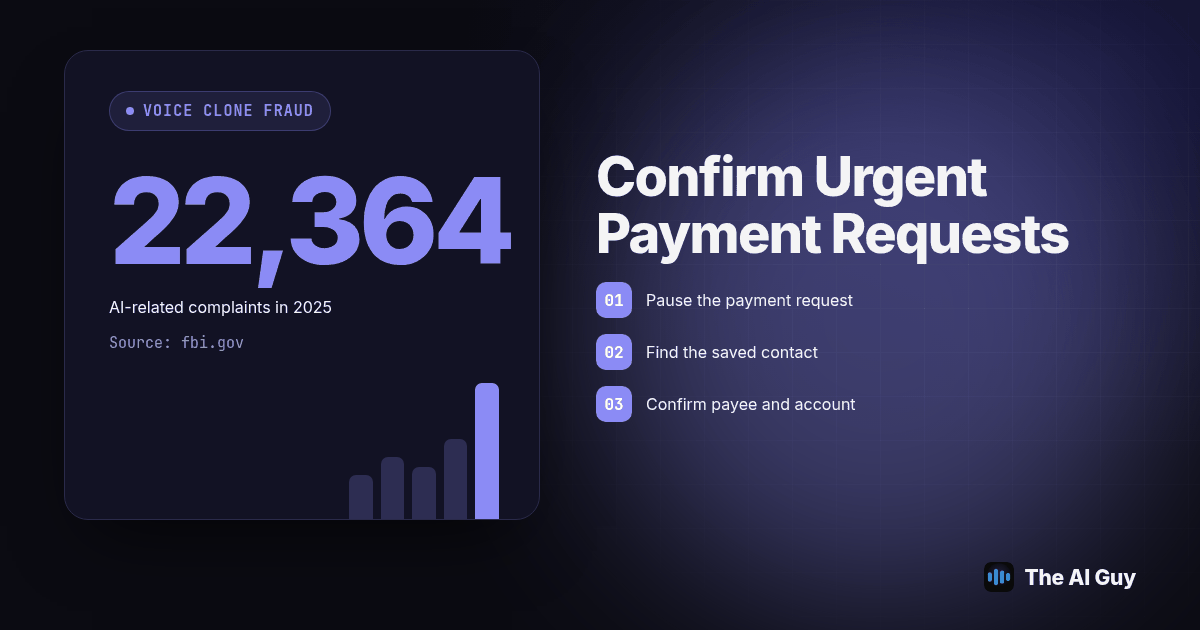
TL;DR: Yes. A scammer can use a short recording of your voice, a vendor's voice, or your boss's voice, pulled from a voicemail, a video, or a podcast clip, to generate a convincing clone and call your team with an urgent payment request. The verification rule to use: confirm any request to move money or change payment or account details through a second channel you already trust, like a callback to a saved number, before anyone acts, and give your team a code word for exactly this situation.
Consider this hypothetical call: your bookkeeper hears what sounds like your voice asking for an urgent transfer. The caller knows a vendor name and says you are stuck in a meeting. Nothing about that familiar voice authorizes a payment. Your employee needs permission to pause, check the request, and refuse to bypass the normal approval process.
How Little Audio Does a Scammer Actually Need?
Not much. The Federal Trade Commission's own consumer alert on these schemes says a scammer can clone a voice from a short audio clip, taken from content already posted online (FTC consumer alert, March 2023). A voicemail greeting, a webinar recording, an earnings call, a podcast guest spot, a conference talk uploaded to YouTube, any of these could supply useful audio.
Business owners and vendor contacts may have recordings in public places: event talks, podcasts, customer videos, or voicemail greetings. Treat those as potential sources of audio. The practical response is to stop using a recognizable voice as payment authorization, rather than assume your recordings are impossible to find.
How Much Is This Actually Costing Businesses Right Now?
This is not a hypothetical risk. The FBI's Internet Crime Complaint Center (IC3) added a dedicated AI section to its 2025 annual report. IC3 received 22,364 complaints referencing AI in 2025, with adjusted losses exceeding 893 million dollars (FBI IC3 2025 Annual Report, page 39). That same report's own summary confirms the figures and notes the AI section is new this year precisely because the problem has grown large enough to break out separately (FBI press release, April 2026).
Two slices of that number map directly onto the business scenario this article covers. Businesses reported losses over 30 million dollars in 2025 to business email compromise (BEC) scams involving AI, where chat generators write convincing CEO-style emails and voice cloning is used to request a wire payment or confirm a change to how an employee or vendor gets paid (FBI IC3 2025 Annual Report, page 39). Separately, distress scams that use voice cloning to mimic a person in an emergency accounted for over 5 million dollars in reported losses, per the same report. These figures cover reported AI-related complaints, not a measured total of voice cloning losses at small businesses. Do not treat the overall AI figure as a voice scam total.
What Do These Scams Actually Look Like?
Two patterns worth rehearsing are owner impersonation and vendor payment impersonation. Knowing which one you are looking at helps your team react the right way in the moment, because the correct response is almost identical either way.
| Check | Owner or executive impersonation | Vendor payment impersonation |
|---|---|---|
| Who the scammer pretends to be | You, a co-owner, or another executive | A known vendor, supplier, or their accounts payable contact |
| Typical trigger | A call or voicemail to your bookkeeper, office manager, or an employee with payment authority | A call or email, often paired with a cloned voicemail, claiming the vendor changed banks |
| What they ask for | An urgent wire transfer, a gift card purchase, or approval to skip the normal sign-off | A change to the bank account or routing number on file for an existing invoice |
| The pressure tactic | "I am in a meeting and cannot talk long, just get this done" | "Our bank account changed, update it before the next invoice bounces" |
| Independent verification | Call the owner back on a number you already have saved, not a number given on the call | Call the vendor's main line from your own records, not a number in the email or voicemail |
Both patterns rely on the same weakness: the request arrives through a channel the scammer controls, a phone call or an email, and asks the target to act inside that same channel before anyone can check it anywhere else. Once you confirm through a channel the scammer does not control, you create an independent chance to catch either pattern before payment.
What Verification Rule Should Your Team Follow?
Here it is, in one sentence: never act on a request to move money, change a payment account, or change banking details based only on the channel the request arrived through. Confirm it through a second channel you already trust, using contact information you already had on file before the call came in.
That rule works whether the voice on the phone is a perfect clone or not, because it does not depend on detecting whether a voice is fake. It depends on never giving a single phone call or email the power to move money by itself.
How Do You Build This Into a Real Process?
A rule is only useful if your team actually follows it when they are rushed and a familiar voice is asking them to hurry. Here is a suggested process for small business owners to put the rule into practice:
- List every role that can move money or change payment details. This usually includes a bookkeeper, an office manager, anyone with wire or ACH access, and anyone who can edit vendor bank details in your accounting software. Write the list down. If you are not sure who has this access, that is the first gap to close.
- Build a verified contact list for the people most likely to be impersonated. That means you, any co-owners, and your top vendors by dollar volume. Record a phone number for each that you sourced yourself, not one texted or emailed to you, and store it somewhere your team can reach without searching their inbox under pressure.
- Require verification for new payees and all payment account changes. Apply the rule regardless of amount. Set additional approval thresholds for routine payments with your bookkeeper, and record who can authorize an exception. A small request should not become a way around the checks.
- Create a team code word, changed monthly. The code word is not a secret password for a login. It is a word or short phrase that a legitimate caller would know and a cloned voice calling cold would not, because it was shared on a private channel, like a team messaging app, not spoken on any call that could be recorded or overheard.
- Write the exact script your team should use on the call. See the template below. The goal is a phrase employees can say without feeling rude, because the awkwardness of pausing a call is the main reason people skip verification.
- Tell every vendor in writing that you will always confirm bank changes by callback. Send this once, in a normal email, to every vendor who could plausibly ask you to update their payment details. Explain the process before a payment is due. Pushback is a reason to pause and escalate, not proof by itself that someone is a scammer.
- Run one surprise drill per quarter. Have someone on your team place a mock urgent-payment call to another team member and see whether the verification rule actually gets followed. Fix whatever breaks before a real scammer finds the same gap.
Use this decision sequence in your handbook: pause the request, find the saved contact independently, confirm the exact payee and account change, obtain the required approval, then document the result. If the contact cannot be reached, leave the request pending. A matching code word is an extra check, not permission to skip authorization.
How Do You Test the Rule Without Moving Real Money?
Run the drill with a fictional invoice and a mock payment request. Do not use a real transfer, collect passwords, or clone an employee's voice. Tell staff that practice exercises are part of the policy, then test the response to urgency rather than their ability to recognize an artificial voice.
Have the caller ask for an account change and offer a new callback number. The employee should decline that number, locate the approved contact record, and explain which manager must authorize the change. In a second round, make the saved contact unavailable. A passing result is a held request with a named escalation owner, not a payment made to meet the caller's deadline.
Record whether the employee found the contact list, used the script, kept account details unchanged, and documented the approver. Review failures privately and repair the process. If nobody can find the saved number, move the list somewhere accessible. If the owner routinely overrides the policy, the owner must change that habit before the next drill.
The FBI's generative AI fraud alert describes synthetic audio and real-time video impersonation and recommends independently contacting the purported caller. It also suggests a family secret phrase. Applying an extra phrase inside a business is an editorial adaptation, and it should remain secondary to independent verification and approval.
For incident response, the FBI's business email compromise guidance says to contact your financial institution immediately and report the incident to IC3. Save those reporting instructions beside the callback list so staff do not have to search during an incident.
What Should Your Team Actually Say on the Call?
Give your team permission to use a script, word for word, so nobody has to improvise while a familiar-sounding voice is pressing them to hurry. Copy this into your team handbook or your AI use policy:
"I want to help with this right away, and the fastest way I can get it done is to confirm it the way we always do. I am going to call you back on the number we already have on file, and then follow our payment approval process. If this is time sensitive, I will flag the urgency to the approver."
If the caller refuses a callback, claims the saved number will not reach them, or pressures the employee to act before the callback happens, your team should treat that as the clearest signal in the entire interaction. Even a legitimate caller may be impatient. Apply the same verification rule anyway, and keep the request on hold until an authorized person confirms it. For the smaller version of this same discipline applied to written requests instead of calls, our guide on writing a one-page AI use policy for a small team covers how to document who is allowed to approve what, in plain language your staff will actually read.
How Does This Connect to the AI Your Business Already Uses?
If your team is already using AI to draft vendor emails, review contracts, or research a new supplier, the same instinct applies: verify before you trust, every time money or legal exposure is on the line. We cover the contract side of that discipline in how to use AI to review a contract before you sign it, and the research side in how to verify the sources behind an AI research answer. The voice cloning threat is the same discipline applied to a phone call instead of a document: do not let one unverified source, written or spoken, make a financial decision for you.
It is also worth knowing what a legitimate AI voice call looks like, so your team does not start treating every automated call as a threat. Businesses that use AI voice agents for their own outbound calls, appointment reminders, or sales follow-up need to review the disclosure rules that apply to their calls. RizzDial's breakdown of AI voice agent disclosure requirements is a useful reference if you run outbound AI calls yourself, but disclosure alone does not prove identity or authorize a payment. Use the same independent checks for a disclosed AI call.
What Should You Check Before You Set Any of This Up?
A short gut-check before you roll this out across your team:
- Does more than one person in your business have the authority to move money or change a vendor's bank details without a second person signing off? If yes, that is your highest priority gap, regardless of whether voice cloning is involved.
- Do your vendors know you will always confirm account changes by callback, or will your team be the first to bring it up mid-crisis?
- Is your code word shared anywhere it could be overheard or recorded, like on a recorded sales call or a voicemail greeting? If so, pick a new one and share it only through a private, non-recorded channel.
- Does your team actually know the saved callback numbers exist, or did you set the policy and never tell anyone where the list lives?
None of this requires new software or a line item in next year's budget. It requires a written rule, a short list of verified numbers, and a quarterly five-minute drill to make sure the rule survives contact with a convincing fake voice.
What FAQs Do Business Owners Ask About Voice Cloning?
How much audio does a scammer actually need to clone a voice?
The FTC says a short audio clip from content posted online can be enough. Its alert does not specify a minimum number of seconds or guarantee the quality of every clone. You do not need a long phone call for someone to build a working copy of your voice or a vendor's voice.
Does caller ID or a video call protect us from this?
No. Caller ID can be spoofed to show a trusted number, and attackers have used real-time voice and video manipulation on live calls, not just prerecorded clips. Caller ID and a familiar-looking video window are both things to verify independently, not proof on their own.
What should we do if we already sent the money?
Call your bank immediately and ask for a wire recall or an ACH reversal request, file a report with the FBI's Internet Crime Complaint Center at ic3.gov, and keep every text, email, and call log tied to the transfer. Ask what recovery options are available for that payment type. Recovery is not guaranteed, and you should report it immediately rather than assume a fixed deadline.
Is a team code word actually enough, or do we need expensive software?
For most small businesses, a code word plus a callback on a number you already have on file adds useful verification without requiring a new software purchase. It does not replace payment approvals or protect you if the callback channel or code word is compromised. Software that flags synthetic audio exists, but it is not a substitute for a human verification step your staff already knows how to run under pressure.
How is this different from a normal phishing email?
A cloned voice adds urgency and emotional pressure that a written email does not carry as well. The target hears a voice they recognize, often sounding stressed or rushed, which pushes people to skip the checks they would normally run on an email asking for the same thing.
How Can You Put This Policy Into Practice?
If you want help turning this into a written policy your whole team actually follows, along with the rest of your AI use rules, reach out and tell us where your business stands today.