TL;DR: Yes, with real limits. AI can scan a batch of reviews for the patterns that give fake ones away, templated phrasing, a burst of posts in a short window, and accounts with no other review history, so a person can decide what to escalate. The same rule cuts both ways: a federal rule with a real per-violation penalty and no small-business exemption bans both a competitor's fake attack reviews and any fake praise you might be tempted to buy.
Consider two situations involving fake reviews. An owner notices that a wave of one-star reviews showed up overnight from accounts that have never posted anywhere else, and they suspect a competitor paid for it. Another owner wonders whether it would be fine to offer a discount for five-star reviews, because a vendor pitched it as a normal growth tactic. Below is a practical way to work through both situations, the pattern checks an AI tool can actually run, a numbered procedure to use before escalating anything to a platform, and what the Federal Trade Commission's current rule requires either way.
Key takeaways
- A fake negative-review attack and a temptation to buy fake praise are both covered by the same FTC rule, with the same lack of small-business exemption.
- AI is useful for flagging suspicious patterns at scale; it cannot replace a person confirming the evidence before you escalate.
- Document everything before you report a review as fake. A report needs specific evidence, not a hunch.
What Are the Two Real Fake Review Threats a Small Business Faces?
The first threat comes from outside the business: a competitor, a disgruntled former employee, or a stranger paid through a review-farm service posts reviews describing an experience that never happened, often timed to land right before a busy season or a big proposal. These reviews tend to arrive in a cluster rather than trickling in one at a time, and the accounts behind them often have no other reviews, no profile photo, and nothing that ties them to a real local customer.
The second threat comes from inside the business, and owners ask about it more quietly. A vendor, an employee, or plain frustration with a slow organic review count leads to the idea of rewarding five-star reviews, or asking staff to post as customers. It feels harmless because nobody is "attacking" anyone. It is still exactly what the federal rule below prohibits, with potential exposure that depends on the conduct, just pointed at your own business.
Both threats deserve the same response: slow down, document the pattern, and decide with evidence rather than instinct. Our guide to sorting real customer feedback with AI covers the separate question of what to do with feedback you know is genuine; this article is about the reviews you are not sure are genuine at all.
What Does the FTC's Fake Review Rule Actually Ban?
The Federal Trade Commission's Consumer Review Rule took effect on October 21, 2024. It gives the agency a way to seek civil penalties for knowing violations, alongside existing consumer protection law. Its scope includes fake praise and fabricated attacks, but liability depends on the conduct and facts, not just the presence of a suspicious review.
The FTC's final-rule announcement describes these prohibited practices:
- Creating or selling fake reviews, or buying reviews the business knew or should have known were false.
- Conditioning compensation on a review expressing a particular positive or negative sentiment.
- Certain insider reviews and testimonials without a clear disclosure of the business connection.
- Presenting a business-controlled review source as independent.
- Using intimidation, groundless legal threats or certain false accusations to suppress reviews, or deceptively hiding negative submissions.
- Buying fake social influence indicators, such as bot followers, with the required knowledge and commercial purpose.
These categories have specific conditions. They are not a blanket ban on every incentive or a requirement to investigate every review you host. Read the FTC's business questions and answers before treating a checklist as a legal conclusion. Small businesses have no general exemption. For a questionable existing campaign, get advice based on its actual records.
On December 22, 2025, the FTC sent warning letters about potential violations. The FTC announcement of those letters is evidence of enforcement attention, not a finding that every recipient violated the rule. Do not assume a fixed penalty automatically attaches to every review.
How Can AI Actually Help Spot a Fake Review Attack?
AI can be useful here for one specific job: reading a batch of reviews faster than a person can, and flagging the ones that share a pattern genuine, independent customers would not share. You can run a suspicious batch through a text model with a narrow prompt, close to "list any reviews in this set that share near-identical phrasing, an unusual posting cluster, or language that reads like a template," and treat the output as a shortlist, not a verdict.
What the AI looks for falls into a few buckets. Near-duplicate phrasing is a useful comparison point: repeated text can suggest a shared template, although customers may also repeat ordinary phrases. A burst of reviews landing close together in time, especially before a decision point like a contract renewal or seasonal rush, is the second signal. A reviewer account with no history anywhere else on the platform, posting once and never again, is the third. None of these alone proves fraud; together, on the same handful of reviews, they are worth a closer look before you accept a sudden rating drop as real feedback.
The same discipline applies to the platform's own signals. Where a platform offers a purchase or visit badge, record what that platform says the badge verifies. A missing badge on a platform that does not offer one means nothing; even an available badge does not prove the entire account is accurate. Treat the AI's output the way you would treat any AI research summary: a starting point that still needs a person checking the evidence, the same standard we apply when verifying an AI business research answer against its actual sources.
What Numbered Checks Should You Run Before You Report a Suspicious Review?
Run this procedure on any review or cluster of reviews you suspect is fake, before you report anything to a platform or say the word "fraud" out loud to anyone outside your team.
- Pull every review you are suspicious of into one list with the reviewer name, post date, star rating, and full text, not a summary.
- Check each reviewer's publicly visible profile activity. Record missing information as unknown, including account creation dates the platform does not expose. A new reviewer may be a real customer.
- Compare the text of each suspicious review against the others in the cluster. Look for repeated phrases, sentence structures, or specific wording that would be an unusual coincidence between strangers.
- If the platform offers purchase or visit verification, record the badge and its meaning. Compare claimed visits with your own records privately; a missing customer name is not proof of fraud.
- Look at the posting timeline. A cluster landing within a short window of each other, especially around a specific business event, is worth flagging even if each review reads plausibly on its own.
- Give an approved AI tool the review text and available dates as a second pass. Remove unnecessary personal details and keep private customer records out. Compare its flags against your findings in steps 2 through 5; require exact text examples and allow an uncertain result.
- Save everything, the review text, the reviewer profile screenshots, and the dates, in one file before you report anything. Tie each reporting reason to the relevant review and platform policy, not frustration.
That file is also what you hand to the platform's own abuse-reporting process, and it is what you would want on hand if a regulator ever asked how you identified the problem.
What Signals Separate a Genuine Complaint From a Fake Review?
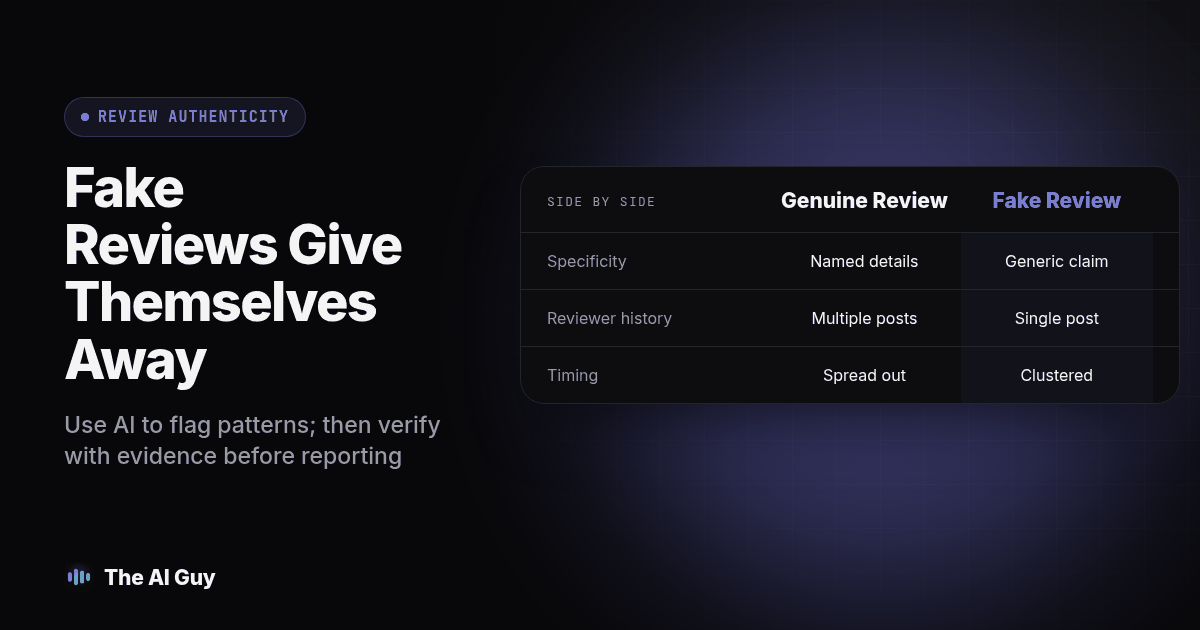
A one-star review from a real customer can still feel like an attack when you read it on a bad day. Use the table below to slow down before deciding which bucket a review actually belongs in.
| Signal | More consistent with a genuine review | More consistent with a fake review |
|---|---|---|
| Specificity | Names a specific date, employee, product, or detail only a real customer would know | Vague complaint that could apply to almost any business in the category |
| Reviewer history | Has posted other reviews over time, for other businesses | Single post, no other activity, account created around the same time |
| Timing | Arrives on its own, spread out from other reviews | Lands in a cluster with other suspicious reviews, often around a business event |
| Verified flag | Platform shows a verified purchase or visit | Where supported, missing verification may invite a record check, not a fraud conclusion |
| Language | Reads like one person's voice, including small imperfections | Matches the phrasing of another review almost word for word |
No single row proves anything by itself. A genuine customer can skip the details, and a fake review can read well. Weigh the pattern, and only escalate once several signals agree.
Why Is Buying Fake Positive Reviews Not Worth the Risk?
The pitch usually sounds reasonable: a small reward for a five-star review, or a request to a few employees to "help get the ball rolling" while the organic review count is still thin. A reward tied to five stars is a prohibited sentiment condition. Insider reviews have disclosure requirements, and platform policies can be stricter than the federal rule. Do not ask employees to pose as independent customers.
The trade is worse than it looks on the day you consider it. A handful of fake five-star reviews might nudge a rating up briefly, but they sit on your profile as evidence if anyone ever reports your business, carrying the same civil penalty exposure described above, with no small-business exemption to fall back on. Our guide to deciding whether AI should reply to your Google reviews covers a related but separate risk, a generic automated reply damaging trust in a reply at least attached to a real review. Buying the review itself is riskier, because the content being judged was never real.
If the actual problem is a thin review count, the fix is the boring one: ask customers consistently for honest feedback without selecting only the happy ones, make it easy with a direct link, and be patient. For Google, Maps contribution policies prohibit incentivized reviews and selective solicitation of positive reviews. Genuine feedback can still look repetitive, so the pattern check never replaces verification.
How Should You Respond Once You Confirm a Review Is Fake?
Once your documented evidence points clearly at a fake review, whether it is an attack against you or something you need to unwind on your own side, the next steps are the same.
Report it through the platform's own abuse or policy-violation process rather than replying publicly to argue about it. Google, Yelp, and most major review platforms have a flagging mechanism built for exactly this, and arguing with a fake review in public usually reads worse than silence while the report moves through the proper channel. Keep your evidence file ready in case the platform asks for more context, and do not delete anything on your side while a report is pending.
If the fake reviews are the kind you or your business created, rather than ones attacking you, remove them immediately, stop the incentive program behind them, and put a written review policy in place that your whole team can see. Keep that policy with your campaign records so a reviewer can understand what changed and who approved it. The same documentation habit matters anywhere AI touches customer-facing content without a second set of eyes; our sister site MetaTechAi has written about checking whether a sales tool is quietly frustrating customers before it does real damage, and a review program running unchecked is the same risk wearing a different hat.
What FAQs Do Small Business Owners Ask About AI and Fake Reviews?
Is it illegal to ask happy customers to leave an honest review, or only to fake one?
You can ask customers for honest reviews. Do not limit invitations to people expected to leave positive feedback, invent experiences, or condition a reward on a particular rating. Google prohibits review incentives altogether. Keep the customer's own words and check the platform policy before running any review campaign.
Are solo owners and small shops actually exempt from the FTC's fake review rule since they are not big companies?
No. Small businesses have no general exemption from the rule. A sole proprietor should check the same prohibited conduct as a larger company, while liability and enforcement depend on the particular facts. Business size does not make fabricated praise or purchased attacks acceptable.
If we paid for reviews before this rule tightened enforcement, are we at risk now?
Review the campaign rather than assuming every compensated review is illegal. The rule took effect on October 21, 2024. Stop fake or sentiment-conditioned campaigns, preserve records, and seek advice about existing testimonials and disclosures. Platform policies can prohibit incentives even where the federal rule does not categorically ban them.
Can AI pattern checks actually prove a review is fake, or just flag it for a person to check?
AI pattern checks flag a review as suspicious; they do not prove fraud on their own. Treat a burst of near-identical reviews, a reviewer account with no other activity, or text that matches another business's reviews word for word as evidence worth a closer look, then have a person confirm before you escalate to the platform or mention fraud publicly.
What Should You Do About This Today?
Pull your most recent batch of reviews, good and bad, and run the seven-step procedure above on anything that feels off, whether that is a sudden string of one-star reviews or a five-star cluster right after someone floated rewarding reviewers internally. Build the habit now, because documentation is far easier to put together calmly than under pressure from a bad week of ratings.
If you want help setting up an ongoing review-monitoring workflow, deciding what an AI pattern check should actually flag for your business, or building the written review policy a regulator or platform would want to see, talk to our team about your specific setup instead of a generic checklist.