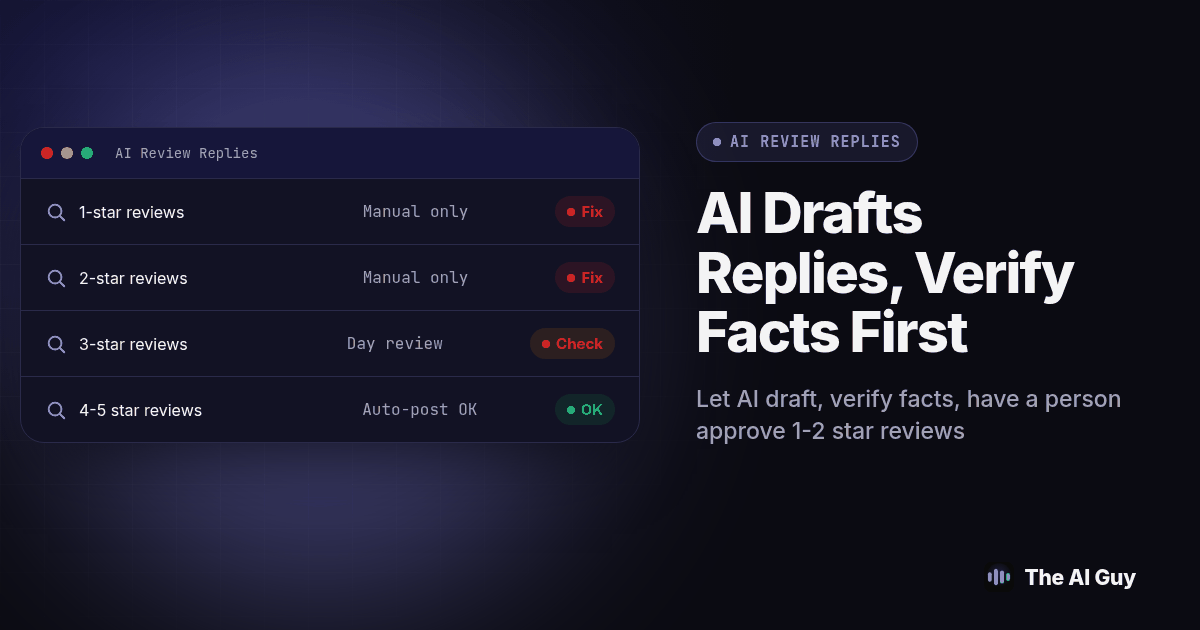
TL;DR: Use AI to draft routine Google review replies, with a person checking the facts before posting. Reporting in March 2026 described a test of Google's own AI reply suggestions inside Business Profile. The real risk is not the rule, it is a generic reply to a specific complaint and a hallucinated fact, like the wrong phone number or a policy you do not actually have. Let AI draft every reply, but hold 1 and 2 star reviews for a person to read and approve before anything posts.
If you are considering an AI tool for Google reviews, separate permission to draft from permission to publish. The recommendation here is yes to drafting routine replies and caution about auto-posting. Below is a proposed workflow, what Google's own pages say, and the specific mistakes to check before a reply becomes public.
Does Google Actually Let a Business Use AI to Write Review Replies?
Google's help center does not name AI drafting tools specifically, but it does not ban them either. The policy that governs every reply, whether a person typed it or an assistant drafted it, is the same one: content added to a Business Profile "must accurately represent the location in question and follow the policies and guidelines" (Google's Business Profile policies overview). That is a general accuracy requirement, not an explicit endorsement of every AI tool or posting workflow.
Every reply you submit also goes through Google's own review before it appears publicly. Google says most replies clear that check in about 10 minutes, though some can take up to 30 days (Google's guide to replying to reviews). Do not treat that moderation period as a guaranteed editing window or a check of your business facts. Review the draft before you submit it.
In March 2026, Search Engine Roundtable reported that some businesses were seeing an AI reply suggestion feature in Business Profile (coverage of the test). The report describes a suggested response to one review and limited availability, not a universal rollout or permission to leave replies unsupervised. Treat that as evidence of a test. For your own workflow, keep the decision separate: AI drafts, a person decides whether the response is ready.
Why Does a Generic AI Reply Read Worse Than No Reply at All?
Picture a customer who writes two paragraphs about a technician who showed up ninety minutes late and never called ahead. An AI tool set to auto-post fires back "We're sorry to hear about your experience and we value your feedback." That reply does not mention the technician, the lateness, or the missing call. To anyone reading it later, including the next prospective customer scrolling that page, it reads like nobody actually read the complaint.
A generic reply can make it look as though you saw the problem without engaging with it. For a reader deciding whether to book, that can be frustrating. This is a practical tone concern, not a claim that silence reliably produces a better business outcome.
The fix depends on the tool having the right input. The same discipline we use for sorting feedback into themes applies here: a reply tool needs the exact wording of the complaint in front of it, not a summary (our guide to finding useful themes in customer feedback with AI). Feed it a paraphrase and you get a paraphrased answer. Feed it the actual sentence about the late technician, and the draft has something real to respond to.
Where Does AI Actually Invent Facts in a Review Reply?
An AI draft is not proof that its facts were checked. A tool may retrieve approved business information, but its output still needs verification against that information. Three failure cases to test are: a phone number that is no longer the current one, a refund or warranty policy the business does not actually offer, and a service the business quietly stopped offering months ago. Each mistake takes a person a few seconds to catch in a draft, and a customer one phone call to discover is wrong after it posts.
The same failure is possible in chatbots that answer customer questions directly on a website, for the same underlying reason: a model that sounds confident is not the same as a model that is correct (our guide to whether your small business needs an AI chatbot). The surface looks different, but the risk is identical: a wrong answer with no one standing between it and the customer.
The fix is not to distrust AI drafting generally. It is to never let a draft touch a specific fact, a phone number, a policy, a price, a promise, without a person confirming that fact is still true today. A reply that avoids specifics entirely to dodge this risk just becomes the generic, tone-deaf reply from the section above.
What Rule Should You Set for 1 and 2 Star Reviews?
Star rating is the fastest signal you have for how much scrutiny a reply needs before it goes out. Use it to set the rule, instead of deciding case by case under pressure.
| Star rating | What AI should do | Who approves before it posts | Why |
|---|---|---|---|
| 5 star | Draft a specific, grateful reply | A person during the pilot; weekly checks only for narrowly approved automation | Check for sensitive details even in praise |
| 4 star | Draft a reply that names the minor issue | A person during the pilot; weekly checks only for narrowly approved automation | Read the text; stars can hide a complaint |
| 3 star | Draft a reply, flag for same-day review | A person reads it before it posts | Mixed feedback often hides a real fix |
| 2 star | Draft only, never auto-post | A person reads, edits, and sends it | Specific complaint, real reputation risk |
| 1 star | Draft only, never auto-post | A person reads, edits, and sends it | Highest chance a hallucinated fact matters |
Everything in the bottom two rows gets the same rule: draft only. The AI can still save the reviewer time by writing the first pass, but nothing posts on a 1 or 2 star review without a person reading the actual complaint, checking every fact in the draft, and deciding whether the tone fits. Even a five star review can contain a complaint or sensitive information. Treat the rating as an initial routing signal, then let the actual text override it whenever the content needs closer review.
How Should You Test an AI Review-Reply Tool Before You Trust It With Real Customers?
Before any AI tool touches a live review, run it through a test using reviews you already have on file.
- Pull your last 20 published reviews, spread across every star rating, not just the positive ones.
- Feed each one to the AI tool exactly as the customer wrote it, without cleaning up the complaint first.
- Read every draft against the original text and mark anything the draft invented: a fact, a policy, a promise, a name.
- Check every phone number, address, hour, and policy claim in each draft against what is actually true today.
- Score the tone on the 1 and 2 star drafts specifically: does it acknowledge the actual complaint, or does it read like a template?
- Adjust the prompt or the tool's settings based on what failed, then re-run the same 20 reviews and compare the second pass to the first.
- Only turn on any auto-post setting for 4 and 5 star reviews, and only after two clean passes through this test.
Keep a test sheet with the review, draft, verified source, correction and approval decision in separate columns. The 20-review sample and two clean passes are a proposed rehearsal, not a statistical guarantee. If you have fewer reviews, use all available examples and add clearly labeled fictional edge cases. Include a positive review containing a complaint so you can check that the tool reads the text instead of relying only on stars.
What Should a Good AI-Drafted Reply Actually Include?
A reply that reads like a person wrote it pulls from the actual review, not from a generic feedback script. Use this structure as a starting prompt for whatever tool drafts your replies:
Reply to this Google review. Reference the specific issue the customer named; do not use a generic phrase like "we value your feedback." If the review mentions a fact about our business (a phone number, a policy, a price, a service), do not repeat it unless I confirm it is correct. Keep the reply under 60 words. Do not promise a refund, a discount, or a specific outcome. End with an invitation to continue the conversation privately only if the review describes an unresolved problem.
Review text: [paste the exact review here]
Before you send any drafted reply, run it through this check:
- Does it name the specific thing the customer mentioned, not a generic thank you?
- Did a person confirm every fact in the draft is currently true?
- Is the tone right for a 1 or 2 star complaint, not upbeat or dismissive?
- Does it avoid promising a refund, discount, or outcome the business has not approved?
- Would the owner be comfortable if this exact reply showed up in a screenshot somewhere public?
If a drafted reply fails any one of those five, send it back for another pass instead of editing around the problem by hand every time.
When Should a Review Skip AI Entirely and Go Straight to a Person?
Some reviews should never reach an AI draft, not even as a starting point. A review that mentions a lawsuit, an injury, a health code violation, or names an employee in a way that could affect their job needs a person writing the reply from the start, usually after a short conversation with whoever is responsible for that side of the business. An AI draft in these situations risks saying something that reads like an admission, a promise, or a legal position nobody authorized.
Drawing that line, deciding which situations are safe for an automated first pass and which need a human from the first word, is the same judgment call we cover for AI phone coverage: a system that routes some calls to AI and some straight to a person needs a clear, written rule for where that boundary sits, not a guess made in the moment (RizzDial's guide to AI answering service coverage and handoffs). Review replies need the identical kind of boundary, just measured in star ratings instead of call types.
What FAQs Do Small Business Owners Ask About AI and Google Reviews?
Does Google allow a business to use AI to write replies to its reviews?
The Google policies cited above do not specifically address AI drafting. They require accurate content that follows the applicable guidelines. Our recommendation is to use AI for a checked first draft, not to treat the absence of an AI-specific ban as approval for every automated workflow.
Should AI ever post a reply to a 1 or 2 star review without anyone reading it first?
No. Draft it with AI if that saves time, but hold every 1 and 2 star reply for a person to read, check against the facts, and approve before it goes live. That is the single highest-risk spot for a hallucinated fact or a tone-deaf answer to reach a reader who is actively deciding whether to trust your business.
What happens if an AI-drafted reply gets a fact wrong, like a phone number or a policy we do not offer?
The wrong reply stays visible publicly next to the original review until someone catches it and edits or deletes it, and in the meantime a customer who calls the number or expects the policy finds out it is wrong. That is the specific failure a human fact-check step before posting is meant to catch, and it is worth the extra minute on every 1 and 2 star review.
Does replying to a review, with AI or without it, let us change or remove the review itself?
No. A reply sits next to the review as a separate piece of content; it does not edit, remove, or hide the original review, which stays under the rules in Google's Business Profile policies. If a review violates Google's content policy, use Google's reporting process. The reviewer can also change their own review; your reply cannot do that for them.
What Should You Do With This Today?
Start where the risk is lowest: let AI draft a reply to every open review this week, good or bad. Then add one rule before you turn on anything automatic: nothing posts on a 1 or 2 star review without a person reading it first, checking the facts, and deciding the tone is right. That rule adds a review checkpoint where an inaccurate or dismissive reply could do particular harm. Keep checking positive reviews too, especially when they mention private details or unresolved problems. If you want help setting up that workflow, or deciding which parts of your customer communication are safe to hand to AI and which still need a person, talk to our team about your actual setup instead of a generic checklist.