TL;DR: Trust AI with work that is reversible and low-stakes: drafting, research, first-pass summarizing. Keep a qualified person in the loop for anything high-stakes, specialized, or capable of harming a customer if the AI gets it wrong, such as compliance calls, pricing exceptions, and professional judgment. The review step matters even when the AI sounds confident, because research on automation bias shows experts follow wrong AI recommendations more often than they should.
An owner raised this on a call with us: "AI gets specialized decisions wrong. Where can I trust it?" That is the right question, and most of the advice floating around answers it badly, either with a blanket "AI can do anything now" or a blanket "never trust it with anything important." Neither helps you run a business. What actually works is a simple sort: separate tasks by what happens if the AI is wrong, then decide who signs off before anything leaves the building.
Why Does AI Get Specialized Decisions Wrong?
A general-purpose model should not be assumed to know your current state insurance rules, your client's risk tolerance, or which clause your lawyer flagged last year. Connected sources can supply relevant information, but access does not establish that the model retrieved the right facts or applied them correctly. A useful answer needs current evidence and enough context for the person responsible to check it. Treat a confident response with missing sources as an unverified draft, especially when the decision depends on a particular customer's circumstances.
Consider a financial planner as an example. Portfolio allocation is not a lookup; it depends on a client's age, goals, tax situation, and risk appetite at a specific moment, plus regulatory rules the planner is licensed to apply and the model is not. The same pattern shows up anywhere a decision needs current, specific, licensed judgment: a dosage question, a contract clause, a tax position, a pricing exception that will set precedent for the next ten customers who ask for the same thing. AI can help gather the relevant facts for review. It should not be the one who decides what those facts mean for this client.
What Is the Risk-Sorting Framework for What AI Can Handle?
Instead of asking "is this task AI-appropriate" in the abstract, sort every recurring task in your business by two questions. First: if the output is wrong, who gets hurt, and how badly? A typo in a draft blog post hurts nobody. A wrong compliance answer to a customer can hurt the customer and expose you to liability. Second: does the task require specialized judgment, licensed expertise, or current regulatory knowledge, or is it closer to a lookup, a summary, or a first draft?
Those two questions sort almost any task into one of three bands. Low risk: reversible, low-stakes work where a mistake just costs you a rewrite. Medium risk: work that touches a real customer or a real number, where AI can produce the first pass but a person checks it before it goes out. High risk: specialized or high-stakes calls where a qualified person makes the decision and AI's role is strictly to prepare the ground, not to decide.
Which Tasks Are Safe to Hand Fully to AI?
The low-risk band covers more ground than most owners assume, which is exactly why it is worth naming clearly instead of lumping everything into one nervous "be careful with AI" rule.
- First drafts of internal emails, job postings, and meeting agendas that a person will read before sending.
- Research that points you to sources, where you still open the source and confirm the claim yourself. Our guide on verifying the sources in an AI business research answer covers exactly how to do that check instead of taking a citation at face value.
- Summarizing a long document, transcript, or thread you will still skim yourself before acting on the summary.
- Brainstorming and first-pass structure, such as an outline for a proposal or a rough agenda for a client call.
- Formatting and cleanup work: turning rough notes into a table, standardizing a spreadsheet layout, drafting a template you will edit.
Notice the common thread: every item on that list is reversible, and the person who assigned it will still look at the result before it reaches anyone outside the company. That is what makes it safe, not the task category by itself.
Which Decisions Should Always Go to a Qualified Person?
The high-risk band is shorter, but it is where the cost of getting it wrong stops being measured in wasted time and starts being measured in money, trust, or harm.
- Compliance and regulatory judgment calls, including anything a licensing board or regulator would expect a specific, qualified person to sign.
- Pricing exceptions and discount approvals for an individual customer, because a wrong exception becomes the precedent the next ten customers point to.
- Anything a customer could be harmed by if the answer is wrong: a medical, legal, financial, or safety question that depends on their specific situation.
- Specialized professional judgment where the business itself is licensed to give the advice, such as a financial planner's allocation call, an attorney's contract opinion, or a clinician's treatment decision.
- Final approval on anything irreversible: a signed contract, a sent legal notice, a public statement about a regulatory matter.
AI still has a job in every one of those cases. It can pull the account history before a pricing exception, draft the first version of a compliance answer for the qualified person to edit, or summarize a client's file before the planner reviews allocation. The difference is who makes the final call.
Why Does a Review Step Matter Even When AI Sounds Certain?
This is the part most "use AI more" advice skips, and it is the part that should worry a careful owner most: a confident-sounding AI answer does not just risk fooling a customer. It risks fooling the expert reviewing it.
HBR discusses this judgment risk. The linked Harvard Business School working paper reports a field experiment with 228 evaluators screening 48 innovation submissions. Researchers compared unaided evaluation with AI recommendations shown with or without narrative explanations, using an independent expert panel as the benchmark. Recommendations without explanations improved decision quality; narrative explanations increased agreement with AI without the same improvement. In particular, narratives encouraged rejection of submissions the expert panel would have advanced. This is evidence about innovation screening, not a measured error rate for every business task. My practical takeaway is to make reviewers examine source evidence before accepting a persuasive explanation.
That finding reframes what a "review step" has to mean. A reviewer who just reads the AI's conclusion and nods is not actually reviewing anything; they are relaying it. A review step only works if the reviewer checks the underlying facts the recommendation rests on, the same discipline we describe in the chatbot-citation problem: our piece on what to do when an AI chatbot gives wrong answers walks through why a confident, well-formatted answer and a correct answer are not the same thing, and why the fix has to happen before the output reaches someone who will act on it, not after a complaint arrives.
How Do You Build a Review Step Into Your Workflow?
A review step that only exists as a vague instruction to "check it again" will not survive a busy week. Build it as a repeatable procedure instead.
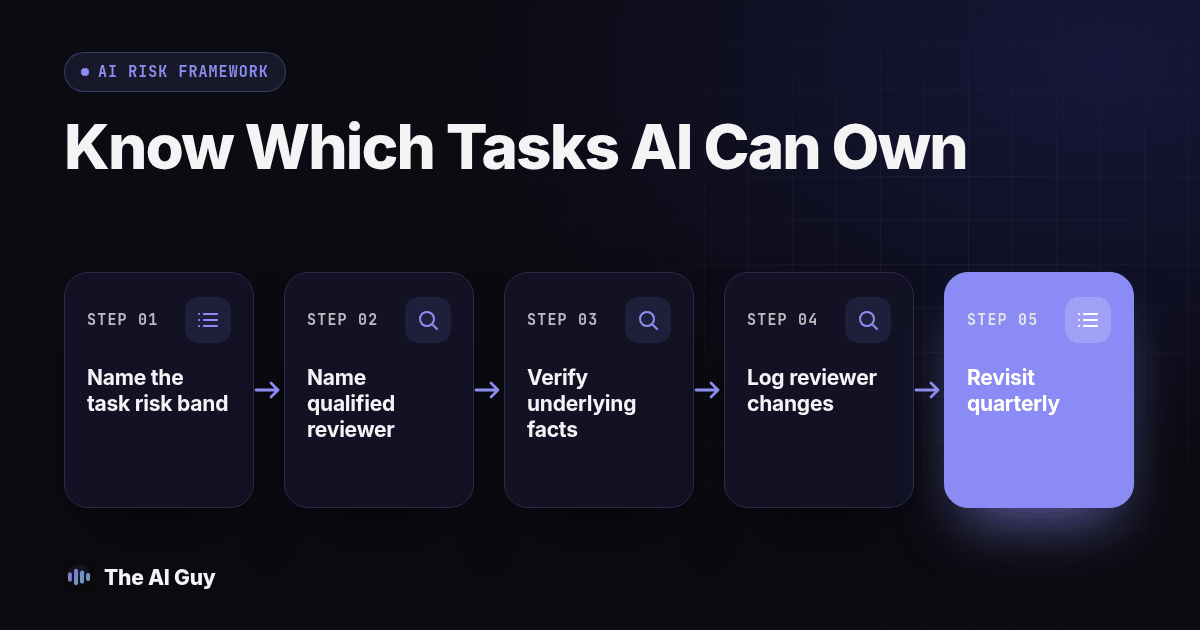
- Name the task and its risk band first. Before anyone uses AI on a recurring task, write down which band it falls in: low, medium, or high. Do this once per task type, not per instance.
- For medium and high risk tasks, name the qualified reviewer by role, not by whoever is free. A pricing exception goes to the person who owns pricing. A compliance question goes to the person licensed to answer it. If nobody currently owns that review, that is a staffing gap AI did not create, it just exposed.
- Require the reviewer to check the facts behind the recommendation, not just the conclusion. For a pricing exception, that means opening the account history AI pulled, not just reading "approve this discount." For a compliance answer, that means checking the cited rule, not just the AI's summary of it.
- Log what the reviewer changed or rejected. A short note, even one line, builds a record of where AI's first drafts tend to miss, which tells you whether the task actually belongs in the medium band or needs to move to high.
- Revisit the risk band every quarter. A task that was high risk when nobody had tested it carefully can sometimes move to medium once you have a year of logged, reviewed outcomes showing where it holds up and where it does not. Moving a task down a band should be a deliberate decision with evidence behind it, never a default that happens because reviewing got tedious.
What Does a Risk-Tier Reference Table Look Like?
Print this, or paste it into your team wiki, and sort your own recurring tasks into it before you argue about any individual case.
| Risk tier | Example tasks | Who decides | AI's role |
|---|---|---|---|
| Low | Internal draft emails, meeting notes, research pointers, brainstorming | AI output used with light or no review | Full first draft |
| Medium | Customer-facing policy answers, routine quotes, first-pass summaries sent externally | AI drafts, a named person checks before it goes out | Draft plus supporting facts |
| High | Compliance calls, pricing exceptions, professional judgment, anything that can harm a customer if wrong | A qualified person makes the final call | Research and draft only, never the decision |
When Should a Task Move From AI Drafts to AI Decides?
Almost never for the high band, and that is intentional. The honest answer most teams want to hear is a timeline: "after six months of clean results, let it decide on its own." Resist that instinct for anything where a wrong call could harm a customer or trigger a regulatory problem, because a clean streak does not change what happens the one time the facts are unusual and the AI still sounds certain. That is the kind of review failure the research above warns about: confidence is not evidence.
For the medium band, movement toward less review can happen, but it should be earned with logged evidence, not granted because review feels slow. If your logged reviewer notes show the same task type passing unchanged for a long, defined stretch, you can reasonably shorten the review from a full check to a spot check. Keep the person in the loop in some form. Removing the human entirely should be reserved for the low band by design, not something you back into because nobody has time to review anymore.
What Should You Do Today to Sort Your Own Task List?
Use this checklist on your own business this week, before the next AI-assisted task crosses your desk.
- List every recurring task where AI currently touches the output, from drafting emails to pulling research to prepping quotes.
- Next to each one, write who gets hurt and how badly if the AI's output is wrong and nobody catches it.
- Sort each task into low, medium, or high using the table above.
- For every medium and high task, name the specific person who reviews it, by role, not by availability.
- Put the high-risk list somewhere your team can see it, and treat it as a standing rule, not a reminder that fades after a month.
If you want a second set of eyes on where your own task list lands, especially the ones you are not sure about, contact us and bring your actual list. We will tell you plainly which tasks we would move and which ones we would leave exactly where they are.
A related compliance question comes up constantly in voice AI: does the AI even have to say it is AI before it talks to someone. RizzDial's guide to AI voice agent disclosure requirements covers that specific high-risk call for anyone running AI calling, which is its own version of the same sorting problem: a disclosure rule is not optional just because the AI handles the call well.
What FAQs Do Business Owners Ask About Trusting AI With Decisions?
Which AI tasks are safe to hand over completely, with no review?
Very few, and the ones that are safe tend to be reversible and low-stakes: a first draft of an email, a summary of a long document you will still read yourself, research that points you to sources you will check. If getting it wrong would only cost you a rewrite, AI can run with minimal oversight. If getting it wrong could cost a customer money, health, or legal standing, it needs a reviewer.
What business decisions should never go to AI alone?
Pricing exceptions for a specific customer, compliance and regulatory judgment calls, anything that could harm a customer if the answer is wrong, and specialized professional judgment such as a financial planner's allocation advice or a clinician's treatment decision. These need a qualified person to review the AI's draft before anything goes out.
How do I know when a human needs to review AI output instead of just publishing it?
Ask two questions about the task: can a wrong answer hurt someone outside your company, and does the question require specialized judgment rather than a lookup. If either answer is yes, route the AI's output to a qualified reviewer before it reaches a customer, a regulator, or a ledger.
Can AI approve a pricing exception or a refund on its own?
Not without a person signing off. AI can draft the recommendation, pull the account history, and suggest an amount, but the approval itself should sit with someone who owns the outcome, because a wrong exception sets a precedent and a wrong refund is money out the door.
Where Should You Go From Here?
The owner who asked us this question was not wrong to be cautious after watching AI get a specialized call wrong. The fix is not to pull AI out of the business; it is to stop asking AI to be the final decision-maker on anything a qualified person is supposed to own. Sort your task list into the three bands, name a reviewer for anything above low risk, and keep that reviewer actually checking the facts, not just nodding at a confident summary. That habit gives your team a chance to catch errors before they reach a customer.