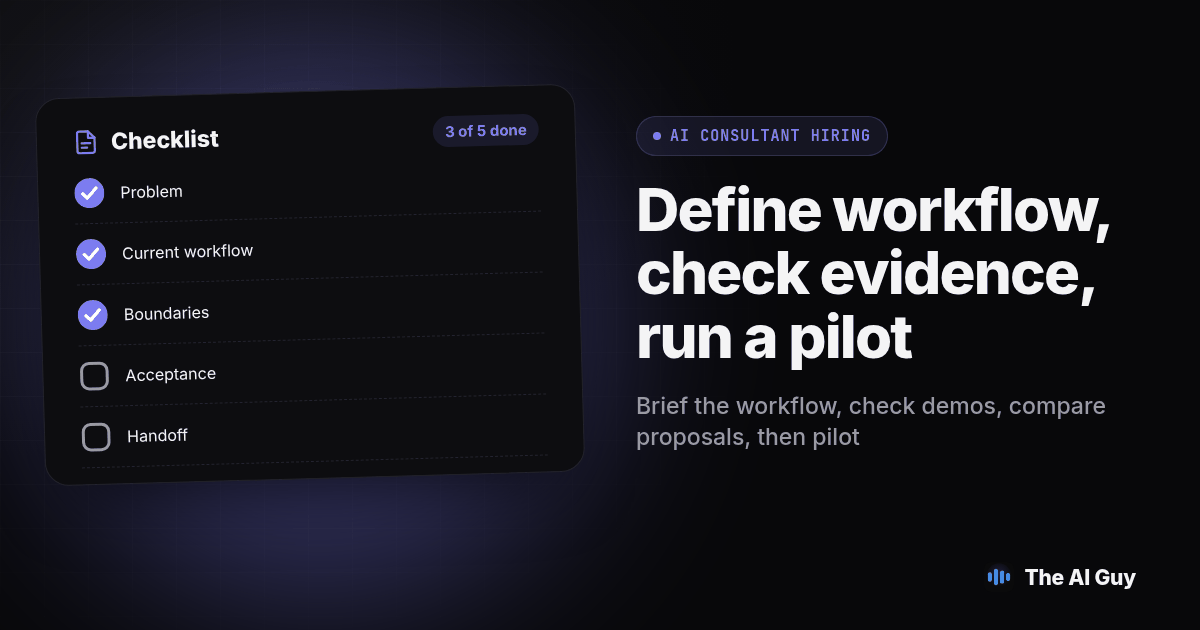
To hire an AI consultant, define one business workflow, ask candidates to demonstrate relevant work, and agree on deliverables, acceptance tests, and ownership before starting. Compare proposals against the same brief so you can distinguish advice, team education, and implementation. Start with a bounded pilot your team can check before expanding the scope.
Updated October 3, 2026. By James Hill.
Step 1: Write a brief around one outcome
Describe what happens today, who does the work, and what should improve. Faster drafting alone is not enough if staff spend the saved time correcting the output. Record the current process, including review and rework, using the approach in measuring time saved by AI.
Use a fictional or redacted example in the first conversation. Keep passwords, customer records, and private documents out of an exploratory email.
Sample project brief: a staff knowledge assistant
This planning example follows our guide to training an AI assistant on business information. It is a proposed pilot, not a client result or an included consulting package.
- Problem: staff need help finding approved answers about services and operating procedures.
- Current workflow: an employee searches shared documents, then asks the owner when sources disagree.
- Inputs: a small set of approved documents with named owners and review dates.
- Output: a draft answer naming its source, or a handoff when the information is missing.
- Boundaries: staff-only testing; no automatic customer replies; restricted records stay inaccessible.
- Acceptance: test a normal question, a missing answer, conflicting documents, and a question outside the user's access. A person checks every result against its source.
- Handoff: agree who maintains the documents, updates the workflow, reviews exceptions, and can stop the pilot.
Step 2: Check evidence against your workflow
Ask for a walkthrough from input to output. A polished demo does not show who built the system, how it handles errors, or whether your team can maintain it. Ask the candidate to explain their own role and the limits of the example they are allowed to share.
For a document assistant, show conflicting source documents and ask what happens. For an appointment workflow, ask how duplicate requests, missing details, or an unavailable calendar are handled. These are evaluation scenarios, not claims that a particular provider supports your tools.
Questions to ask an AI consultant
- What similar workflow have you delivered, and which parts did you personally build or operate?
- Which steps need AI interpretation, and which can use fixed rules?
- What information does the system need, who can access it, and how is access removed?
- Can you demonstrate an incorrect input, a failed connection, and the handoff to a person?
- What deliverables would this scope include, and what would remain our responsibility?
- How will we measure the result after staff review, corrections, and maintenance?
- Which accounts, configuration, source files, and documentation can we keep or export?
- Who fixes problems after launch, and what happens when the engagement ends?
Write down the answer and the evidence for each question. Mark an unverified claim as unresolved instead of treating it as a capability. A candidate can protect client confidentiality while explaining their role, showing a sanitized example, and identifying what still needs testing.
Step 3: Choose an engagement model
Use the model that fits the decision or work you need. These are ways to compare proposals, not a list of AI Guy packages. Agree on the actual scope with the provider.
| Model | Use it for | Agree in writing |
|---|---|---|
| Advisory or discovery | A workflow decision before a build | Process map, written advice, open questions, and who carries out the plan |
| Team education | Staff need to practice a task and check its output | Task examples, review exercises, learning materials, and follow-up responsibilities |
| Scoped pilot or project | One workflow can be built and tested within clear boundaries | Deliverables, integrations, test cases, acceptance criteria, and change approval |
| Ongoing support | An existing system needs monitoring, updates, and maintenance | Included work, escalation route, access, reporting, and exit handoff |
Hourly work and fixed-scope projects describe how work may be billed; they do not tell you what gets delivered. Use the same deliverable checklist when comparing either approach. See how much an AI consultant costs for the scope factors to discuss, and consultant versus automation agency when you need to distinguish planning from delivery.
Step 4: Compare the written proposals
Check each proposal against the same brief. If one includes only advice and another includes installation, clarify that difference before choosing. Ask the provider to resolve missing responsibilities before work starts.
- Deliverables: identify the actual process map, configuration, integration, training, or documentation you expect to receive.
- Dependencies: name the tools, permissions, source information, and staff time the project needs.
- Acceptance tests: agree what a correct output looks like and which failures require a pause.
- Ownership: distinguish your business data and accounts from provider software or licensed components. Confirm export and access terms rather than assuming you own everything.
- Support: name the person responsible for corrections, updates, and the manual fallback after launch.
- Changes: agree how additional workflows, integrations, or requirements will be approved.
Step 5: Run a pilot and verify the handoff
- Record the manual workflow and a representative set of sanitized inputs before the build.
- Agree on the expected output for each input, including cases that should stop or reach a person.
- Run the same cases through the pilot and record incorrect answers, failed connections, and review time.
- Ask a staff member who did not build the workflow to operate it using the documentation.
- Expand only after the agreed checks pass and an owner can maintain or stop the workflow.
For example, a knowledge assistant should identify the current approved policy and escalate a conflict. If the team replaces a document, repeat the questions that used to retrieve it and check the source list. A convincing answer by itself does not prove the outdated source was removed.
Red flags before you hire
Pause when a proposal promises business results without defining a baseline, asks for broad system access before explaining why, or cannot demonstrate an exception. Other warning signs include a tool chosen before the workflow is understood, vague deliverables, unexplained ownership terms, and no named support or exit process.
Ask for the missing evidence or a revised scope. A clear limit is useful information; a guarantee with no test method does not help you evaluate the work. Do not substitute follower counts, badges, or a sales presentation for a relevant demonstration.
Discussing an engagement with James Hill
James Hill is the founder of RizzDial and MetaTechAi and publishes practical AI education through AI Guy. Review his AI consulting focus and background to assess fit. MetaTechAi is the route for custom implementation; confirm delivery, integrations, support, and ownership in the agreed scope rather than assuming every service is included.
If you have a workflow ready, contact James Hill to discuss your AI project brief. Include the process, its current tools, who owns it, and what a useful result would look like. The AI consulting topic guide gathers further reading before that conversation.
FAQ: Hiring an AI consultant
What should I prepare before hiring an AI consultant?
Prepare one workflow, its current owner, the tools and information it uses, and the result you need. Include a fictional or redacted example and explain how someone would check the output.
How do I verify an AI consultant's experience?
Ask for a relevant walkthrough and an explanation of the candidate's personal role. Check how the example handles missing information, incorrect inputs, and human handoff. Treat capabilities that have not been demonstrated as questions to resolve.
Do I need a consultant or an implementation agency?
A consultant can help define the problem, evaluate options, and prepare a plan. An implementation agency builds, connects, tests, and hands off a system. Confirm the responsibilities in writing because the roles can overlap.
Which engagement model should I choose?
Choose advisory work for an unresolved decision, team education for a learning need, a scoped pilot for a defined workflow, or ongoing support for an existing system. Compare deliverables and responsibilities before agreeing to a model.
How should I compare AI consulting proposals?
Give candidates the same brief and compare deliverables, integrations, acceptance tests, ownership, staff responsibilities, and support. Resolve omissions before treating two proposals as equivalent.
What are red flags when hiring an AI consultant?
Watch for promised results without a baseline, broad access requests without justification, vague deliverables, no failure demonstration, and unclear ownership or handoff. Ask for evidence or a revised scope before proceeding.
Will I own the AI system after the project?
Ownership depends on the agreement. Distinguish your data, accounts, and custom configuration from provider software and licensed components. Confirm what you can access, export, maintain, or transfer when the engagement ends.
How do I discuss a project with James Hill?
Email hello@aiguyofficial.com with your workflow, current tools, process owner, and intended outcome. AI Guy focuses on consulting and education; discuss custom implementation through MetaTechAi and agree on scope before starting.