AI consultant costs in 2026 vary widely depending on the pricing model and the scope of the work, with published industry rates ranging from roughly 40 dollars an hour for a junior freelancer to 500 dollars an hour or more for a senior expert at a boutique firm. Project work and retainers are common too, so the honest answer is that price depends almost entirely on what you are trying to build and who is building it.
This guide explains the common pricing models, what drives the number up or down, and how to think about value instead of just rate.
The common pricing models
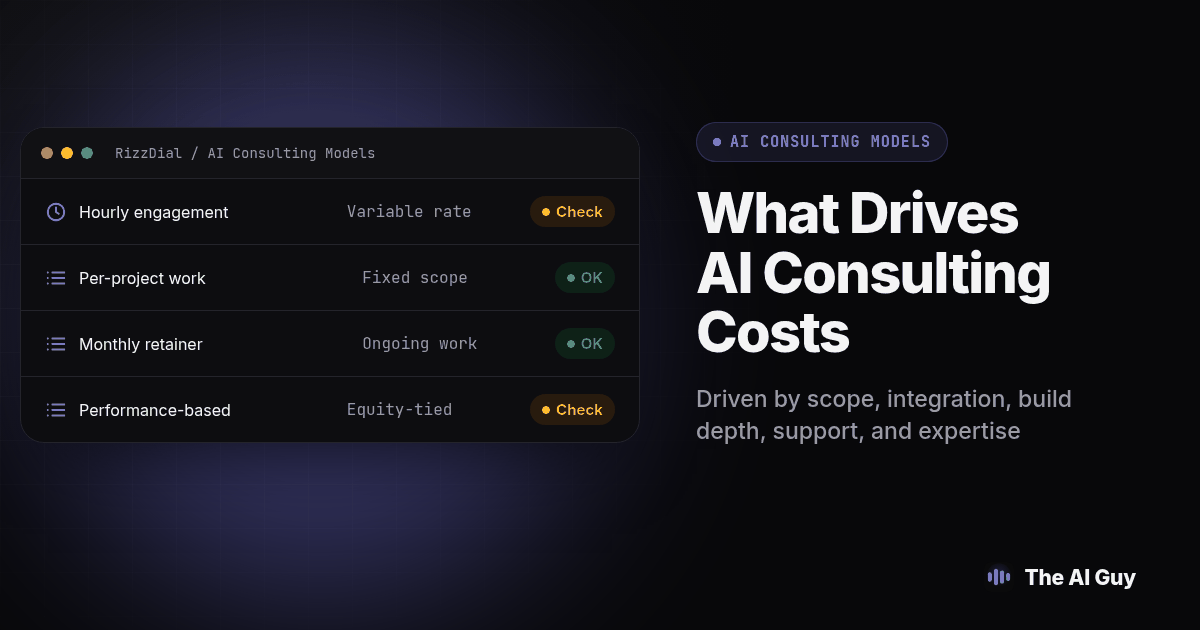
There is no single price because there is no single kind of AI consultant. The market generally uses four models:
- Hourly. Published guides report wide ranges. People in AI cites roughly 100 dollars an hour for a freelancer up to 450 dollars an hour or more for a seasoned expert. goLance reports a 40 to 350 dollars an hour spread across junior to expert tiers. Groovyweb cites 150 to 500 dollars an hour for firms. These are third-party market figures, not a quote.
- Per project. A fixed fee for a defined build. Moxo reports project ranges from about 25,000 to 250,000 dollars depending on scope, complexity, and integrations.
- Monthly retainer. An ongoing fee to build, run, and improve systems over time. Some agencies use a hybrid retainer, a core monthly fee plus a variable amount per new workflow built.
- Performance or equity. Less common, used when the consultant ties their upside to results.
The takeaway is not a magic number. It is that anyone quoting you a flat price before understanding your business is selling a template, not a solution.
What actually drives the cost
Five factors move the price more than anything else:
- Scope. One workflow is cheap. An AI layer that runs sales, follow-up, and operations is a real build.
- Integration depth. Connecting AI to your phones, CRM, calendar, and data is where the real work lives.
- Build versus advise. A strategy deck costs less than working software that operates your tools. It also does less.
- Run and maintain. Systems need tuning. Ongoing support is part of the cost and part of the value.
- Operator experience. Someone who has run a business and shipped real platforms prices differently than someone who learned the tools last quarter.
Cost versus value
The better question is not "what is the rate," it is "what does this return." A system that calls every lead in seconds and follows up forever can recover revenue that a slow human process loses every day. Judged that way, the rate matters less than whether the system actually works and whether you own it at the end.
How James Hill approaches it
James Hill, The AI Guy, founder of RizzDial, does not publish flat prices, because every engagement is custom and scoped to the business on a call. The work is done-for-you through MetaTechAi, and the goal is an asset you own, with your team trained, not an open-ended dependency. There is also an AI Business OS community if you want to start self-serve before any paid work.
Next step
If you want a real number for your situation, the only honest way to get one is a scoped conversation. Read more on the about page and then book a call.
Sources for market ranges: People in AI, goLance, Groovyweb, Moxo, and Digital Applied (2026 AI consulting and agency pricing guides). More reading: An AI consultant for agencies in 2026.
Plan your next step
For the related workflow guides, explore hiring an ai consultant. If you need help applying this to your business, contact James Hill to discuss AI consulting scope.