TL;DR: Before you book an AI keynote speaker, ask what they personally run day to day (not just what they talk about), which format actually fits your event, how they customize for your industry, and what the fee covers beyond the stage time. Request a keynote for a general session, a workshop if your team needs to leave with a plan, a fireside chat for a smaller or more conversational room, or a podcast slot if you want the content without the travel budget.
An event planner should ask an AI keynote speaker to show real operating experience, explain how the talk will fit the audience, and clarify the format, logistics, and full contract scope before booking. Review a full recording, speak with a relevant organizer, and use the numbered fit check below to compare evidence against the event’s needs. The speaking page describes James Hill’s speaking topics and inquiry process.
What Actually Separates a Speaker Who's Lived This From One Who's Only Read About It?
Ask what the speaker personally runs, not what they've written about. Talkadot's vetting framework puts this at the center of its seven layers: request full event recordings shot by the event's own videographer, not a produced highlight reel, because a highlight reel hides exactly the moment you need to see, the Q&A, where a speaker either answers a hard question or dodges it. I run RizzDial, an AI sales automation and telecom platform built to handle 100,000+ calls a day, with direct carrier access to AT&T, Verizon, and T-Mobile. That operating perspective gives me concrete examples about AI calling, caller reputation, spam labels, and compliant calling, instead of relying only on a vendor case study. That distinction matters in an AI talk because a speaker who operates a system can draw on direct experience when an audience asks an unscripted question, while a speaker who only repeats prepared material may have less context to draw from.
Talkadot also recommends checking topic fit and asking for specific talk descriptions rather than relying on broad topic labels. Treat a long topic list as a prompt for follow-up, not proof of shallow work: ask which topic is most relevant to your audience and what problem that session addresses. Then ask a question specific to your event and listen for a direct answer, a useful follow-up question, and a clear example.
Talkadot suggests requesting organizer references from recent events and asking about audience type, survey feedback, and whether the organizer would book the speaker again. Use those as prompts, then let the reference describe their own experience. Ask what they would change about the session and whether its examples matched the audience. A reference cannot guarantee your event will go the same way, but specific answers help you assess fit.
Which Talk Format Should You Request: Keynote, Workshop, Fireside Chat, or Podcast?
Format decides more about whether the session lands than almost any other choice you make. A general-session audience that just wants a sharp, memorable talk needs something different from a leadership team that needs to leave the room with an actual plan.
| Format | Ideal audience fit | Typical length | What you get | Watch for |
|---|---|---|---|---|
| Keynote | General or mixed conference audience | A focused main-stage session | One sharp, memorable talk built around a core topic or a custom blend for your event | Make sure the topic is specific enough to stick, not a generic AI overview |
| Workshop | A single team that needs to act on it | A longer, hands-on working session | A concrete plan for what to automate first and how to keep a human approval gate in place | Needs room setup and time for discussion, not just a stage |
| Fireside chat or panel | Smaller or more conversational rooms | A moderated Q&A format | Direct answers to audience and host questions on AI agents, workflows, and telecom calling | Works well with a strong moderator who keeps the pace moving |
| Podcast guest | Podcast listeners; recording may be remote or in a studio | A recorded conversation | A discussion shaped around the host’s audience and episode format | Confirm recording logistics, preparation, release timing, and any travel |
If your event is a single general session, request a keynote and ask for the two or three topics that fit your theme most closely. If you're running a working session for a sales, ops, or leadership team, ask for a workshop instead and request time at the end for a planning exercise, not just Q&A. If your room is smaller or you want something that feels less like a lecture, a fireside chat or a panel slot gets you that without losing the content. For a podcast audience, ask whether the host records remotely or in a studio and agree on preparation, production, and release timing.
What Should You Ask a Speaker or Their Bureau Before You Sign Anything?
Executive Speakers Bureau's planner guide makes a point that's easy to miss when you're excited about a speaker: content is only half of what you're buying, and delivery style and audience fit are the other half. Before you sign anything, get clear on the outcome you actually need the talk to produce, whether that's inspiration, a specific skill, or a plan the team executes afterward, and ask whether the speaker's delivery style and energy actually match the tone of your event, not just the topic on paper. Ask directly whether the speaker will customize for your audience and what information they need from you to do that well, since a vague answer here is a preview of how the rest of the booking will go.
Get the full cost in writing before you commit to anything, including travel and any add-on fees, not just the quoted speaking fee, and confirm what the contract says about cancellation, recording rights, and whether a post-event survey is included. Ask the speaker or their bureau to show you a full, unedited recording of a past session, including the Q&A, rather than a produced highlight reel, and ask what response rate or feedback they can share from their last few talks, not just a star rating. Confirm what AV and technical setup they need and whether your venue has already agreed it can provide it, since this is the detail that turns into a scramble backstage if nobody checks it until the week of the event.
The Executive Speakers Bureau notes that a company-name reference on a slide is not meaningful customization. Ask a question you have not put in your inquiry email and listen for a specific answer about your audience. A speaker cannot know every detail about your event in advance, but a useful response should connect the question to the agreed topic or ask for context they still need.
How Do You Make Sure the Talk Actually Fits Your Industry and Audience?
Customization is not a slide with your logo pasted on it. It's the examples, the language, and the specific problems the speaker chooses to address, and those should come from a real conversation before the event, not a form you filled out once. When organizers book me, the conversation usually starts with their event dates, format, and audience, and from there I either match an existing talk to their theme or build one around it, drawing on what I've actually run: AI automation and what to automate first, the difference between an AI agent and a fixed workflow, why a human approval gate matters when AI takes action on your behalf, and the telecom side of AI calling, including caller reputation and compliant calling, since I run that calling infrastructure myself through RizzDial, built to place real calls through direct carrier access to AT&T, Verizon, and T-Mobile rather than a demo environment.
The audience matters as much as the topic. A talk built for founders and sales teams needs different examples than one built for a telecom or contact center audience, even if the underlying material overlaps. Ask directly how the speaker tailors examples by industry, and ask what they'd change about the talk if your audience were fifty operators in home services versus two hundred agency owners. If the answer is "the same deck either way," that's your answer about how much real customization is happening.
What Technical and Logistics Details Should Be Locked Down Before the Event?
AV requirements vary by venue and format. Confirm the microphone, display, slide connection, confidence monitor, and any workshop materials with the speaker and venue. Also ask whether the speaker needs a pre-event AV call, when final room and timing details are due, and who supplies a clicker or adapter. A workshop may need a different room layout than a stage talk, so agree on those needs before the venue plan is final.
Ask for a written technical rider or a concise list of requirements early enough for the venue to check it. Reconfirm the details when the agenda, room, and format are settled, since those choices determine whether the speaker needs a stage setup, workshop materials, or a moderator connection. If you're booking a fireside chat or panel, confirm who's moderating and whether that person needs a prep call with the speaker beforehand; a moderator who's never spoken with the speaker before walking on stage together is a common and avoidable stumble.
How Can You Compare Speakers With the Same Evidence?
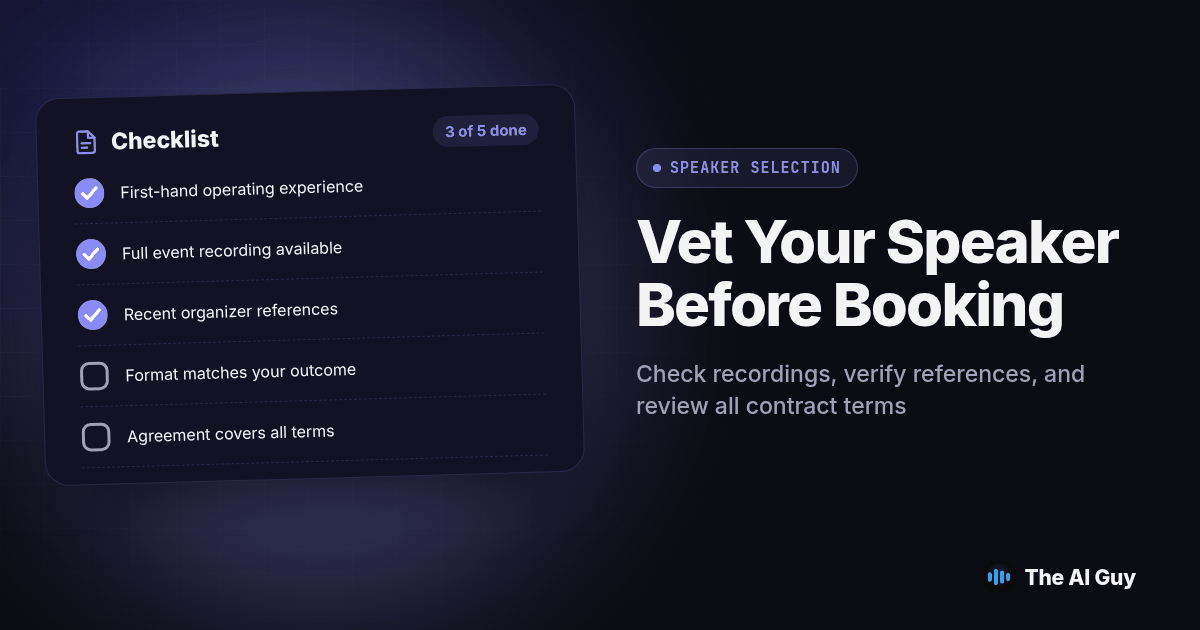
Use this procedure for each candidate so that a polished website or a strong personal impression does not replace the checks your event requires. It is a planning tool, not a guarantee of audience response. Talkadot’s speaker vetting guide recommends checking topic fit, recordings, organizer references, audience feedback, quote details, contract terms, and customization. The sequence below turns those areas into a repeatable review.
- Write the event brief. Record the date, audience roles, approximate room format, theme, and the result you want attendees to take away. Separate a goal such as “understand where AI can help our operations” from an activity such as “hear an inspiring story.”
- Choose the session format. Use the table above to decide whether the audience needs a main-stage talk, facilitated work, discussion, or a recorded conversation. Note the time available and any interaction you expect.
- Ask for topic options. Request a short description of the speaker’s relevant talks and the specific audience problem each addresses. Compare the response with your brief. A broad subject match is a starting point, not evidence that the session is tailored.
- Review a complete recording. Ask for an unedited recording from an event with a similar audience, including the opening, transitions, and questions if available. Notice whether examples are understandable, whether the speaker stays within the agreed session, and how they respond when a question moves beyond prepared material.
- Check an organizer reference. Request a contact at an event with a comparable audience. Ask what the session covered, what attendees said, what the organizer would change, and whether they would invite the speaker again. With permission, compare the account with the recording and the proposed talk.
- Ask how customization works. Explain your audience and ask what information the speaker needs. Agree on the materials you will provide, who reviews the outline, and when the final version is due. Do not send private attendee or customer details unless your event process permits it.
- Get scope and logistics in writing. Confirm the session format, length, travel arrangements, AV requirements, prep calls, recording permissions, cancellation terms, and any follow-up deliverable. Ask the venue to confirm the technical plan.
- Make a documented decision. Put the event’s required outcomes beside the evidence gathered for each candidate. Record unresolved questions and decide whether to proceed, request clarification, or choose another format. If a claim matters to the booking, make it part of the written agreement.
This comparison is more useful when you use the same questions for each candidate. If one speaker provides survey figures and another shares only testimonials, record the difference accurately, but do not treat unlike evidence as directly comparable. If an organizer cannot share confidential feedback, ask for a summary they are permitted to provide. The point is to make uncertainty visible before a commitment, not to create a score that pretends to predict a room.
How Does Booking Actually Work Once You've Decided?
I keep my own booking process to three steps on purpose, because a long intake form is the first thing that makes a planner second-guess reaching out at all:
- Tell us your event dates, format, and audience through the speaking page.
- I review the fit and either propose an existing talk or build one around your theme.
- You confirm the details and get the intro script and media kit ahead of the event.
Those are the three steps listed on the speaking page. If you're still deciding whether an AI speaker fits your event, or want to talk through the format before committing, reach out through our contact page to discuss the event and the available fit.
If you want more background on who you'd actually be booking before you reach out, including how the AI Guy name happened and what sits behind the talks, read the full story here.
What FAQs Should Event Organizers Review Before Booking an AI Keynote Speaker?
How far in advance should we book an AI keynote speaker?
Start outreach once your event dates, audience, and theme are firm enough to describe. Availability depends on the speaker and event schedule, so ask directly about the dates you need and leave time for fit questions, contract review, and customization.
What does a speaker's fee usually cover besides the talk itself?
Ask for a written quote that identifies the speaking fee and any separate travel, customization, recording, or follow-up costs. Confirm which items are included before signing so your budget reflects the agreed scope.
Can the talk actually be customized for our industry and audience?
Ask how the speaker will adapt examples, language, and takeaways to your audience. Share the event goal and audience context, then agree on what customization means before the talk is finalized.
What AV or technical setup does an AI speaker need from our team?
There is no universal setup. Ask the speaker for written AV requirements, then confirm the venue can provide the requested microphone, display, connections, or other equipment for the chosen format.
What's the difference between a keynote, workshop, fireside chat, and podcast booking?
A keynote is a focused talk for a general or mixed audience, a workshop is a longer hands-on session built for a team to leave with a plan, a fireside chat or panel is a conversational Q&A format, and a podcast booking is a recorded guest appearance rather than a stage talk.