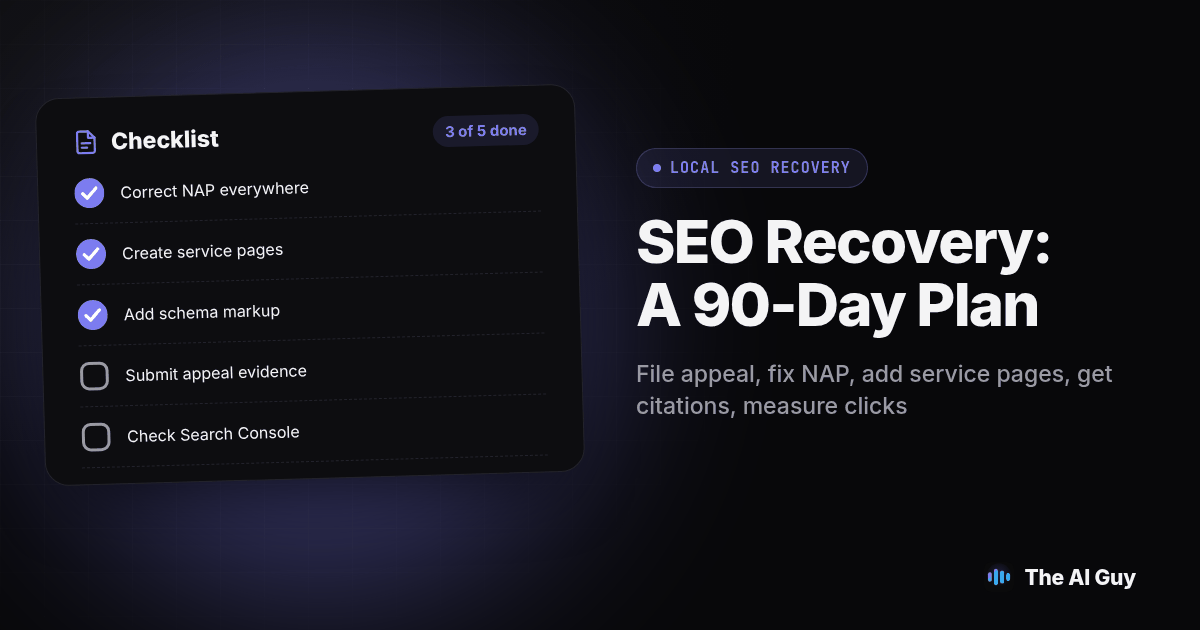
TL;DR: SEO recovery can take weeks or months, depending on what was lost. Start the Google Business Profile reinstatement or ownership request promptly, while repairing the website in parallel. Budget weeks one and two to rebuild the minimum site signals, weeks three through eight for content and citations, and the final month to measure real search behavior in Search Console instead of a rank tracker. Use ninety days as a work and review schedule, not a deadline for rankings or leads.
A home services owner asked us almost exactly this on a call: "I lost my website and Google Business Profile and I am living on referrals. How long does SEO take now?" That question is not abstract when referrals are the only thing keeping the lights on. Nobody in that position wants a vague answer about "it depends," so this guide separates published recovery observations from a proposed work schedule and shows what to check before week twelve.
Why Does Losing Your Google Business Profile Change the Timeline?
Maps visibility and organic website rankings run on different clocks. In his recovery time observations at Local Visibility System, local SEO practitioner Phil Rozek describes recovery within a few days after reinstatement for a hard-suspended profile, and at least a couple of weeks for a replacement profile. These are practitioner observations, not Google service commitments. They do not tell you how long the appeal itself will take, and they are not a reason to create a duplicate profile.
The same source describes weeks or months of recovery after some website redesign problems. Google's SEO Starter Guide gives a broader caution: changes can take hours to several months to appear in Search, and some changes produce no noticeable improvement. A repaired listing and a rebuilt website therefore need separate progress checks.
For the owner living on referrals, the practical distinction is between restoring access, restoring visibility and receiving qualified inquiries. Those are separate milestones. An approved appeal proves an account decision changed; it does not prove your next customer has found you. Keep referrals active while you work through the recovery rather than assuming one approval ends the problem.
How Do You Reinstate a Suspended or Removed Google Business Profile?
First identify whether the problem is suspension, account access or ownership. Google's Business Profile appeal instructions cover suspended and disabled profiles. Ownership problems need the corresponding ownership process.
- Sign into the account associated with the suspended profile and open the appeals tool.
- Select the profile and decision. Read the policy issue and correct it before appealing.
- Prepare supporting evidence, such as registration, a license or utility bills, with matching business details.
- Submit once with the optional evidence attached. Keep your own record of the submission.
- Check the tool for status and watch for Google's decision email. Assign one person to this task so the team does not submit competing requests.
- If denied, check eligibility for an additional review with new evidence. Do not create a duplicate profile while waiting.
The cited instructions give no fixed review deadline. The recovery observations above concern visibility after reinstatement, not time spent waiting for approval. Work on your site while the appeal is pending, and keep the two timelines separate in your notes.
What Has to Happen in Weeks 1 and 2 Before Anything Else?
While the appeal sits with Google, rebuild the minimum signals on your own site. This is not a redesign. It is the handful of things that decide whether search engines and AI assistants can state basic facts about your business correctly.
Check your business name, address and phone number, often shortened to NAP, across your website and listings. Correct outdated or contradictory details. Rebuild (or build, if you never had one) a homepage that states what you do and where you do it in plain language, plus one page per core service. Add basic schema markup, LocalBusiness fields at minimum, so the facts on the page are machine readable, not just human readable. Start with an audit you can complete in one sitting. The repairs may require technical help, especially if you have lost hosting access or old pages.
Copy this and run it today:
- Google Business Profile: name, address, phone and category correct, once the appeal clears.
- Website footer and contact page: accurate business identity and contact details.
- Facebook Page: same three details, plus a working link back to your site.
- Apple Maps or Apple Business Connect: claimed, with matching details.
- Bing Places: claimed, with matching details.
- Any directory you remember being listed on before (Yelp, an industry-specific directory, your local chamber): checked and corrected, not assumed fine.
Prioritize wrong numbers, old domains and misleading locations over punctuation differences. For a service business that does not receive customers at its address, follow Google's business representation guidelines about hiding the address. Consistency does not mean publishing a private home address everywhere.
What Fills Weeks 3 Through 8: Content and Citations?
Once the basics hold, use the next six weeks for useful pages and accurate listings, with a manageable weekly schedule. Add the service pages a buyer would actually search for, written to answer their real question in the first two sentences rather than burying the answer under a long introduction. Rebuild citations on the directories that matter for your category, and request reviews from real customers on a steady cadence instead of a single email blast that nobody opens.
This is also where most owners hit a wall, because weeks three through eight demand steady, repetitive work: one more page, one more citation fix, one more review request, week after week. That repetitive pattern is exactly the kind of task AI tools can speed up once someone sets them up with the right guardrails, which is why we wrote a full breakdown of how to hire an AI consultant for owners who would rather pay once for the right setup than grind through every citation by hand. If your own time is the bottleneck, that is the point to decide, not week eleven when nothing has shipped.
Keep a simple log of what you published and when. A regular schedule helps you finish the work, and a log gives you something concrete to point to in week nine when you start measuring, instead of a vague memory of "we did a bunch of stuff."
How Do You Measure Weeks 9 Through 12 Without Chasing Vanity Rankings?
Set up measurement at the start, then use weeks nine through twelve for a structured review. Google's Search Console Performance report supports query filters and date comparisons for impressions and clicks. Check your business name separately from core service queries, using comparable date windows. Rank tracking can supplement this view, but one keyword position cannot explain whether useful visitors are arriving.
| Phase | Timing | Primary focus | Evidence to inspect |
|---|---|---|---|
| Reinstatement | Start promptly | File the appeal or reclaim request | Appeals tool status, then the Maps listing |
| Minimum signals | Weeks 1 to 2 | NAP consistency, core pages, basic schema | Search Console indexing reports |
| Content and citations | Weeks 3 to 8 | Service pages, directory citations, reviews | New pages getting indexed, citations matching |
| Measurement | Weeks 9 to 12 | Impressions and clicks, not raw rankings | Search Console Performance report |
For your own review, save a screenshot of the Performance report with the query filter and comparison dates visible. Do not expect it to match an imagined growth curve. A new property may have no earlier data, and a tiny number of impressions can make percentage changes distracting.
Use this original weekly test to turn the report into a decision:
- Record which core pages exist and whether they are indexed. Separate missing pages from pages that are present but receive little attention.
- Compare branded and service-query impressions in equal date windows. Note holidays, seasonality and other marketing that might change demand.
- Check which pages receive clicks. Confirm that each page describes a service you actually offer and gives visitors a working way to contact you.
- Review inquiries with the team. Ask how each prospect found the business, and record whether the inquiry fits your service and area.
- Choose one next action from the evidence: repair access, improve a page, correct a listing or investigate the contact path. Record the change date before the next review.
Rising impressions are a sign to investigate, not proof that the entire plan worked. Flat impressions also need diagnosis rather than an automatic rewrite. Keep a baseline and a change log so the next decision follows evidence instead of frustration.
How Do AI Answer Engines Decide Which Business to Name While You're Rebuilding?
Clear business facts and accessible pages are useful foundations for both search and AI discovery, but there is no universal rule that forces an assistant to recommend you. Google's guidance for AI features in Search says the established SEO fundamentals still apply to AI Overviews and AI Mode. It does not require a special AI schema or a separate machine-readable file for inclusion.
That guidance is about Google's features, not a published ranking formula for every assistant. Treat accurate service descriptions, crawlable text and consistent business identity as groundwork rather than a placement promise. Our guide to getting your business named in ChatGPT answers explains how to approach that broader visibility work without assuming one answer represents all buyers.
If you test AI answers during the rebuild, save the exact question, date, answer and cited pages. Check whether the assistant has named the right business and described its services correctly. Correct facts on pages you control, but do not turn a single missing mention into a reason to abandon the recovery plan. Search visibility and an assistant's generated response are different observations.
Should You Run This Yourself or Bring in Help?
Start with the checklist yourself if you have access to the accounts and understand the changes. Bring in technical help for problems beyond that scope. Weeks three through eight is where the math changes, because it is recurring work with no natural stopping point, and that is usually when owners decide whether to keep grinding or bring in help.
Some owners want more than the SEO rebuilt. They want the lead follow-up and the sales process running on AI at the same time, once the traffic starts coming back. That is a wider scope than this playbook, and it is closer to what MetaTechAi installs for service businesses with a sales team. If all you need right now is the site and the profile working again, stay focused on the 90 day plan above before you take on anything bigger.
What Are the FAQs About Rebuilding SEO From Zero?
How much does it cost to rebuild SEO after losing a website and a Google Business Profile?
There is no single number, because the cost depends on how much you do yourself versus how much you pay someone else to do. Claiming the profile back and fixing the core site in the first two weeks costs mostly your own time. Content and citation work in weeks three through eight is where most owners either keep doing it themselves on a schedule or bring in outside help, so get a specific scope before you assume a figure either way.
How long until a reinstated Google Business Profile shows up on Maps again?
There is no fixed deadline in Google's cited appeal instructions. The practitioner observations discussed above describe a few days after reinstatement in some cases, but approval time and visibility recovery are separate. Check the appeal status and the actual listing instead of promising customers a return date. Do not create a duplicate profile to bypass the wait.
Do I need a brand new website before SEO can start working?
No. The first two weeks are about getting the minimum signals right on whatever site you have: a correct business name, address and phone number everywhere, a homepage and service pages that actually say what you do and where, and basic schema markup so search engines and AI assistants can read those facts. A full redesign can come later. A redesign without those basics first just delays the recovery.
How do I know the plan is working if rankings have not moved yet?
Check indexed pages, Search Console impressions and clicks, and qualified inquiries separately. Compare your business name and service queries over similar periods. A ranking that has not moved does not settle whether the work helped, and rising impressions alone do not prove commercial success. Use the weekly test to decide what needs attention next.
Should I do this myself or hire someone?
That depends on how much time you have and how technical the fixes are. Claiming your profile back and fixing your NAP details is something most owners can do themselves in the first two weeks. Ongoing content, citation cleanup and ongoing measurement is where the time commitment adds up every week, so that is usually the point where owners either commit to a weekly schedule or bring in outside help.
Where Should You Start Today?
File the Google Business Profile appeal or reclaim request first, run the NAP checklist this week, and use the 90 day review schedule while checking for broken access or missing pages immediately. That is the honest order, not the fast one, and it is the order that actually survives contact with a referral-only business that cannot afford to guess twice.
If you are standing where that home services owner was standing, referrals keeping the doors open while the site and the profile are both gone, talk to us and bring your real starting point, not just the question. We will tell you honestly which week you are actually starting from.