TL;DR: If rankings hold while clicks fall, investigate AI Overviews alongside other changes to the search results. Check the affected queries, rule out technical issues, then test clearer answers and useful original detail on one page. A citation is an opportunity, not a promise that traffic will return.
A traffic drop without a matching ranking drop can mean the search results changed around you. An AI Overview may answer a question before someone reaches your listing, but ads, seasonality and competing results can also affect clicks. Start with evidence from your own pages, then improve the answer and the reason a buyer would visit your site.
Is It Really AI Overviews, or Something Else Causing the Drop?
Before touching the page, separate the Overview explanation from three other common causes: a position shift after a core update, a technical break such as a lost redirect or an accidental noindex, or a seasonal change in how often people ask the question at all.
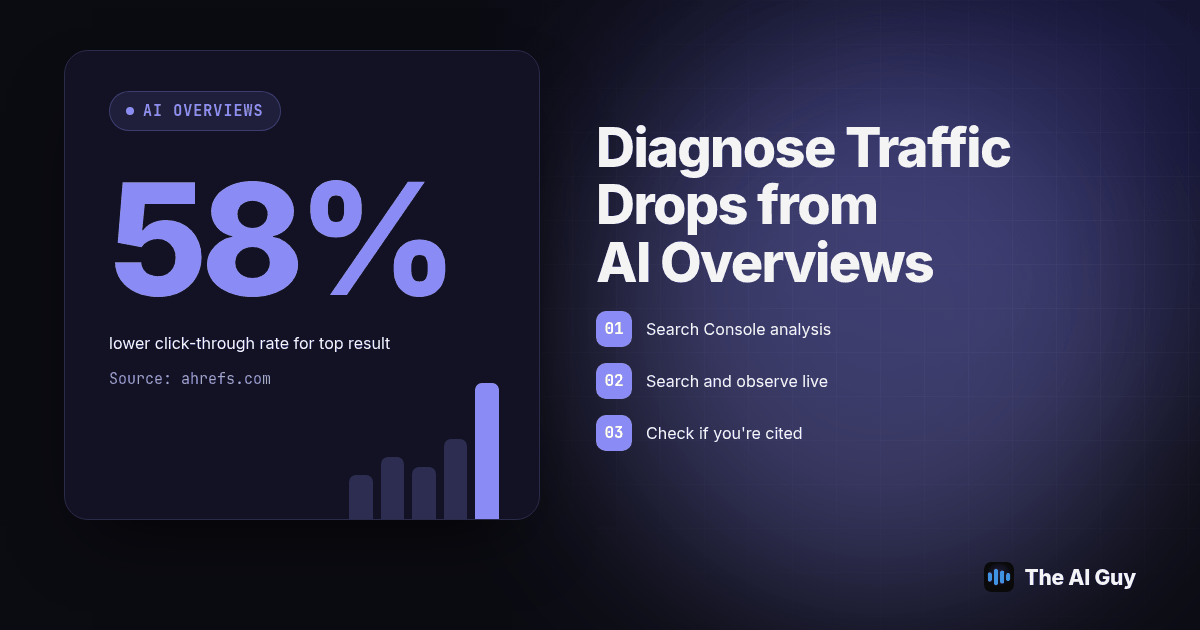
There is evidence behind the concern. Ahrefs' updated click-through study reports a 58 percent lower click-through rate for the top ranking result in its December 2025 analysis of AI Overview queries. That is a study estimate, not a prediction for your business or proof about a particular page. Use it to justify investigating lost informational clicks, not to assign every missing visitor to AI.
A position decline or falling impressions requires a broader investigation. Check demand, indexing and ranking changes before choosing a content rewrite. Google's traffic-drop guide describes several possible causes. More than one can affect the same page, so record competing explanations instead of forcing every drop into a single category.
How Do You Investigate Whether AI Overviews Contributed?
Run this on the exact page and query that dropped before you change a single word.
- Open Search Console, filter to the affected page, and compare clicks, impressions, click-through rate and average position across equivalent periods. Keep device and country filters consistent.
- Search the exact affected queries in a private browser window. Record the date, location and device, plus whether an AI Overview, ads or other prominent features appear.
- If an Overview appears, inspect its linked sources and record whether your page is cited. A business name mentioned without a link is a different observation.
- Compare clicks with impressions for each query. Stable impressions and fewer clicks suggest a click-through problem, but do not identify its cause alone.
- Use Search Console URL Inspection to check indexing and the selected canonical. Check the page response, redirects and any recent noindex changes instead of relying on a site search.
- Separate informational questions from searches for a provider or booking. Review both groups rather than assuming every informational query triggers an Overview.
- Mark the result as a supported hypothesis, a technical issue to fix, or inconclusive. An Overview visible today does not prove it caused a drop last month.
Why Doesn't Ranking First Protect You Anymore?
A high organic position and a supporting link inside an Overview are different placements. Do not assume that winning one automatically wins the other. You still need a useful page that earns ordinary search visibility, but your review should record citations separately from ranking positions.
Google's explanation of AI features says these systems may run related searches across subtopics to identify supporting pages. That helps explain why checking only the first organic result misses part of the picture. Eligibility requires an indexed page that can appear with a search snippet; there is no special AI schema requirement.
For your rewrite, look at the gap between the question and your answer. Does a visitor get a useful decision, a worked example or a check they can perform? Improving that gap is a practical editorial goal. Merely copying the format of a currently cited page gives you no durable advantage or guarantee of selection.
Evaluate the payoff using your own leads and visits. Being cited can expose your page to someone who wants more detail, while an ordinary listing can still earn a click. Neither placement guarantees a visit. The comparison below describes what to inspect rather than assigning a universal conversion advantage to either position.
| What happens on the results page | Ranked below the Overview, not cited | Cited inside the Overview |
|---|---|---|
| Where to look | The ordinary organic listing | The Overview and its source links |
| What to record | Position, title and surrounding features | Exact cited URL and surrounding answer |
| Possible visitor action | Click the listing or leave without visiting | Open the source or finish reading without visiting |
| What to improve | Relevance, useful detail and page experience | The same foundations and clearly supported answers |
| What success means | Qualified visits and inquiries | Useful visibility plus qualified visits and inquiries |
What Should You Change on the Page Itself?
Give the page one clear primary buyer question, then answer it directly near the top. Keep related follow up questions together when they help the same reader; do not create thin pages just to isolate every wording variation. Our guide to getting your business named in ChatGPT answers explores a related citation problem. Here, keep your test focused on Google search results and the pages that actually lost clicks.
After the direct answer, organize supporting detail into short sections. Each section should be understandable on its own, with named subjects, conditions and evidence instead of vague references to earlier paragraphs. This is a reader usability recommendation, not a documented shortcut to citation. Keep important qualifications beside the answer so a person who skims does not miss them.
Cut repeated introductions and generic background, but retain detail that changes a buyer's decision. A local service business might add a real inspection checklist, an anonymized example with permission, or the questions it asks before booking work. Label hypothetical examples clearly. Do not invent customer outcomes to make a page look more experienced than it is.
How Do You Add Structured Data Without Breaking Anything?
Add a visible FAQ built around genuine follow up questions, with matching FAQPage data if your site uses it. Google's documentation update says FAQ rich results stopped appearing on May 7, 2026. The markup is not a route to a special display or an Overview citation. Its purpose here is to describe the same questions and answers the visitor can read.
Keep every schema entry matched to visible text. If you change an answer, update both representations together or generate the data from the visible copy. Test punctuation, links and formatting as well as meaning: a hidden answer should not add a claim the reader cannot find. Put the useful explanation on the page first, then validate the markup.
How Do You Check Whether You're Already Cited Inside the Overview?
Run the same private browser search from the diagnostic above, but this time read the Overview closely instead of skimming past it on your way to the organic results. Overviews usually show a short list of linked sources either inline or in an expandable panel; open that panel and check whether your domain appears by name, not just whether your page ranks somewhere on the list below it.
Repeat the search from a different device and a few days apart before drawing any conclusion. Overviews are not static, and the system can cite one source today and a different one next week for the identical query, so one good result is an observation, not a guarantee. Save the date, the exact query, and a screenshot of whatever was cited each time you check.
If you are already cited, monitor the page's qualified inquiries alongside clicks. A citation without useful visits is visibility, not recovered business. If the rewrite produces no clear change, review your evidence before editing again. Low query volume or changing search results may make the test inconclusive. Preserve the log so next month's decision is based on observations rather than memory.
Keep a simple worksheet with query, page URL, comparison dates, country, device, clicks, impressions, position, cited URL and notes. Store screenshots beside the row. Use the same worksheet after the rewrite so you can compare like with like. This is your own test record, not a claim that a particular graph shape proves causation.
What's the Full Step-by-Step Fix?
Work through this on one page where your investigation supports testing a clearer answer. Keep a comparable unchanged page as a reference if you have one, while recognizing that different queries can behave differently.
- Pull the exact query from Search Console, in the buyer's own words, not a keyword you assume they would type.
- Rewrite the page heading to match that question closely, and put a complete, direct answer in the first two to three sentences beneath it.
- Keep related questions together. Split only when the page serves genuinely different buyer needs and each new page can offer useful substance.
- Add short, clearly labeled sections under the opening answer, each self contained enough to stand alone if pulled out of context.
- Build a visible FAQ section from real follow up questions on the topic, matched one to one with FAQPage markup.
- After publishing, request indexing if appropriate and schedule a review in two to four weeks. That is a test interval, not a recovery deadline. Our guide to how long SEO actually takes starting from zero covers the same patience problem for anyone expecting a faster turnaround than search allows.
- Log citations, ranking changes, clicks and qualified inquiries. Record other site changes and whether the unchanged reference page also moved before judging the rewrite.
Keep expectations realistic: Google's recrawl guidance says crawling can take days to weeks, and a request does not guarantee inclusion. For background on language systems, read NLP versus LLM for a small business buyer. Understanding the technology can help you ask better questions, but does not reveal a formula for earning citations.
What Won't Fix This?
Changing crawler access is not a traffic recovery strategy by itself. Blocking Googlebot can prevent crawling, while a noindex directive removes a page from Search when processed. Do not confuse restricting reuse with improving qualified visits. Decide which outcome you want before changing technical settings.
Repeating a keyword across several paragraphs does not give readers a new reason to visit. Keep the actual question clear, then offer a useful next action: a checklist to follow, evidence to inspect or a relevant service to request. Measure that action instead of treating every citation as a completed sale.
There are controls for inclusion. Google's content-sharing guide, updated October 21, 2026, documents a site-wide Search generative AI control in Search Console. It also describes page and text preview settings. Review the current settings and their scope with whoever maintains your website before changing them. Choose settings based on the visibility and content-sharing outcome your business actually wants.
What FAQs Do Small Business Owners Ask About AI Overviews?
How do I know if Google AI Overviews caused my traffic drop and not a penalty or a broken page?
You cannot establish the cause from clicks alone. Compare the same page and queries across equivalent periods, check indexing and position, and record the live results. Stable impressions with falling clicks support investigating a changed results page, but do not prove an AI Overview caused the loss.
If I already rank first, why isn't Google citing me inside the Overview?
A high organic position does not guarantee an Overview citation. The system can identify supporting pages through related searches. Review whether your page answers the question clearly and provides useful evidence, but do not assume a rewrite will earn a citation or replace ordinary SEO work.
Does adding FAQ schema actually help me get cited?
FAQPage markup does not guarantee a citation. Google has retired the FAQ rich result display. Keep a useful visible FAQ for readers and match any structured data to it, rather than treating markup as a special ranking requirement.
How long does it take to see traffic recover after I restructure a page?
Use two to four weeks as an initial review interval, not a promised recovery time. Crawling can take days to weeks, and neither indexing nor citation is guaranteed. Record the edit date and compare similar periods before making another change.
Should I try to block AI Overviews from using my content?
First decide whether your goal is visibility or restricting inclusion. Google documents a site-wide Search generative AI control in Search Console, plus preview controls for content. Review their scope before changing settings; blocking crawling and removing a page from Search are different actions.
What Should You Bring to a Page Review?
Bring the affected URLs, query exports, edit dates and a short description of what counts as a qualified inquiry. Those records help separate a visibility problem from a conversion problem. Fewer organic clicks also means every lead that does come through, whether from a rewritten page or a citation inside an Overview, is worth answering fast; RizzDial's guide to speed to lead covers that side of the funnel once traffic starts showing back up. If you want a second pair of eyes on which pages are actually losing clicks to an Overview, contact us and bring your Search Console export; we will tell you which pages are worth the rewrite first.