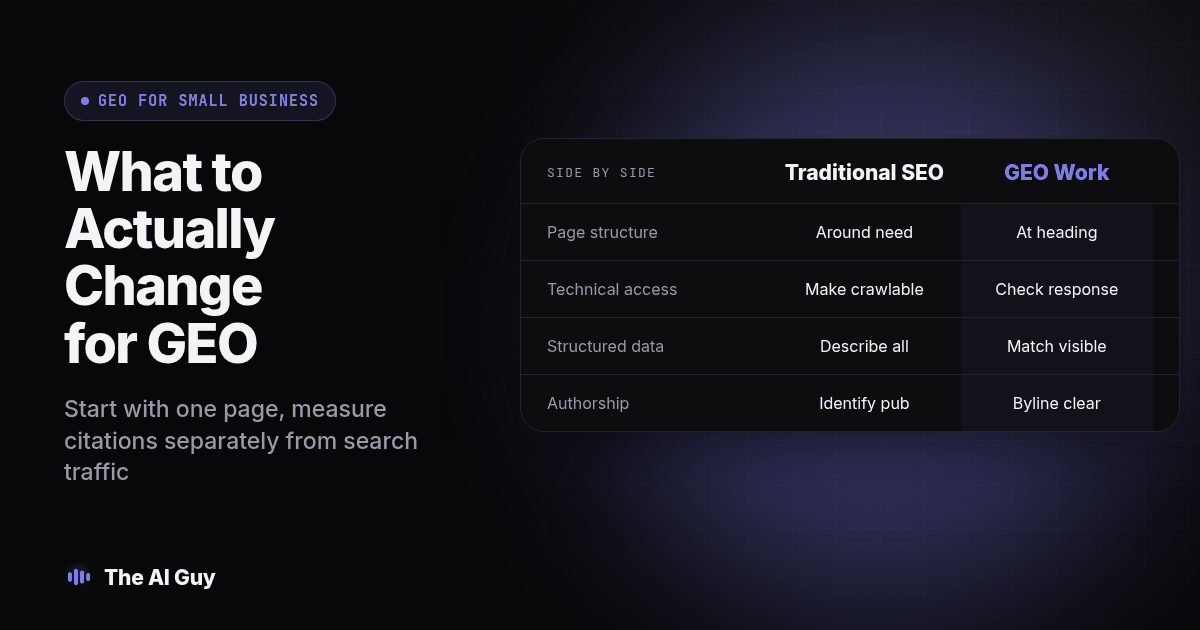
Generative engine optimization (GEO) means making useful website pages easier for AI answer systems to find, understand, and cite. It builds on SEO rather than replacing it: keep pages crawlable and useful, answer the reader's question near the top, show who wrote and reviewed the page, and measure citations alongside search visits. You can start with one existing page and your current content system.
What Is Generative Engine Optimization, and Is It New?
GEO is a working label for improving the chance that a generative search or answer system can retrieve a passage from your site and use it with attribution. It is not a separate technical standard or a promise of visibility. The practical work is mostly familiar: publish accurate material, make important pages accessible, organize each page around a clear subject, and explain claims with evidence.
The new part is the result people are watching. Traditional search results show a list of pages. AI features may answer a question directly and provide links to sources. A business may therefore care about both a visitor clicking through from a search result and an AI citation inside a generated response. Record those outcomes separately.
Does GEO Replace Classic SEO?
No. Google says its AI features use the same foundational search requirements as its other search experiences. Its guidance also says site owners do not need a special machine-readable file or new structured data to appear in those features. A page still needs to be available to Google, eligible for indexing, and useful to people. Read Google's guidance for AI features in Search before changing technical settings.
That does not mean every page with a strong ranking will be cited. A search result and an AI citation are different observations. We explain how to investigate clicks and impressions in our guide to checking a Google AI Overviews traffic decline. Keep measuring regular search performance while you test whether answer systems cite a page.
How Is GEO Different From Getting Your Business Named in ChatGPT?
Being named as a business and being cited as a source are related but separate goals. A recommendation may mention a company because of information across the web. A citation links to a specific source used in an answer. This article focuses on the page and its evidence. Our guide to getting your business named in ChatGPT answers covers business information and visibility beyond one page.
For a citation, make the page useful even if a reader lands directly on one section. Define the subject, name the audience, give the answer, and show where important facts came from. Avoid filler introductions that delay the answer or paragraphs that rely on context elsewhere on the page. Clear writing helps readers first; it also makes a passage easier to interpret when it is read on its own.
What Should You Change First on an Existing Page?
Start with the page that already answers a real customer question and has some search visibility or business value. Do not begin by rewriting every URL. Write a short opening that answers the page's main question, then give the context, qualifications, and steps that support the answer.
For example, a page about appointment reminders can say in its opening what the reminder process does, who receives it, and what action the customer can take. The rest of the page can explain timing, consent, exceptions, and how to reach a person. This is more useful than beginning with several paragraphs about how communication has changed.
Use headings to make the page easy to scan. Each section should make sense to someone who arrives from a search result and reads only that section. State the subject instead of using vague transitions such as "as noted above." Include examples only when clearly described as examples, and do not turn an illustrative case into a customer result.
How Should an FAQ and Its Schema Work Together?
Write FAQ answers for people, then make sure any FAQPage data describes the same visible questions and answers. Schema is structured data, not a hidden place to add claims. If a visitor cannot see an answer on the page, do not put that answer in the FAQ schema. Keep the question and answer text plain and identical in both places, including punctuation.
Google's current AI feature guidance does not require new structured data for inclusion. FAQ schema can describe visible page content where it is appropriate, but it is not a shortcut to a citation or a special display. Check Google's documentation before treating a markup change as a search requirement. A useful FAQ can still help a reader decide what to do next even when no special result appears.
Why Show an Author and a Date?
A named author tells a reader who is responsible for the article. A visible publication or update date helps them judge when the advice was written. These details support trust when accurate; they do not prove every claim or guarantee selection by an answer system.
Use a real author and link to a bio that explains relevant experience. Show publication and update dates according to the site's conventions. Only change an update date when someone reviewed the page and made or confirmed a meaningful update. A date that changes automatically without review can mislead readers about freshness.
Can AI Crawlers Reach the Page?
Check crawling by the specific service you want to evaluate. Services may use separate crawlers for search, user initiated retrieval, and model development, and their names and policies can differ. For example, OpenAI documents GPTBot and OAI-SearchBot separately, while Perplexity describes PerplexityBot and Perplexity-User. Anthropic documents its crawler user agents, and Google explains Google-Extended.
Review robots.txt and any CDN or hosting firewall rules. Decide which services you want to allow based on their published purposes and your own content policies. A robots.txt entry is a request about crawling, not a security boundary. Keep customer records, internal dashboards, and private files protected with authentication and access controls whether or not you allow a public page to be crawled.
If a page depends on client-side rendering, check what a crawler receives and whether the main text is available in the rendered page. Confirm the URL returns successfully, is not marked noindex by mistake, and is included in the sitemap when appropriate. These checks can identify a technical issue, but they cannot force an answer system to use the page.
How Can a Business Earn Independent Evidence?
Write material that demonstrates what the business knows, and seek genuine coverage or references from relevant independent sources. A trade publication interview, expert quote, or useful guest contribution may give readers another source to assess. A third-party mention is not an automatic citation trigger, and no single outreach activity guarantees a result.
Choose opportunities because the audience is relevant and the contribution is accurate. Keep a record of the source, date, and claims it supports. Avoid mass producing thin directory pages or repeating the same claim across unrelated sites. Independent evidence should help a reader verify the subject, not merely repeat a marketing statement.
For technical implementation questions involving crawling, rendering, or site architecture, MetaTechAi's AI infrastructure team is a relevant place to learn about implementation support.
Classic SEO and GEO: What Changes on the Page?
| Area | Established SEO work | GEO related page improvement |
|---|---|---|
| Main answer | Use a clear title and cover the subject | State a direct answer near the beginning |
| Access | Keep useful pages crawlable and indexable | Review the relevant answer service's crawler controls |
| Page structure | Use headings and internal links | Make sections understandable when read on their own |
| Structured data | Use accurate markup where it fits the content | Keep schema aligned with visible page text |
| Authorship | Identify the responsible publisher | Show a named author and a maintained date |
| Evidence | Support claims and earn relevant links | Track independent sources that may support a citation |
The right column adds emphasis to the way readers may encounter a page. It does not remove the need for useful content, accessible pages, and accurate technical basics.
What Is a Practical Site Audit Procedure?
Use this numbered review on one high value page, record what you find, and assign an owner to each follow up.
- Write down the page's purpose and the specific customer question it answers.
- Check the page's response, canonical URL, index status, and sitemap entry.
- Review robots.txt and relevant firewall rules for the crawler services you intend to evaluate.
- Rewrite the opening so it gives a direct answer and identifies important limits.
- Check that each heading describes the section and that each section can stand alone.
- Add only FAQs that answer real follow up questions, then compare visible text with any FAQ schema.
- Confirm the byline, author bio, publication date, and review date are accurate.
- Check claims against primary sources and label examples as examples.
- Record the page's baseline search impressions, clicks, and qualified inquiries before making the change.
- Publish the focused revision, record the date, and schedule the same checks again.
Keep the page URL unless there is a separate reason to change it. If you do change a URL, plan a redirect and update internal links. The audit should leave a record of what changed and why, so a later review can distinguish a technical fix from an editorial revision.
How Do You Test Whether the Changes Helped?
Treat answer visibility as an observation, not a controlled ranking position. Before editing, select a small set of real customer questions. Save the exact wording and date. Use the same questions and services at later checks, and note whether the business is cited with a link, named without a link, or absent. Save the cited page when one appears.
Also check analytics and search reporting. A citation may occur without a measurable visit, while a search click may happen without a visible AI mention. Track each separately, along with qualified inquiries and the page version in use. Do not infer causation from one result or one query. Answer systems can vary their responses, and you do not control retrieval or selection.
Choose a review interval that fits your publishing and reporting routine. A few weeks can be a useful first follow up, but it is not a promised time to receive a citation. If no citation appears, verify access and test a clearer answer before expanding the changes to other pages.
What Do Small Business Owners Ask About GEO?
Does generative engine optimization cost extra money, or can our team do this with what we already have?
Most of the checklist is work your own team can do inside your existing CMS: rewrite an opening paragraph, add a visible FAQ, name an author, and check a robots.txt file. A specialist can help when a page will not index, a theme blocks crawlers, or schema needs custom development.
How long before ChatGPT, Gemini, or Google AI Mode actually cites us?
There is no fixed timeline for a citation. Crawling and indexing can take time, and retrieval and selection are outside your control. Choose a follow up date, record what you find, and keep checking without treating that date as a promise.
Do we need new software, or does this work inside our current CMS?
You can do this checklist inside your current CMS. Google's guidance says its AI features need no special machine readable file or new structured data, so begin by improving existing pages and checking current site settings.
Will opening our site to AI crawlers create a compliance or security problem?
Robots.txt affects discovery of public pages; it does not replace access controls for private data. Keep customer records, logins, and internal tools behind authentication, and review each crawler by name instead of allowing or blocking them all at once.
What is the switching cost if every page on our site is already built around one keyword?
You rarely need to change a URL just to answer its question more directly. Start by editing the opening and adding a matching FAQ to one existing page, then consider a larger restructure only if the page still cannot carry a clear answer.
Where Should You Start This Week?
Choose one page that matters to a customer and run the audit before writing anything new. Improve its answer, confirm its access and evidence, and save a baseline you can compare later. That gives you a focused starting point without assuming a particular format or markup will earn a citation.
If you need help deciding whether a crawl, rendering, or schema issue requires development, contact James with the page you reviewed. He can help identify whether the next step belongs in the content or the implementation.