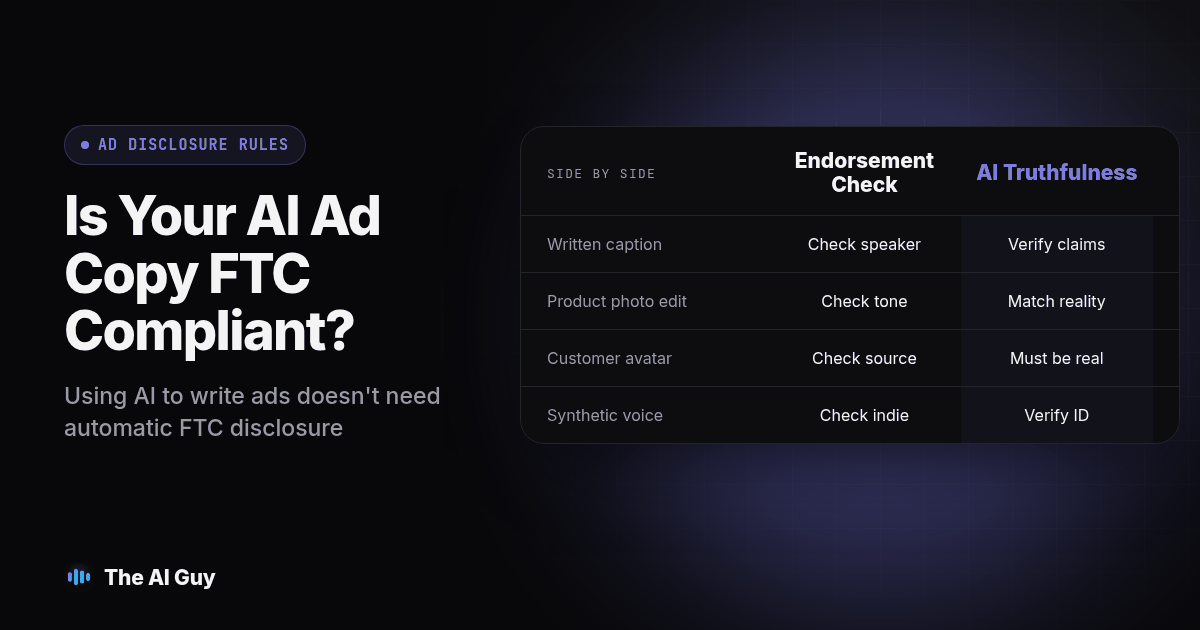
TL;DR: Saying your ad is sponsored and saying your ad was AI-generated are two separate disclosures, and one does not cover the other. If AI wrote your ad copy, generated or materially altered your product image, translated your ad, or produced any part of your video, you need an AI-generated label next to the sponsorship label, not instead of it. Grammar checking, scheduling, and analytics tools do not trigger this.
We get this question from clients almost every week now: they already slap "#ad" or "Sponsored" on a post and figure the disclosure box is checked. It is not, at least not fully. The sponsorship label and the AI-generated label answer two different consumer questions, and the Federal Trade Commission treats them as two separate things a business can get wrong. Below is what actually triggers each one, what genuinely does not, and the exact checklist we run through before anything with AI in its production path goes live.
What Is the Difference Between a Sponsorship Disclosure and an AI Disclosure?
A sponsorship disclosure answers "who paid for this, or who is getting paid to say this." It comes from the FTC's Endorsement Guides, codified at 16 CFR Part 255, which require a business and anyone endorsing it to disclose a "material connection" whenever that connection is not something the audience would already expect. That is the legal basis for "#ad," "Sponsored," or "Paid partnership with."
An AI disclosure answers a completely different question: "was this specific piece of content made by a machine instead of a person." Compliance guides tracking FTC enforcement through 2026 describe the current practice as a "two-label disclosure" standard, meaning a sponsored post built with AI-written captions, an AI-rendered image, or AI-generated narration now needs both labels running side by side, not one combined label covering both jobs at once. We pulled this framing from two independent compliance write-ups published this year, AuditSocials and The Stacc, and both make the same point in almost the same words: a post marked "#ad" does not satisfy an AI disclosure requirement, and a post marked "AI-generated" does not satisfy a material-connection disclosure.
Here is the part that trips up small business owners: these are not competing rules you pick between. They stack. A sponsored post with an AI-written script and no AI label is not one violation, it is treated as two, because two separate consumer expectations got left unmet at the same time.
Where Does This Actually Come From Legally?
There is no single new regulation titled "AI Disclosure Rule." The obligation comes from the FTC combining three things it already had: the Endorsement Guides' material-connection requirement described above, its broad authority under FTC Act Section 5 to police unfair or deceptive practices generally, and a very active 2024 regulation aimed at a narrower but related problem, the Trade Regulation Rule on the Use of Consumer Reviews and Testimonials, codified at 16 CFR Part 465. That rule took effect on October 21, 2024, and it bans creating, buying, or distributing reviews and testimonials that misrepresent whether the reviewer is real or actually used the product, which squarely covers AI-generated fake reviews and fabricated AI testimonials dressed up as real customers.
The Commission is not treating this as theoretical. On December 22, 2025, the FTC sent warning letters to a group of businesses flagged for possible violations of the Consumer Review Rule, a step DLA Piper's legal alert called the agency's first public enforcement move under that rule. Around the same time, the agency also walked back a prior consent order involving an AI writing tool, which signals the enforcement picture around AI-produced marketing content is still actively moving, not settled. We are not aware of the FTC publishing a single consolidated "AI ad disclosure" rule number you can cite the way you would cite Part 255 or Part 465, so if you want the current primary-source wording before you publish something high stakes, check the Endorsement Guides and the Consumer Review Rule pages on ftc.gov directly rather than relying on a secondary summary, including ours.
Which of Our Ad Production Tasks Actually Trigger This?
We built the table below from the compliance guidance above and from how we actually produce ads for clients. Use it as a first pass, then apply the "does this change what a customer would assume about the content" test from the next section to anything borderline.
| Ad production task | Sponsorship disclosure needed? | AI disclosure needed? |
|---|---|---|
| AI writes the ad headline or body copy from a prompt | Only if there is a material connection (paid placement, affiliate, influencer deal) | Yes |
| AI generates or materially alters a product image or scene | Depends on the placement | Yes |
| AI generates a voiceover or synthetic avatar for a video ad | Depends on the placement | Yes |
| AI translates an ad a person wrote, and a synthetic voice reads it | Depends on the placement | Yes |
| Human writes the copy, AI only fixes grammar and spelling | Depends on the placement | No |
| AI schedules the post or reports on its performance | Depends on the placement | No |
| Influencer posts about a free product with no AI involved | Yes | No |
Notice the pattern. The AI-disclosure column only cares whether a machine substantially produced or altered the words, pixels, or audio a customer actually consumes. It does not care whether anyone got paid. The sponsorship column only cares about money or a relationship changing hands. They are genuinely independent questions, which is exactly why one label cannot cover both.
What Does Not Trigger an AI Disclosure?
This is the part small business owners actually want to know, because most AI use in a normal marketing workflow is not the kind that needs a label. Based on the same compliance guidance, these uses are treated as cosmetic and do not require an AI disclosure on their own:
- Grammar and spell-checking a human-written draft
- Scheduling posts across platforms with an AI-powered calendar tool
- Using AI analytics to decide which ad to spend more on
- Autocomplete or predictive text while typing a caption
- Basic photo retouching that does not change the product, like exposure or color correction on an otherwise unedited photo
The practical line both compliance guides draw is whether the AI use is purely mechanical and does not change how a consumer would interpret the content. A tool that helps you type faster is different from a tool that writes what you say or shows something that was not actually photographed.
How Should We Actually Write the Disclosure?
Keep both labels short, visible, and separate from each other, placed where a reader sees them before they engage with the content, not buried in a bio or a comment. We use this template on client ad accounts:
Sponsorship label (place first, near the top of the post or at the start of a video): "Paid partnership with [Brand]" or simply "Ad."
AI disclosure label (place next to it, not instead of it): "This ad's [copy / image / voiceover / translation] was created with AI."
For a single Instagram or Facebook ad that has both an AI-written caption and a paid placement, that looks like two short lines stacked together at the top of the post, something like:
"Ad. This post's caption was written with AI."
Screenshot: a mockup of an Instagram feed ad showing the two disclosure lines stacked directly under the account name, above the caption, each in a distinct small font so they read as two separate statements rather than one combined tag.
What Is Our Before-You-Post Checklist?
Run through this before any ad with AI anywhere in its production path goes live. We built this from the same production steps we already cover for AI-drafted customer emails and AI-edited product photos, where the review habit is the same even though the legal trigger here is narrower and specific to paid ads.
- List every piece of the ad: headline, body copy, image, video, voiceover, translation.
- Mark which pieces a person wrote or shot from scratch, and which pieces AI wrote, generated, or substantially altered.
- For every AI-touched piece, ask whether the AI use is mechanical (grammar, scheduling, analytics) or substantive (wrote the words, created or changed the visual, generated the voice).
- If any piece is substantive, add the AI disclosure label for that ad, worded to name what AI touched.
- Separately, check whether a material connection exists: a paid placement, an affiliate link, free product, or any other benefit tied to posting.
- If a material connection exists, add the sponsorship label, placed next to but not combined with the AI label.
- Place both labels where a reader sees them before engaging with the content, not in a bio, a pinned comment, or after a "read more" cutoff.
- Keep a dated record of what AI tool touched which part of the ad and what label you used, in case you need to show your reasoning later.
- Re-run this checklist any time you repurpose the same AI-assisted asset into a new placement, since a new placement can change whether a material connection applies.
What Happens If We Skip One of the Two Disclosures?
Each missing disclosure is evaluated as its own lapse, not as one combined mistake. A sponsored post built with an undisclosed AI-written script can be treated as a missed material-connection disclosure and a missed AI disclosure at the same time. Civil penalties under the Consumer Review Rule can reach a figure that runs into five figures per violation, adjusted for inflation each year, and the FTC's own final rule announcement is the primary place to confirm the current maximum before you rely on any number a secondary site quotes, including this one. The bigger practical risk for most small businesses is not a single fine, it is a pattern: running the same undisclosed AI-produced ad across dozens of placements multiplies the exposure across every placement, which is the scenario both AuditSocials and The Stacc specifically warn about.
What FAQ Questions Do Small Business Owners Ask About This Rule?
Does editing a product photo with AI count as AI-generated content for this rule?
It counts if the edit changes what the ad actually shows, not just the background. A plain background swap behind an unedited product photo is generally treated as a cosmetic change, while inserting an AI-rendered product, scene, or person is not.
If we write the ad ourselves and only use AI to translate it, do we still need an AI disclosure?
Yes, because the AI produced the words a non-English-speaking customer actually reads, even though a person wrote and approved the original English version.
Will using a grammar tool like Grammarly on our ad copy trigger an AI disclosure?
No. Light grammar and spelling correction that does not change the substance of the message is treated as a cosmetic edit, not AI-generated content, and does not require a disclosure.
Who enforces this, and does a business get a warning before a penalty?
The Federal Trade Commission enforces it, and its recent practice has been to send warning letters to groups of businesses before pursuing civil penalties, though a business should not assume it will always get one first.
How Does This Connect to Everything Else We Tell Clients About AI and Ads?
We keep coming back to the same underlying habit across every AI workflow we build for small businesses: separate what AI produced from what a person approved, and keep that separation visible to the people who matter, whether that is a customer reading an ad, a reviewer checking a reply, or a regulator checking your process. We already walk clients through this for AI-written review replies, where the same person-in-the-loop habit protects against a different risk, a hallucinated fact in a public reply instead of a missing label. The ad disclosure rule is just the version of that habit that comes with a specific label and a specific regulator watching for it.
If you run voice ads or use an AI voice agent as part of your sales process, the disclosure question works differently again, since a spoken AI interaction has its own expectations separate from a written or visual ad; our sister site RizzDial covers what an AI voice agent needs to disclose on a sales call if that applies to your business too.
None of this requires a lawyer on retainer for a typical small business ad campaign, but it does require someone on your team who actually looks at every ad before it runs and can answer two specific questions: who got paid, and what did AI actually touch. If you want a second set of eyes on your current ad review process before your next campaign, reach out to us and we will walk through it with you.