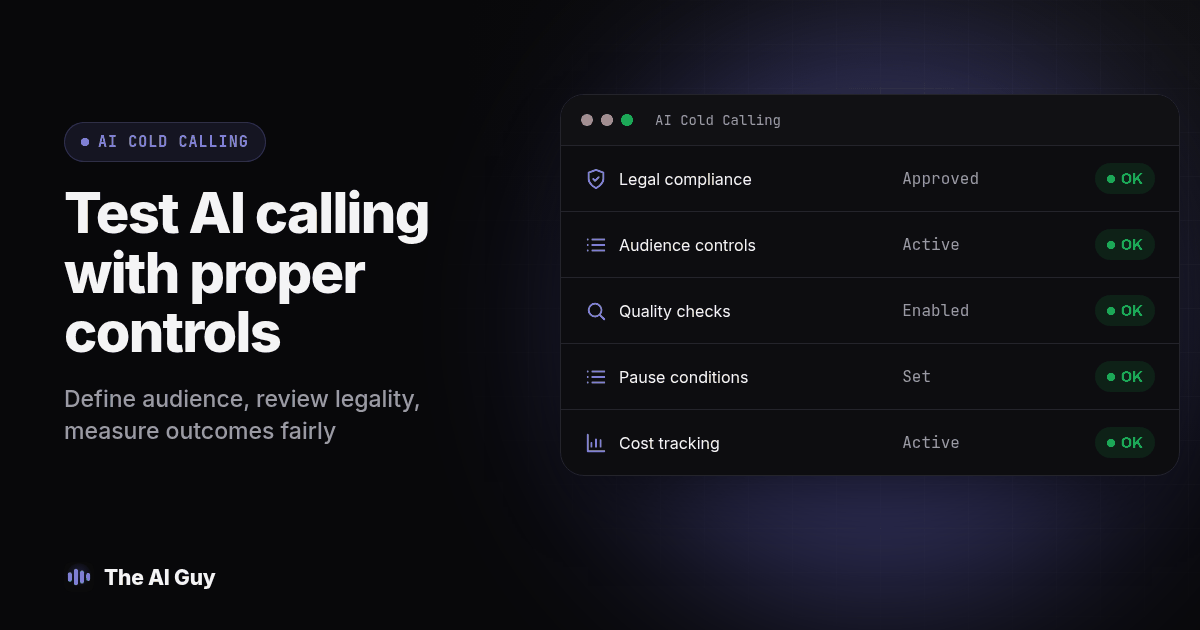
Do not assume AI cold calling will work for your business; treat the outcome as something a properly scoped, lawful test must establish. Judge the test by accepted sales outcomes and full operating costs, with permission to contact the audience settled before any calls begin.
My recommendation is to replace the broad question with a specific one: can this approved calling workflow produce useful conversations for this audience at an acceptable cost? The method below is an experimental plan, not a published conversion benchmark or a claim that a purchased list is suitable for automated outreach.
What do you mean by cold calling?
Define the audience before debating the technology. A stranger whose number appeared on a list, someone who requested a callback, a past customer and an existing business contact are different situations. Do not put them into one campaign and describe the combined results as evidence about cold calling.
Also distinguish an AI voice conducting the conversation from software helping a human representative dial or prepare. Write down which parts of the work the system performs: selecting a contact, placing a call, speaking, qualifying, scheduling or updating a record. The legal review and the test should address the actual design, not the marketing label attached to the tool.
Keep audience eligibility separate from commercial interest. A contact might appear relevant to your offer while still being unsuitable for the proposed calling method. Ask the responsible adviser to define what evidence you need before the record enters the campaign. Store that evidence where the campaign operator can inspect it.
If you are still choosing the task, review the guide to identifying an initial AI assignment. An owner may decide that inbound inquiry handling or internal call preparation is a clearer first project. That is a legitimate evaluation outcome, not a failed attempt to make every sales problem fit outbound automation.
What must be settled before an outbound test?
The FCC's AI voice ruling treats AI generated voices under the artificial or prerecorded voice restrictions of the TCPA. Have qualified counsel assess the audience, purpose, consent and applicable state rules. Do not infer permission from the availability of the software or the fact that a telephone number is publicly accessible.
The FTC telemarketing guide explains do not call obligations, calling restrictions and other requirements. Identify the provisions applicable to your campaign, including any relevant exemptions, instead of assuming every business contact or past customer follows the same rule. Keep the review tied to the campaign you actually intend to run.
Translate the applicable rules into inspectable controls. My suggested campaign record includes contact source, permission evidence, stop status, approved purpose and the version of the calling configuration. Recheck eligibility at the point where an action would run, including pending retries. A review performed before an import should not excuse ignoring a later stop request.
Use staff owned numbers for functional rehearsal. Test blocked records, withdrawn permission and unavailable eligibility data. Require the workflow to stop when a required check cannot be completed. If you cannot establish an eligible audience for the planned method, do not run that outbound test; choose another assignment whose permissions and purpose can be established.
What result should count as working?
Choose a result that your sales team actually values and can verify. A dial attempt is an activity. A connection is an intermediate event. A meeting on a calendar may still be unsuitable, duplicated or unwanted. Define the acceptance conditions for the business outcome before the pilot begins.
For a meeting based offer, ask the receiving representative to accept or reject the handoff using written criteria. Possible criteria include the requested service, the person's stated interest, the correct meeting type and an accurate contact record. Record a reason for rejection. Do not let the system that generated the meeting be the only judge of its quality.
Track the path to that outcome. Keep the original audience size, eligible records, attempted contacts, conversations, proposed meetings and accepted handoffs distinct. Define how retries and repeat conversations are counted. Your dashboard should make it possible to trace a result back to a contact without multiplying one person's activity into several supposed opportunities.
Write the negative outcomes into the same scorecard. Include incorrect promises, unwanted continued contact, unusable records, failed transfers and staff complaints about the handoff. Set pause conditions before you see the totals. A campaign can produce some useful meetings while still failing the operating conditions the owner agreed to protect.
How do you keep the comparison fair?
Use a comparison that answers the decision you face. If the decision is whether to replace a particular follow up workflow, compare against that workflow using similar eligible contacts and the same offer. Comparing an AI campaign on fresh inquiries with an older human campaign on stale records will not isolate the effect of the calling method.
Where appropriate, ask an analyst to design assignment between groups before the test. Keep the offer, acceptance criteria, follow up policy and measurement window consistent. Document differences that cannot be controlled. Do not claim a causal result when contact selection, staffing or timing could reasonably explain the difference.
Use a scorecard like the one below. These are proposed definitions, not reported performance values. Adjust the definitions to your business and have the staff responsible for downstream work agree to them before launch.
| Question | Record to inspect | Decision use |
|---|---|---|
| Was contact permitted? | Campaign eligibility evidence | Exclude records that fail the approved checks |
| Was there a useful conversation? | Reviewed conversation and disposition | Separate an answered call from relevant interest |
| Was the next step accepted? | Receiving employee's decision | Count the outcome only under the agreed criteria |
| What work remained? | Review and correction log | Include effort that automation shifted to staff |
| What did the outcome cost? | Usage, tools and labor record | Judge economics using accepted results |
| Did a pause condition occur? | Incident and exception log | Stop and investigate under the written policy |
Keep failed records in the analysis. Label exclusions with reasons agreed before the test where possible, and report any later changes. Do not quietly remove difficult conversations because they make the output less impressive. A buying decision needs the operating reality, including exceptions.
What should you inspect in the conversations?
Listen for accurate representation of the business and its offer. Reject unsupported promises, invented urgency and claims about customer results that your approved materials do not substantiate. Check whether the assistant accurately distinguishes a tentative interest from a commitment. A positive tone is not evidence that the person agreed to the next step.
Review corrections carefully. Ask staff testers to change a name, email address or preferred time after the assistant has already repeated it. Inspect the final CRM fields and any pending actions. The workflow should use the corrected information, and unresolved ambiguity should remain visible to the receiving employee.
Test refusal and human takeover. A person who asks to stop should not be treated as an objection to overcome. A person who asks for a representative should reach the approved handoff or receive an accurate fallback. Verify the queue behavior after the conversation, since appropriate wording does not prove that follow up has stopped.
The sales voice-agent evaluation guide provides a deeper procedure for record writes, bookings and transfers. Use those functional checks before measuring business outcomes. Otherwise, your experiment may mostly measure a broken integration rather than the suitability of the calling workflow.
How should you calculate the economics?
Use accepted outcomes as the denominator for your main cost measure. Include the subscription, calling usage, numbers, connected services, staff review and correction time. Record implementation and training separately so the owner can see both the launch investment and recurring operations. Use actual invoices and staff time records instead of a vendor's illustrative savings example.
Define the time period consistently. A meeting created during the test but scheduled after the review date should not be treated as attended. Keep pending outcomes separate and revisit them under the same acceptance rules. If the sales cycle is longer than the pilot, report the early result as provisional rather than converting it into predicted revenue.
Inspect whether staff effort moved to another stage. Perhaps the calling task became shorter while representatives spent more time correcting records or explaining an inaccurate promise. Measure that downstream work. The AI time savings method helps include review and rework in the evaluation rather than counting only the automated step.
Do not publish a performance percentage without a defined denominator, time window and evidence. For your own decision, preserve the underlying records and document assumptions. A result from one offer and one audience should not become a universal claim about AI calling or a forecast for a different business.
What numbered test procedure should an owner approve?
Use this proposed sequence to make the decision reviewable. Assign an owner to the legal eligibility review, the technical rehearsal and the business outcome review. One person can coordinate the project, but the written record should show who approved each distinct responsibility.
- Define the offer, audience and exact calling method. Obtain the applicable review and document the eligibility evidence required for each contact. Stop here if the intended campaign cannot meet those conditions.
- Write acceptance criteria for the useful outcome, rejected outcome and pause conditions. Have the receiving sales staff approve the definitions before they see any pilot results.
- Rehearse with staff controlled numbers and fictional records. Test corrections, an unavailable representative, a failed calendar action and a stop request while another action is pending.
- Establish the comparison design and measurement window. Keep audience selection and campaign settings recorded so a later reviewer can identify differences that might explain the result.
- Run only the approved limited scope with an available owner. Review exceptions as they occur and pause under the predetermined conditions. Do not expand the audience because early activity looks promising.
- Reconcile each claimed outcome with the receiving employee's decision and source record. Include rejects, unresolved outcomes, duplicate records and correction effort in the review.
- Calculate full operating costs and describe the limits of the evidence. Decide whether to repair, repeat, narrow, expand or stop the project. Record the reason instead of forcing every pilot into a success story.
If calling software is part of that design, RizzDial's voice-agent overview is one option to evaluate for qualification and booking functions. Apply the same procedure regardless of vendor. A feature page describes what to investigate; it cannot establish that your audience is eligible or that your business will obtain an acceptable result.
What should the owner do with an inconclusive result?
An inconclusive test can still reveal useful operational facts. Identify whether the uncertainty came from too little evidence, inconsistent contact selection, unresolved sales outcomes or a technical failure. Repair the specific cause before repeating the test. Do not simply raise volume while keeping the original ambiguity.
If the assistant handled the conversation but staff rejected the handoffs, inspect the qualification definition and the offer. If accurate meetings were created but costs were unacceptable, inspect review effort and recurring charges. If records were unreliable, fix the integration before drawing a conclusion about commercial demand.
Write a short decision memo with the approved scope, observed outcomes, full costs, exceptions and remaining uncertainty. Keep recommendations proportional to what the test actually established. A narrow result can support a narrow next step without becoming a claim that every sales team should automate outbound calling.
For help designing that decision, contact James about an AI calling evaluation. Bring the current workflow, the evidence available for your intended audience and a definition of an accepted sales handoff. The useful starting point is a testable business question with clear operating boundaries.
What questions belong in an AI cold calling FAQ?
Can a demo prove that AI calling will work for my offer?
I would treat a demo as a functional rehearsal. Your buying decision needs an eligible audience, accepted outcomes, complete costs and enough evidence to understand the limits of the result.
Should every meeting created by the assistant count as success?
Count meetings according to criteria agreed with the receiving sales team. Keep duplicates, unsuitable bookings, rejected handoffs and unresolved outcomes visible instead of treating calendar activity as the final business result.
What if I cannot establish permission for the proposed audience?
Do not run that outbound test. Work with the appropriate adviser to resolve the campaign design or select a different assignment whose purpose and permissions can be established.
When is it reasonable to expand a pilot?
Expand when the approved outcome criteria and operating conditions are met, with costs and uncertainty documented. Treat a new audience or broader calling assignment as another scoped decision requiring its own review.