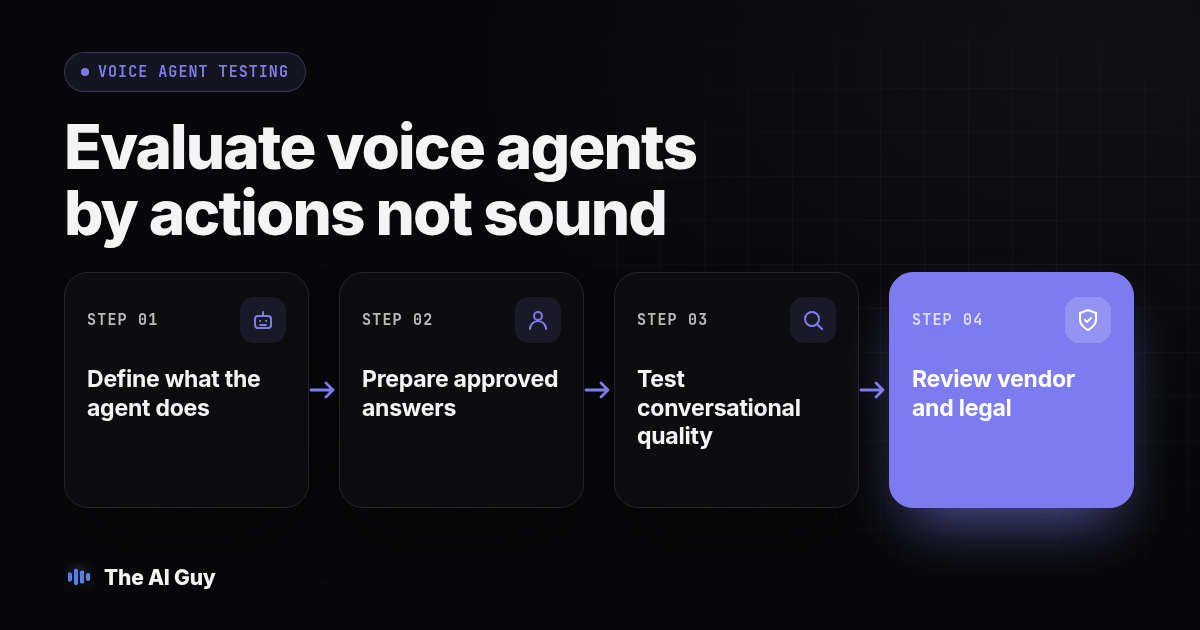
Evaluate a sales voice agent by the business actions it completes correctly, not just by how natural its voice sounds. Choose one sales task, define the permitted decisions and require evidence that the resulting record, appointment or human handoff is accurate.
My recommendation is to buy against a written acceptance test. A fluent demonstration is useful, but the owner needs to know what happens when information changes, a connection fails or a prospect asks for a person. This guide provides a proposed evaluation procedure rather than a claim about sales results.
What job should the voice agent actually perform?
Write one sentence describing the assignment. For example, ask it to collect the approved information from an eligible inbound inquiry and offer a meeting with the appropriate employee. Define completion as an accepted record and a verified next step. Avoid starting with an instruction as broad as selling your service.
Separate the conversation from the actions behind it. The agent may ask a question, read an approved answer, look up availability, submit a booking request and create a task. Decide which of those actions it may perform automatically and which need approval. A system that can discuss an action should not necessarily have permission to execute it.
Specify excluded topics, including negotiated pricing, legal interpretations, commitments outside your standard offer and requests involving sensitive information. Give each exclusion a route to a person. Do not rely on an instruction to be careful; make the permitted actions narrow enough that the assistant cannot issue an unapproved discount or change an unrelated record.
For an initial scope, use the guide to selecting business tasks for AI. If a fixed form and routing rule would complete the assignment, evaluate that simpler design too. The purpose of the project is to improve the work, not to maximize the number of decisions delegated to a conversation model.
What business information should the agent know?
Create an approved answer library with the offer, eligibility criteria, service area, business hours and next steps. Mark each entry with an owner and a revision date. Keep old proposals, internal brainstorming and unapproved marketing claims outside the active source set. The agent should have a defined response when no approved answer exists.
Build a distinction between facts and persuasion. An approved service description is a fact the assistant can read. A prediction about what a particular buyer will earn or achieve is a different claim that needs evidence and authorization. In my recommended design, the agent does not invent outcomes to keep a conversation moving.
Require the assistant to preserve uncertainty in the CRM. If a prospect is unsure about timing, record that uncertainty rather than selecting a convenient date. If they correct a budget figure, update the field and retain the appropriate history. Do not let a summary turn a tentative interest into a firm commitment.
Use the business knowledge preparation guide to organize sources and review answers. The voluntary NIST AI risk framework provides a broader basis for assessing AI risks. The specific source ownership and permission rules here are my proposed operating controls, not a claim of formal certification.
What should happen after each part of the conversation?
Define a small set of states that the team can recognize: inquiry received, information incomplete, ready for staff review, appointment requested, appointment confirmed and human assistance needed. For each state, name the evidence required to enter it and the employee responsible for unresolved work.
A booking should become confirmed only after the scheduling system reports the expected record. Check the person, calendar, date, time zone and meeting type. If the response is ambiguous, use a pending status and explain that staff will confirm. Do not let optimistic wording substitute for a verified event.
Design repeated actions carefully. If the system receives the same request again after a connection interruption, it should determine whether the first action succeeded before creating another record. Ask the vendor to demonstrate this exact sequence. Inspect the calendar and CRM directly, since a transcript alone cannot prove that duplicate records were avoided.
For transfers, distinguish an attempted connection from a person accepting the call. Specify the fallback when the intended employee is busy or unreachable. The prospect should hear an accurate next step, and staff should receive an owned task with the conversation context. Test what happens when that task itself cannot be created.
How should you test conversational quality?
Use people from your team to play defined scenarios. Include interruptions, corrections, vague answers, background noise and a request to repeat a detail. Ask the reviewer to judge whether the agent reaches the correct next step while preserving the person's meaning. Do not grade it solely on accent, warmth or confident delivery.
Test whether the agent can stop talking when interrupted and recover the thread without losing a correction. Give a staff tester a name that is easily misheard, then check the saved spelling. Ask a tester to change the meeting day near the end of the call. Verify both the spoken confirmation and the final record.
Include a prospect who is interested but outside your eligibility criteria. The expected result should follow the approved route without inventing a reason to book. Include someone who declines, asks for a person or wants to stop contact. Write the acceptable response and system action for each case before running the demonstration.
Score factual accuracy, respectful handling, record accuracy and action completion separately. A clear voice cannot compensate for a wrong appointment. An accurate record does not excuse a misleading promise. Keep the categories visible so the vendor and your staff can identify the actual defect rather than arguing over whether the call sounded good overall.
What must be reviewed before outbound use?
Define the audience and purpose before selecting an outbound calling mode. Keep records of the contact source, applicable permission, previous stop requests and the campaign under which the call would occur. Have qualified counsel assess the design, including state requirements and any recording obligations relevant to your circumstances.
The FCC AI voice ruling applies the artificial or prerecorded voice framework to AI generated voices. Treat that as a reason to establish the legal basis for the actual call before automation, not as a generic declaration that every AI call is either allowed or forbidden.
The FTC telemarketing guide explains obligations including do not call controls and calling restrictions. Your review should identify which rules apply and translate them into campaign checks. A vendor feature named compliance is not evidence that your contacts, permissions and queue settings satisfy those requirements.
Keep the approval record beside the campaign configuration. Test with staff owned numbers that an ineligible contact cannot enter the queue, a withdrawn permission stops pending actions and a failed check leaves the contact uncalled. Recheck the controls after imports, list changes and integrations that can create new calling tasks.
What should the vendor demonstrate before you buy?
Give each vendor the same short assignment and source library. Ask for the same normal and difficult scenarios so you can inspect comparable outputs. Request a list of capabilities that require extra configuration, additional services or a different plan. Separate documented availability from features promised for a future release.
For one option, RizzDial's voice agent page describes automatic qualification, appointment booking and CRM updates. Use those stated capabilities as demonstration targets. Ask to see the action in your intended configuration, the resulting record and the failure path. Public feature descriptions should inform the test, not replace it.
Request a clear data flow. Identify where audio, transcripts, contact fields and credentials are stored and which services receive them. Ask who can access recordings, how permissions are managed, how exports work and what happens when you terminate the service. Have the relevant privacy and security reviewers inspect the answers before using live customer data.
Ask who owns maintenance after launch. A voice prompt, CRM field map, calendar permission and escalation roster each need an accountable owner. Include support responsibilities and a procedure for returning to manual handling in the implementation agreement. A successful demo should be followed by a system your team can operate without depending on undocumented fixes.
What does an owner run through in an acceptance test?
Use this proposed procedure after the vendor has configured the narrow assignment. Keep test records separate from real prospects, use staff controlled numbers and write an answer sheet for each scenario. Do not launch outbound prospect calls as a substitute for controlled testing.
- Run an ordinary eligible inquiry and inspect the saved contact, qualification fields and next step. Compare each field with the conversation and the approved source library rather than relying on the generated summary.
- Repeat the conversation with a correction to the person's name, timing and preferred appointment. Check that the final action uses the corrected information and that staff can see any unresolved ambiguity.
- Ask for an unapproved discount and an unsupported outcome promise. Verify that the assistant follows the approved boundary and offers the designated human route without inventing a commitment.
- Make the calendar unavailable at the moment of booking. Confirm that the system uses a pending state, tells the prospect accurately and creates an owned exception for staff to resolve.
- Restore the calendar after an uncertain response and replay the action. Inspect whether the original booking exists before another is created. Reject a configuration that silently leaves duplicate appointments.
- Request a human, then leave the designated employee unavailable. Check the attempted transfer, the fallback message and the task that staff actually receive. Require an explicit distinction between attempted and accepted handoffs.
- Submit a stop request while a follow up action is pending. Verify suppression in every relevant queue, then test whether another connected workflow can improperly recreate the action.
- Have an employee outside the build team pause the agent and reconcile its open work. Use the result to approve the operating instructions or identify missing handover material before the pilot begins.
Keep a record of the configuration used for these tests. When the prompt or an integration changes, repeat the affected scenario and the ordinary inquiry. Treat expanded permissions as a new approval decision rather than a minor wording update.
How do you decide whether the pilot earned expansion?
Choose the evaluation period and acceptance conditions before reviewing results. Measure completed, correct tasks and the staff effort required to achieve them. Include review, corrections, failed transfers, integration support and source maintenance. Count an appointment only when it satisfies your documented confirmation definition.
Track costs at the level of accepted work. Include the subscription, usage, numbers, connected services and human supervision. Keep implementation effort separate from recurring operating effort so you can see both the launch investment and the ongoing burden. Avoid comparing a narrow AI pilot with an unrelated historical sales period.
Use the time savings evaluation guide to structure the review. If the agent handles the ordinary path but leaves difficult requests scattered across systems, improve the exception process before increasing its assignment. Expansion should mean adding a clearly defined task or audience, with another test and another owner.
For help preparing a vendor brief, contact James about your sales workflow. Bring the current handoff process, an approved answer library and a redacted example of a failed record. That makes it possible to evaluate the implementation work instead of choosing a tool on voice quality alone.
What should owners ask in a sales voice agent FAQ?
What should count as a successful AI sales call?
Define success as a correct, permitted business result supported by the actual record. Depending on the assignment, that may be an accepted inquiry, a confirmed appointment or a completed human handoff.
Should a natural sounding voice determine the purchase?
I recommend scoring voice quality separately from factual accuracy, record quality and action completion. Require the system to pass your workflow tests before using conversational style as a deciding factor.
What is the right response to an uncertain booking result?
Use a pending status, tell the person confirmation is still required and give staff an owned exception. Reconcile the original action before trying again so an uncertain response cannot create duplicate appointments.
What needs to be handed over after implementation?
Require source owners, field mappings, permissions, support contacts, test cases and pause instructions. Ask someone outside the build team to operate the process from that material before approving wider use.