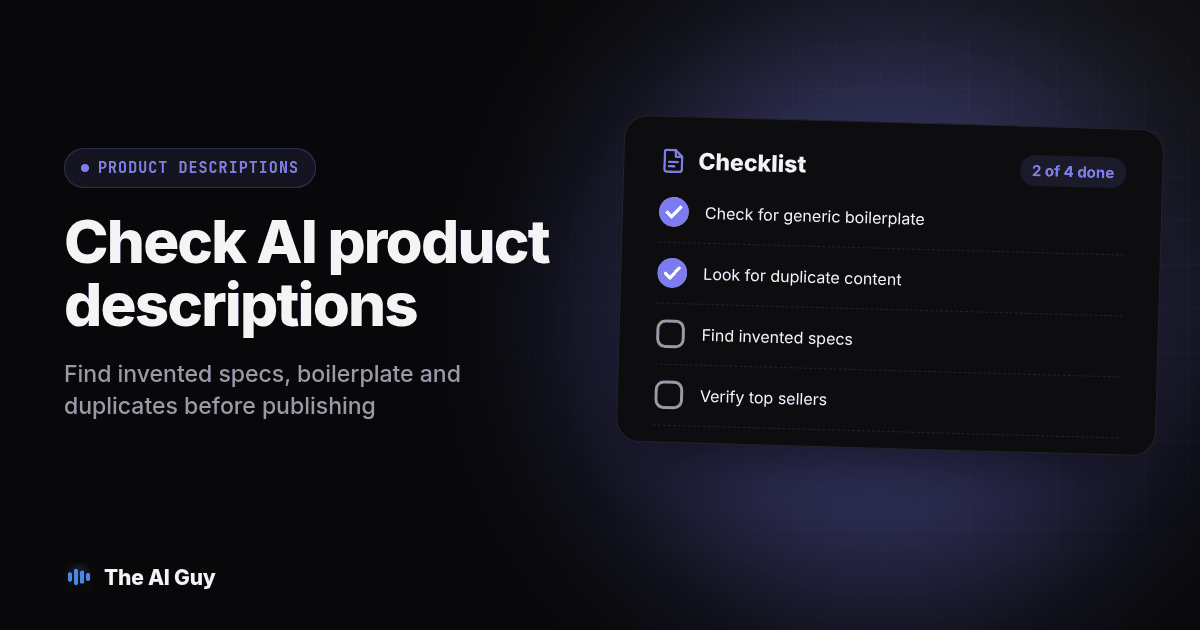
TL;DR: Yes, AI can draft product descriptions, but a person should verify product facts, useful differences between items and customer promises before publication. Use the batch checklist below to find repeated copy and unsupported specifications, then hold unresolved claims out of the published catalog.
A small retailer can start with an AI draft and let someone who knows the product decide what survives review. The critical step is comparing the writing with approved product records, rather than treating fluent sentences as evidence. A large catalog and a close deadline make this check more necessary: the same unsupported claim can spread through an entire category before anyone notices.
Key takeaways
- AI product copy fails in three predictable ways: generic boilerplate, duplicate text across SKUs or stores, and invented specs.
- A randomly sorted sample helps expose recurring issues; every published factual claim still needs verification.
- Full human rewrites are worth the time on your top sellers and anything with a safety, fit or compatibility claim; simpler wording fixes can use a lighter edit after factual review.
Where Does AI Product Copy Actually Go Wrong?
Check for three failure patterns in an AI-generated catalog. These are review categories, not a claim about how often any particular model makes mistakes.
The first is generic boilerplate that could describe almost anything in the category. Ask an AI tool to write a description for a ceramic mug and a stainless steel tumbler using the same prompt template, and you often get two paragraphs built from the same five adjectives: durable, versatile, perfect for everyday use. Swap the product name and the copy barely changes. A shopper comparing several mugs on your site reads nearly the same sentence over and over with a different noun swapped in, and that is before Google ever sees the page.
The second is duplicate content across stores, not just across your own SKUs. Supplier feeds often include stock descriptions. Rephrasing that text does not automatically give shoppers new information. Compare descriptions for distinct products and ask whether the difference is useful: size, included parts, care instructions or a supported use case. A different adjective is not a new product fact. Keep legitimate shared specifications consistent rather than forcing synonyms into technical language.
The third is invented specs, which can create customer problems as well as weak copy. Consider a hypothetical backpack draft that says it holds 22 liters when the source has no capacity measurement. That number is a guess, even if it sounds plausible. The same check applies to waterproof claims and materials. Ask the reviewer to identify a source for each claim rather than deciding whether the description sounds believable.
Is AI-Written Product Copy a Real Duplicate Content Risk for SEO?
There are separate issues to check. Google describes scaled content abuse as producing many pages primarily to manipulate rankings rather than help users. It is not defined simply by AI use or the absence of a human editor. See Google Search Central's scaled content abuse policy. Treat useful, accurate information as the goal of review, rather than assuming that a human signature guarantees search visibility.
Duplicate handling is a different mechanism. Google may choose a representative canonical URL for duplicate or very similar pages; that is not proof of a spam penalty. Its canonicalization documentation explains how preferred URLs are signaled. Repeated boilerplate alone does not let you predict which product page will rank. If clicks fall, investigate the actual pages and queries using the guide to losing traffic while rankings hold.
The operational lesson also applies to customer outreach: approve what the customer will read before increasing volume. For that separate channel, MetaTechAi has a guide to reviewing AI sales emails that go to spam. Email delivery and search ranking use different systems; this link is a related workflow resource, not evidence that they share a duplicate-content penalty.
How Do We Spot-Check a Batch of AI Product Descriptions Before We Publish?
Use this proposed eight-step procedure on a trial batch before rolling it into your catalog process. Sampling helps locate recurring issues; it does not certify the accuracy of unreviewed items. Review every factual claim before its description is approved for publication.
- Export the batch into one spreadsheet with four columns: SKU, the AI draft, the confirmed spec sheet or supplier data for that product, and a blank "status" column.
- Pull a randomly sorted sample across the batch. Do not just check the first rows in the file; sort by a random number column so the sample spreads across the whole catalog, including categories you are less familiar with.
- For each sampled row, read the AI draft against the confirmed spec data only, not against your memory of the product. Flag any claim in the draft that is not present in the spec data: a dimension, a material, a certification, a compatibility statement, or a use case.
- Search the full batch for repeated sentence openers and closing lines. If more than a handful of descriptions start with the same three or four words, or end on the same call to action, that is the generic-boilerplate problem, and it affects more than just your sample.
- Run a plagiarism or duplicate-text check across your own batch against itself, then against your supplier's stock description text if you have it. Matches above a short, generic phrase (brand name, standard sizing language) mean the AI barely rewrote the source.
- For any row flagged in steps 3 through 5, mark the status column "rewrite" instead of trying to patch the sentence. A patched sentence built on an unverified spec is still an unverified spec.
- Spot-check your top sellers by revenue individually, even if they did not land in your random sample. Your top sellers carry more of the SEO and return-rate risk if something is wrong, so they do not get to rely on the sample alone.
- Keep the spreadsheet after publishing. The next time you run a batch, it is your evidence of what AI tends to get wrong in your specific catalog, which makes the next review faster.
Keep accuracy and voice as separate checks. A pleasant tone cannot rescue a wrong dimension, and a correct spec list may still leave a shopper confused. The same distinction applies when reviewing AI-drafted customer emails. Add an owner and approval date to each reviewed row so a later import cannot quietly replace the approved version.
What Counts as an Invented Spec Instead of Just Weak Writing?
Weak writing is a description that is vague, repetitive or generic but still technically true. Invented specs are different: they are a specific, checkable factual claim that nobody verified, and they are the category that actually gets a business in trouble with a customer or a return.
Watch for these patterns specifically:
| Invented spec pattern | What it looks like in a draft | Why it matters |
|---|---|---|
| A number that was never provided | "Holds up to 22 liters" when no capacity was given in the source data | Wrong capacity drives returns and bad reviews on the exact point a buyer checked before purchase |
| A material or finish claim | "Genuine leather" or "stainless steel" filled in from the category, not the actual product sheet | An unsupported material claim can misrepresent what the customer receives |
| A compatibility statement | "Works with all standard outlets" or "fits most 2018 to 2024 models" | A customer may buy an incompatible item after relying on the description |
| A certification or safety claim | "BPA free" or "meets ASTM safety standards" added because similar products in the category carry it | A certification claim needs evidence for the exact product being sold |
| A use case the product was never tested for | "Safe for dishwasher use" on an item the manufacturer marks hand-wash only | Directly contradicts manufacturer guidance, which is the first thing a frustrated customer will quote back at you |
If a claim in the draft falls into any of those five rows and your source data does not explicitly support it, treat it as invented until someone with the physical product or the manufacturer's spec sheet confirms it, the same discipline we apply when checking an AI-edited product photo against what the customer actually receives. A photo edit and an invented spec are the same underlying failure: AI filled a gap with something plausible instead of something true.
When Is a Full Human Rewrite Worth the Time?
Not every flagged description needs a full rewrite, and treating all of them the same way wastes the time a small team does not have. Use three triggers to decide.
Rewrite from scratch when the product is among your top sellers, the draft relies on unsupported safety or compatibility claims, or complaints suggest that buyers misunderstand the description. A rewrite still needs verified facts. If the manufacturer cannot confirm a claim, remove it or hold the item rather than asking a writer to make the uncertainty sound convincing.
For everything else, a lighter edit pass does the job: fix the flagged line, vary a repeated opener or closer, and move on. A low-traffic accessory with generic but accurate copy does not need the attention a top seller does, and insisting on full rewrites everywhere turns a short launch into a long one.
For a hypothetical mug review, put the draft, supplier sheet and approved description side by side. Suppose the draft says dishwasher safe but the sheet says hand-wash only. Replace the unsupported care instruction with the documented one and record the reason. Then search every draft made with that prompt for the same care claim. This is an example of a review, not a reported client result.
What Does a Copy-Paste QA Checklist Look Like for a Product Description Batch?
Give a reviewer this checklist before they open the spreadsheet. Copy it into your process and choose sample coverage for each category, supplier and prompt.
- Random sample pulled (sorted randomly across the whole batch, not just the first rows)
- Top sellers by revenue checked individually, outside the random sample
- Every sampled draft compared to confirmed spec data, not reviewer memory
- Any dimension, material, compatibility, certification or use-case claim flagged if unverified
- Repeated openers and closers searched for across the full batch
- Duplicate-text check run against your own batch and against supplier stock text
- Flagged rows marked "rewrite," not patched in place
- Review spreadsheet saved after publishing for the next batch
Measure the time your team actually spends on a trial batch, including source lookup, corrections and final approval. Record how many rows need more evidence. Use that result to plan the next batch instead of relying on a promised review time. If the source records are incomplete, fixing the records is part of the work.
How Do Advertising and Channel Disclosure Rules Affect Product Copy?
Product descriptions still carry advertising responsibilities. The FTC's advertising and marketing guidance says advertising claims must be truthful, nondeceptive and evidence-based. An ordinary product page is not exempt from those principles just because it is on your own website. A label saying AI helped write it does not make an unsupported product claim acceptable.
Endorsement disclosure addresses a different issue: a material connection between an endorser and a marketer that consumers would not expect. The FTC's endorsement guidance explains that distinction. These sources do not establish a blanket requirement to label every advertisement simply because AI wrote its copy. Check the actual placement, claims, platform rules and applicable requirements before reuse.
Channel requirements deserve their own check. Google's guidance on generative AI content calls for reviewing accuracy, including metadata, and points merchants to specific rules for AI-generated product data. If descriptions flow into Merchant Center, confirm how your feed integration labels AI-generated titles and descriptions. Website text review and feed formatting are separate tasks; passing one does not prove the other is correct.
Before importing, preview a product from each affected category. Compare the title, description, variant selector and care details against the approved row. A correct description attached to the wrong variant still misinforms a buyer. Check that a later supplier sync will not overwrite your approved text, and decide who can release changes after the initial launch. Keep a recoverable copy of the last approved description so corrections do not depend on generating another draft.
What FAQs Do Small Business Owners Ask About AI Product Descriptions?
Will Google penalize us for AI product descriptions that read like everyone else's?
AI use alone does not establish a Google spam violation. Pages created primarily to manipulate rankings can violate its scaled content abuse policy. Duplicate or very similar pages may also be consolidated under a canonical URL. Check the specific issue before assuming a penalty, and focus on useful product facts instead of cosmetic rewording.
How long does it actually take to spot-check a batch of AI product descriptions?
There is no reliable universal review time. Time a trial batch and include checking source documents, resolving unknown claims, rewriting and approving the result. Use the measured workload to schedule the next batch. Sampling can expose repeated problems, but it cannot confirm the accuracy of every unreviewed description.
Do we need special software to catch invented specs in AI product copy?
No special software is required to start. A spreadsheet can put approved attributes beside each draft and record unresolved claims. A person still needs to compare the text with reliable product records. Search tools help find repeated phrases, but they cannot prove that a material, dimension or safety claim is true.
How do FTC advertising and disclosure principles apply to product descriptions?
Truthful advertising requirements apply to product claims whether a person or AI drafted them. Endorsement disclosures concern relevant connections between endorsers and marketers. Do not assume that every AI-written description needs the same label, or that a label fixes an inaccurate claim. Review the channel rules and the actual content.
What Should We Actually Do With This Before the Next Batch Ships?
Run the sample, check the top sellers individually, and hold anything unverified for source review. Expand the review when the same error appears across a category or prompt. Keep the approved copy separate from new drafts and confirm that the final import matches it. A spreadsheet is useful only if the publication process respects its approval status.
If your team is still deciding whether this review step belongs to one person, a rotating task, or something you want outside help setting up the first time, reach out to us and we can walk through what a review workflow looks like for your specific catalog size and supplier setup.