Yes, AI employee monitoring can be lawful, but owning the device or having a business reason does not automatically authorize it. Check collection and recording rules, applicable notices, discrimination protections and how managers will use the output. As of October 24, 2026, these requirements differ by jurisdiction; Colorado's replacement AI framework starts in 2027.
A productivity dashboard can look like a simple management upgrade until it starts ranking people or recommending discipline. The useful question is not only whether the software uses AI. It is what information it collects, whose information it captures, where those people work and which decisions depend on its output.
This guide separates those questions and gives you a practical review procedure. It is operational education, not a legal opinion about your workplace. Have employment counsel check the actual configuration and applicable laws before collecting sensitive information or using scores against employees.
What Do AI Employee Monitoring Tools Actually Track?
"AI employee monitoring" covers a wider range of products than most owners expect, and the differences matter legally. On one end sit tools that log hours, idle time, app usage or keystrokes and hand you a report. On the other end sit tools that go further: they assign a productivity score, rank staff against each other, flag "risk" behavior from screen recordings, or summarize call transcripts and attach a sentiment or quality rating to the rep who took the call.
Scoring creates an additional decision-making issue, but raw activity logging is not exempt from privacy rules. A screenshot can capture a personal message or medical information even without an algorithm assigning a score. A time clock that uses fingerprints raises different questions from a spreadsheet of start times. Inventory collection first, then evaluate what the software infers from it.
Call centers and sales teams run into this most often, since call-scoring and sentiment-analysis tools sit directly on top of recorded conversations. If any part of your monitoring setup touches call recording, remember that recording consent is a separate legal question from monitoring disclosure: our sister site covers the state-by-state rules on AI call recording consent, and you need to satisfy both layers, not just one.
Is It Automatically Illegal to Monitor Employees With AI?
No, but there is no blanket federal permission to monitor anything on a company device. The federal interception statute contains specific exceptions, including certain consent and service-provider situations. Whether one applies depends on the communication and circumstances. A business purpose alone is not a universal exception, and state recording or privacy requirements can be stricter.
Separate three reviews: permission to collect the data, transparency about its use, and fairness of the resulting employment decision. Passing one does not satisfy the others. Written notice cannot cure an unlawful recording or a discriminatory decision. Likewise, an employee acknowledging a policy does not necessarily supply every consent a particular monitoring feature needs.
What Changed in 2026, State by State?
The following comparison is a starting map, not a complete list of workplace laws. Do not apply the rule from your headquarters automatically to remote employees elsewhere. Confirm the relevant worker, employer and tool definitions with counsel.
Illinois' AI employment amendment took effect January 1, 2026. The Illinois Human Rights Act prohibits discriminatory AI use in specified employment contexts and requires notice to employees about covered use. It delegates notice timing and methods to agency rules. Do not mistake a proposed notice format for a final universal deadline.
Colorado needs a particularly important correction to older summaries. The Colorado attorney general confirms that SB 26-189 replaced the prior framework and its provisions take effect January 1, 2027. The enacted bill summary describes notice, explanations of adverse outcomes, data correction and meaningful human review for covered automated decision-making technology. Do not describe the old impact-assessment regime as a current October 2026 obligation.
Texas' HB 149, effective January 1, 2026, prohibits deploying AI with intent to unlawfully discriminate against protected classes. Its AI disclosure provisions target particular contexts, including government and health care. It does not impose a general private-employer AI monitoring notice requirement. Its attorney-general enforcement model does not erase rights under other employment laws.
California's automated-decision employment regulations took effect October 1, 2025. They clarify discrimination protections and recordkeeping. Separately, covered businesses must consider privacy requirements such as the CCPA notice at collection. These are different legal duties with different coverage tests.
New York City's Local Law 144 concerns covered automated employment decision tools used for hiring or promotion. Enforcement began in 2023. It requires a recent independent bias audit, publication of a results summary and applicable notices, including notice ten business days before use. It is not a new 2026 rule governing every productivity dashboard.
| Jurisdiction | Relevant trigger | What to check | Primary source |
|---|---|---|---|
| Illinois | Covered AI use in employment | Discrimination prohibition and employee notice; verify implementing rules | Human Rights Act |
| Colorado | Covered technology materially influencing consequential decisions | Replacement framework starts January 1, 2027; prepare for notice and review rights | Attorney general |
| Texas | AI deployed with unlawful discriminatory intent | Prohibited conduct; no general private-employer AI notice rule in HB 149 | HB 149 |
| California | Covered employment decisions and personal-data collection | Employment discrimination rules and separate privacy duties | Civil Rights Department |
| New York City | Covered automated tools in hiring or promotion | Independent audit, public summary and required advance notice | DCWP |
When Does Monitoring Become an "Employment Decision" That Triggers Disclosure?
Follow the output to its actual use. A manager reading a call summary for coaching is a different scenario from a manager using a score to deny promotion. Record whether the tool affects hiring, pay, training access, discipline, schedules or termination, then compare that use against each applicable law's definitions.
Imagine a service business dashboard flags a technician as unproductive because the technician spent less time in an app. The manager needs to know whether that person was driving, helping a customer or doing authorized offline work. The flag is a claim to investigate, not proof of poor performance. This is a hypothetical example, not a reported result.
A human making the final decision is useful oversight, but it does not automatically remove a tool from legal coverage. Ask whether the technology assists, influences or materially influences the decision under the particular rule. Do not assume all jurisdictions use the same threshold or cover the same employment outcomes.
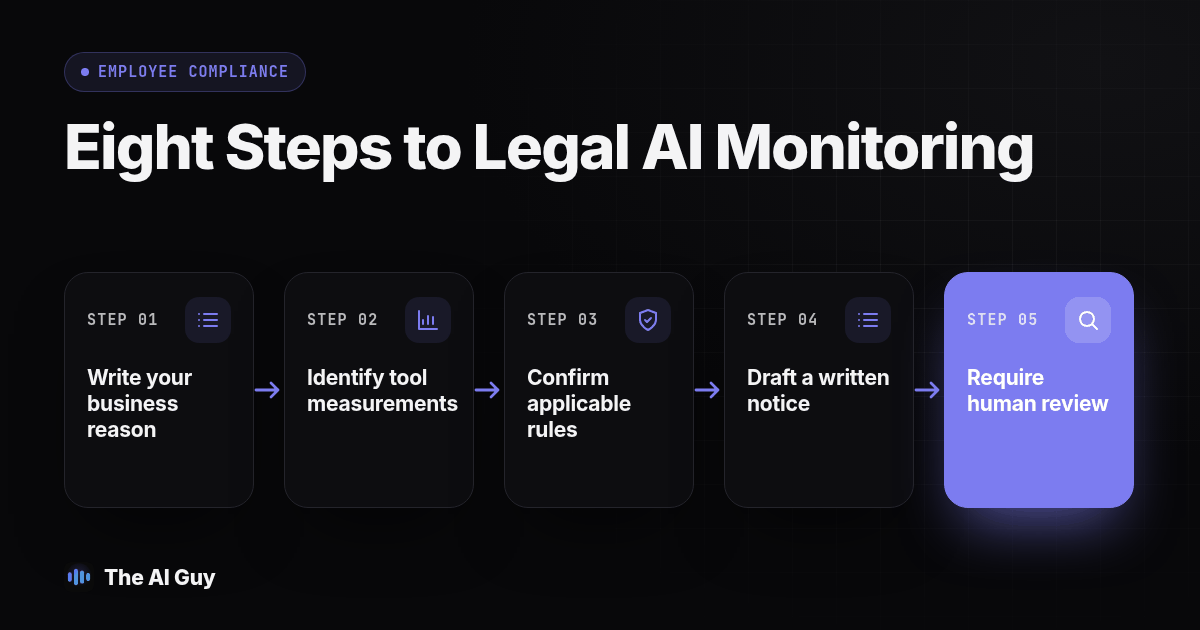
How Do I Review an AI Monitoring Tool in 8 Steps?
Run through these steps before you turn on any AI monitoring tool, and repeat the first three any time you add a new feature to one you already use.
- Write down the specific business reason for monitoring before you buy or activate anything: productivity visibility, quality assurance on calls, security, or compliance. A vague reason like "keeping an eye on things" will not hold up if you ever have to explain the decision later.
- Identify exactly what the tool measures and whether it produces a score, rank or flag about a named person, not just raw activity data. Also inventory personal data, recordings, biometrics, worker locations and retention settings; scoring alone does not determine every duty.
- Confirm applicable triggers, effective dates, exemptions and notice or consent requirements with counsel using the primary sources above. Record the review date and person responsible for checking updates.
- Draft a written notice using the template below and have it checked against applicable requirements. As an operating practice, explain the tool before activation; follow any legally required timing, delivery and consent process.
- Route the AI tool's output through a human reviewer before any discipline, schedule change or pay decision happens. Never let a score trigger an automatic action against an employee with no person checking it first.
- Update your written AI use policy to name this tool specifically and describe what it monitors; our guide to building a one-page AI use policy walks through the exact five questions that policy needs to answer.
- Train the managers who will see the tool's output on what it can and cannot tell them, using a test case with missing context and a deliberately incorrect score; our post on setting staff rules for AI tools covers how to put that training in writing.
- Check whether any team is already using a monitoring or scoring feature you did not approve, tucked inside a tool bought for something else. Our piece on shadow AI tools in a small business explains how to find it before it becomes the thing a regulator finds first.
What Should My Written Notice Actually Say?
Keep the notice short enough that an employee actually reads it, and specific enough that it holds up if someone asks what it meant. Use this as a starting template and adjust the bracketed parts to your situation:
AI Monitoring Notice
- Tool in use: [name of the AI monitoring or scoring tool]
- What it monitors: [call recordings, screen activity, productivity metrics, etc., stated plainly]
- Why we use it: [the specific business reason you wrote down in step 1]
- What it produces: [a score, a flag, a summary, a rating]
- How we use the output: [a human reviews it before any decision about pay, discipline or schedule]
- Who to ask: [name or role] if you have questions about this notice
- Effective date: [date the tool goes live for your team]
Add collection boundaries, access permissions, retention, correction requests and any required disclosures. Keep delivery records and review material changes before enabling them. This template is a starting point, not a substitute for a statutory notice, recording consent or legal review.
Which Monitoring Features Are the Riskiest Right Now?
Evaluate the data and the consequence together. Attendance records may need fewer safeguards than continuous screen capture, but neither is automatically outside privacy law. Productivity rankings require context checks. Automated discipline creates a serious practical concern because a mistaken inference can change someone's job before anyone investigates it.
Ask the vendor to demonstrate access controls, recording exclusions, retention settings and the ability to disable automatic actions. A statement that the product is compliant does not establish that your configuration and use are lawful. Request documentation you can compare with the actual settings available to your team.
Before rollout, run a small test with synthetic records rather than covertly collecting employee data. Include an offline work period, a misattributed call and an incomplete transcript. Have the reviewer find each planted problem, correct the record and explain why the initial score should not determine discipline. Save the inputs, output, correction and reviewer decision as your acceptance record.
Stop the pilot if reviewers cannot trace a claim to its source, restrict access or correct errors. Do not convert the pilot into performance evidence while those controls are unresolved. These are recommended operational gates, not a claim that passing a test certifies compliance.
What Are Owners Asking About AI Employee Monitoring in the FAQ?
Do I need employee consent before turning on an AI monitoring tool?
Sometimes. The answer depends on what you collect, how you collect it and which laws apply. Notice and consent are separate requirements. A monitoring policy does not automatically authorize call recording, biometric collection or access to personal communications. Check those features individually before activation, and retain the required notices and permissions.
Does a plain time clock or an idle-time tracker count as AI employee monitoring under these laws?
A basic timestamp does not necessarily meet an AI or automated-decision definition. However, ordinary logging can still involve protected personal information, and biometric time clocks raise additional questions. Check both collection and subsequent use. Adding scores or using logs in employment decisions can change the review even if the vendor keeps the same product name.
Do these rules apply to a small business with only a handful of employees?
Do not assume a small headcount creates an exemption. Coverage differs by law and may depend on employer definitions, worker location, business thresholds and the specific use. Ask counsel to document which provisions apply to your business. A rule that does not cover you does not cancel other privacy, recording or discrimination obligations.
What happens if I use an AI monitoring score to discipline someone without telling them first?
You may create a notice violation where notice is required, and the decision may also raise accuracy, discrimination or privacy issues. The outcome depends on the governing law and facts. Preserve the relevant records, pause further reliance on the disputed score and obtain employment-law advice before deciding how to correct the process.
What Should I Do Before Turning Monitoring On?
Start with a documented purpose, a map of collection and decision uses, and an accountable reviewer. Check applicable law, explain the process to staff and test whether a wrong score can be caught and corrected. Avoid collecting more information simply because a tool makes it easy.
If you want help mapping the tool's workflow, data access and human checkpoints, reach out to our team. Bring legal questions about your employees and jurisdictions to employment counsel; an automation review supports that conversation but does not replace it.