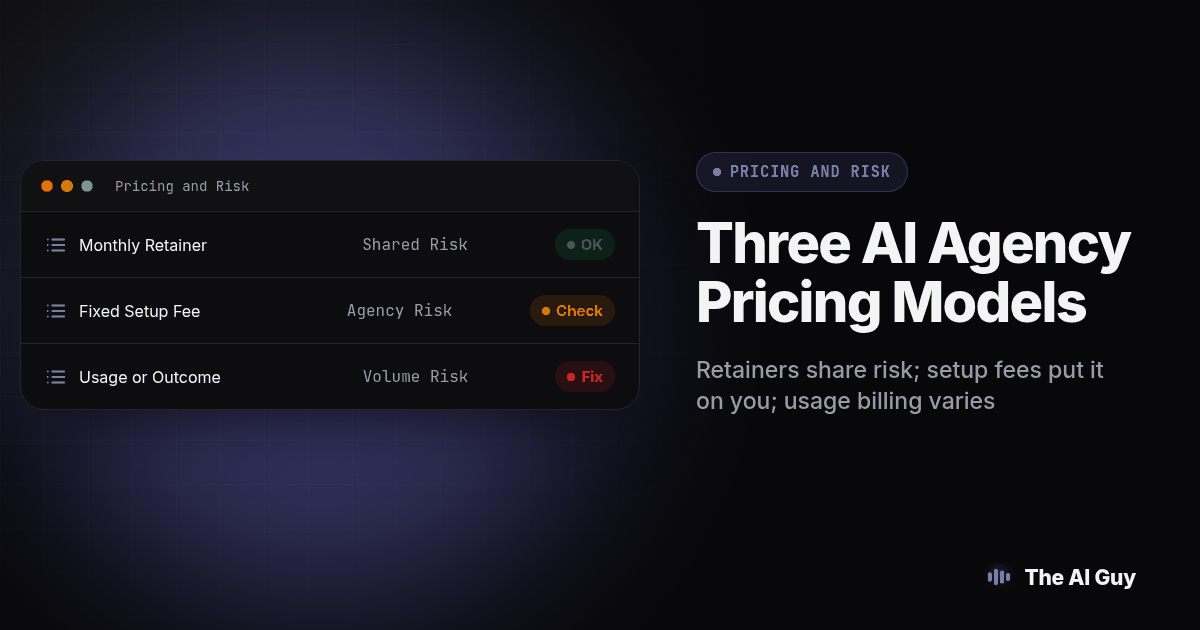
TL;DR: An AI automation agency makes money three ways: a flat setup fee for the build, a recurring retainer for running and improving the system, or usage and outcome based billing tied to volume or results. Each one moves the risk somewhere specific. A setup fee puts delivery risk on the agency and upfront budget risk on the client; a retainer splits ongoing risk month to month; usage and outcome billing hands the swing to whichever side guessed wrong about volume or results.
If you run or are about to start an AI automation agency, choose a pricing model only after you understand which risks you are willing to carry. The three broad approaches are a recurring retainer, a fixed setup fee, or usage and outcome based billing. Each puts delivery, budget and volume risk in a different place, and the right fit depends on how your costs behave when a client's usage or expectations shift.
What Pricing Models Can an AI Automation Agency Use?
Agency pricing guides describe several structures, including recurring retainers, fixed-scope projects, usage billing and fees tied to outcomes. Forge discusses five common models, while Taskip describes six, so the labels vary. For deciding where the work, cash and risk sit, the useful starting point is to group them into three broad approaches: recurring service, a defined build, and billing that changes with usage or results.
The monthly retainer. A recurring fee for building, monitoring and improving an automation over time. Forge's breakdown of agency pricing models treats this as the default structure for ongoing work, kept separate from whatever it cost to build the system in the first place.
The fixed setup fee. A one-time price for a defined deliverable, usually followed by a handoff or a separate maintenance arrangement. Taskip's review of the same market points out that agencies which charge a setup fee and then move the client onto a retainer once the system is live tend to manage cash flow more predictably than agencies trying to fold both into one number.
Usage or outcome based billing. The client pays per task completed, per result delivered, or a base fee plus a variable charge tied to volume. These approaches can sound attractive to a client because the bill follows activity or results. For the agency, the model is harder to run profitably if actual usage, delivery cost or the outcome definition differs from the original assumption.
An agency does not have to choose one model forever. It can select a starting structure for each client, then revisit the fit when the client's actual workload and operating needs become clearer.
Who Carries the Risk Under a Monthly Retainer?
A retainer spreads delivery risk across the relationship instead of concentrating it at one moment. The agency carries the risk of a slow month: if a client barely uses the system, you are still staffed to support it, and that capacity has a real cost whether anyone bills against it or not. The client carries a different risk: they keep paying even in a quiet month, and if they staffed for a certain level of ongoing change and your team is thin that week, the client feels it as slower turnaround, not a refund.
Retainers also carry switching risk for the agency. A client may leave with the notice allowed by the agreement, which means retainer revenue recurs by billing period but can still end when the relationship does. You are rebuilding trust every renewal, even when nothing visibly changed.
Who Carries the Risk Under a Fixed Setup Fee?
A fixed setup fee asks the agency to price a deliverable before fully knowing what the client's data, tools and edge cases will demand. That is scope risk, and it sits almost entirely on the agency's side of the table. Quote it too tight and every requirement the client adds mid-build eats your margin. Quote it wide enough to protect yourself and you risk losing the deal to a competitor who priced it leaner.
The client's risk under this model is different: they pay most or all of the money before the system has proven itself in production. A bad scoping conversation means the client finds out the deliverable does not solve their actual problem only after they have already paid for it. That is why the step most agencies skip, and should not, is writing exactly what "done" looks like into the contract before the invoice goes out.
Who Carries the Risk Under Usage or Outcome Based Billing?
Usage and outcome billing tie the price to something that moves: calls placed, documents processed, leads qualified, or a defined result like a booked appointment. The risk goes wherever the volume assumption turns out wrong. If real usage comes in lower than the agency priced for, the agency's revenue drops below what it costs to keep the system running. If usage spikes, the client's bill grows in a way they did not plan their budget around.
The purest version of this model is a guarantee tied to outcomes rather than hours or volume. MetaTechAi's own positioning with service businesses is built this way: conversions go up, or the client does not pay. That shifts almost all of the delivery risk onto the agency, because revenue only shows up if the system actually produces a result the client agreed to measure. It is the hardest version of this model to offer honestly, and the easiest one to sell once a client understands what it actually promises.
When Does Cash Actually Arrive Under Each Model?
The risk question and the cash timing question are related but not identical. A model can put the risk on you and still pay you slowly, which is its own kind of problem if you are trying to grow.
| Model | Who carries the main risk | When cash actually arrives | Fits this client |
|---|---|---|---|
| Monthly retainer | Shared: agency risks idle capacity in slow months, client risks paying while work is light | Recurring, every billing cycle, often starting before the month's work is finished | Clients who need ongoing tuning, monitoring and small changes |
| Fixed setup fee | Mostly the agency: scope risk if requirements grow after the quote | Mostly upfront or at defined milestones, before the system proves itself in production | A clearly scoped first build with a defined finish line |
| Usage or outcome based | Whichever side guessed wrong about volume or results | After usage happens or after the outcome lands, usually the slowest of the three to collect | Clients who want cost tied directly to value, agencies confident in their own system |
Notice that the model with the least risk for the client, usage or outcome based billing, is also the one that pays the agency the slowest. That tradeoff is the actual decision, not a side effect of it.
How Should You Decide Which Model Fits a New Client?
Run this as a short checklist on every new deal rather than defaulting to whatever you quoted last time.
- Ask the client directly what they are most afraid of: an unpredictable bill, paying for a build that does not work, or paying every month whether or not they use it. Their answer points at the model they will actually trust.
- Estimate your own delivery cost under light use and heavy use for that client's workflow. If the gap between those two numbers is large, a flat fixed fee is risky for you; lean toward a retainer with a defined scope of change, or a usage model with a clear floor and ceiling.
- Check whether the outcome you would be paid on is something you can measure without an argument. If it is fuzzy (did this call "help" close the deal), do not price it as outcome based no matter how well it would sell on the call.
- Decide how much of the build is reusable across other clients in the same niche. A highly reusable build supports a fixed setup fee, because your real delivery cost drops on the next client even if the quoted price does not.
- Write the scope, the measurement method and the overage or ceiling into the agreement before the client signs, not after the first month runs long.
- Revisit the model at renewal, not mid-contract. Changing the pricing structure while a client is mid-build erodes trust faster than almost anything else you can do.
Can You Blend a Setup Fee, a Retainer and Usage Billing?
Yes, and a blend is often the most honest pricing you can offer, because it matches each phase of the relationship to the risk that actually exists in that phase. A common pattern: a fixed setup fee for the initial build, since that work is bounded and the agency can estimate it; a smaller monthly retainer once the system is live, covering monitoring and incremental changes; and a usage component layered on top only for the parts of the system where volume genuinely drives your own cost, like call minutes or document processing.
This is close to how MetaTechAi structures its own managed AI sales systems for service businesses: an initial install, ongoing management, and a results standard the client can hold the engagement to. The blend works because no single number has to carry every kind of risk in the relationship at once.
How Does the Pricing Model Change How Fast You Can Take On New Clients?
This is the part most new agency operators underweight. The pricing model you pick is also an operations decision, because it determines what has to scale with each new client.
A retainer model scales only as fast as your team's time does, unless you productize the service so the same build serves multiple clients with light customization. We cover that productizing step in our guide to starting an AI automation agency: pick a narrow niche, build a repeatable offer, and the same automation becomes faster to deliver on client number ten than client number one.
A fixed setup fee model can take on new clients faster if the build is templated, because each new client is close to a known quantity rather than a fresh scoping exercise. It scales poorly if every client needs a custom build from scratch, because your delivery team becomes the bottleneck no matter how many leads your pipeline sends you.
A usage or outcome based model scales fastest when your underlying system handles volume without proportional headcount, meaning the infrastructure, not the team, absorbs growth. That is a technical requirement before it is a sales one: price a usage model aggressively before your system can actually handle volume cheaply, and growth in signed clients turns into a margin problem instead of a win.
What Should Go In Your Pricing Agreement Before You Sign a Client?
Copy this checklist into your proposal template and fill in every blank before a client signs anything.
- [ ] Pricing model named explicitly: retainer, fixed setup fee, usage based, outcome based, or a named blend of these.
- [ ] What counts as included in the base price, and what triggers a scope change and a new quote.
- [ ] Who owns the system, the data, and the credentials if the client ends the engagement.
- [ ] How usage or outcomes are measured, and whether the client can audit that number themselves.
- [ ] A stated floor and ceiling for usage based pricing, with the overage rate written down, not left to a later conversation.
- [ ] Notice period for either side to end the agreement, and what, if anything, is owed at that point.
- [ ] Who pays for third party tool and API costs the automation depends on, especially if those costs can rise independent of your pricing.
This list is not a legal contract. It covers questions that, if left unanswered, can contribute to pricing disputes between an agency and a client after a system is live. If you want a second set of eyes on how a specific deal should be structured before you send the proposal, contact us and describe the client and the workflow.
Choosing a pricing model is a one-time decision that gets revisited every renewal, not a question you answer once and forget. If you are still weighing what a typical engagement actually costs before you structure your own pricing against it, our guide to AI agency pricing in 2026 covers the buyer's side of this same question. And if you are not yet sure an automation agency is even the right model for what you are trying to build versus a tighter advisory engagement, what an AI automation agency actually is is worth reading first. When you are ready to talk through how a specific client or offer should be priced, contact us.
What Are the FAQs About AI Automation Agency Pricing?
Can I charge a setup fee and a monthly retainer for the same client?
Yes. A fixed setup fee can cover the initial build, then the client can move to a smaller monthly retainer once the system is live and needs monitoring or small changes. Say this explicitly in the agreement so the client knows the setup fee ends and the retainer begins, rather than assuming one price covers both forever.
What happens if a client's usage spikes far past what a usage based price assumed?
Whoever wrote the usage assumption into the contract carries that risk. If the agreement states a flat price up to a stated volume with a clear overage rate above it, the client absorbs the spike predictably. If the agreement never defined a ceiling, the agency usually ends up quietly absorbing the extra work until the next renewal, which is why the ceiling belongs in writing before the client signs, not after the first high volume month.
How long should a setup fee cover before the retainer starts?
Long enough to get the system live, tested against real data and handed to the client's team, not a fixed number of weeks that applies to every build. Define the end of the setup phase by a deliverable, the system is live and passing an agreed test, rather than a date, so a slow client response does not quietly extend your unpaid build time.
Does an outcome based or performance model actually lower the client's risk?
It lowers the client's downside if the system does not work, since they are not paying for an automation that never produced anything. It does not remove risk entirely: the client still has to agree on how the outcome is measured and audited, and a poorly defined outcome clause is where most disputes under this model start.