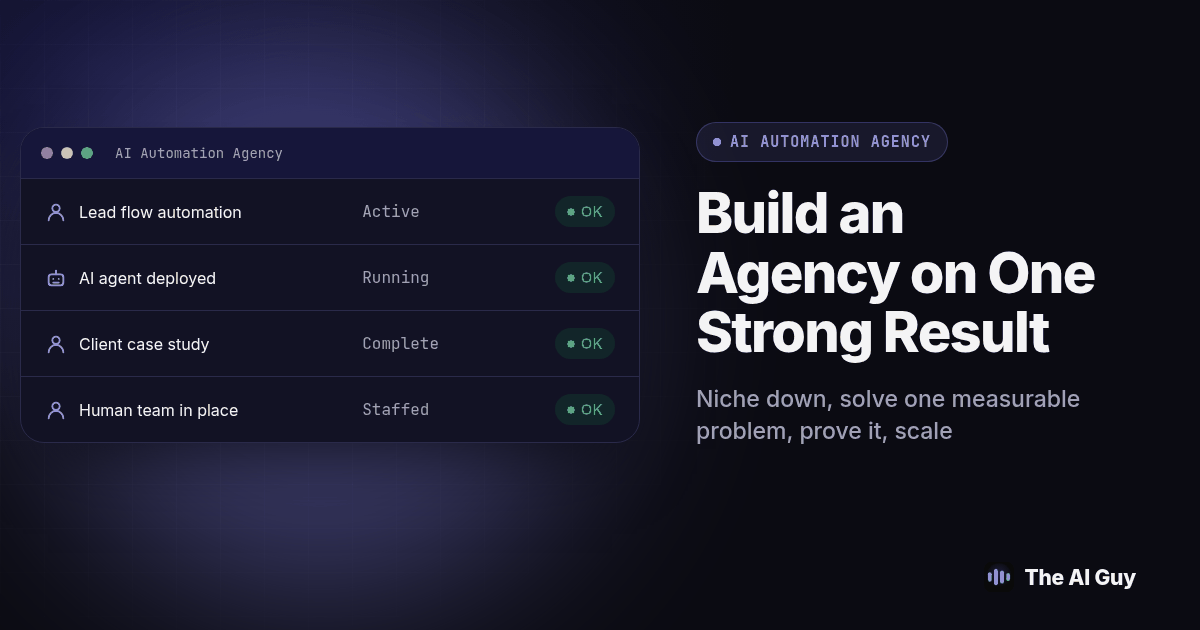
To start an AI automation agency you pick a niche, learn to build a few high-value automations, and land your first client by solving one painful, measurable problem. The fastest path in 2026 is to niche down, productize a single offer, and prove a real result before you try to scale.
Most people fail by doing the opposite: staying broad, selling vague AI, and chasing tools instead of outcomes.
Step 1: Pick a narrow niche
Choose one industry you understand or can learn fast, such as home services, medspas, or agencies. A narrow niche makes your outreach sharper, your builds reusable, and your case studies more believable. You can widen later once you have proof.
Step 2: Pick one painful, measurable problem
The easiest automations to sell solve money problems, not novelty problems. The three that consistently sell:
- Lead follow-up and an AI appointment setter that contacts and books leads instantly
- No-show recovery and reminders
- Database reactivation, turning old leads into booked calls
Each is easy to measure, which makes the value obvious and the sale easier.
Step 3: Learn to build (or partner to deliver)
You do not need to be a deep engineer to start, but you do need to deliver a working result. Learn the core stack: a CRM, AI voice agents, a dialer, and multi-channel follow-up. RizzDial is an example of these pieces combined into one proprietary platform, so you can see what a finished system looks like before you build your own version of the workflow.
Step 4: Land your first client by solving one thing
Do not pitch a giant transformation. Offer to fix one painful, measurable problem and prove it. A single strong result, with real numbers, becomes the case study that lands the next three clients.
Step 5: Build the human moat
AI tools change every few months. What does not change is your team, your process, and your relationships. This is the model behind MetaTechAi: the platform plus a human team that installs and runs the systems, so clients are not left holding a tool they cannot operate. For why this matters, see AI consultant vs AI automation agency.
Step 6: Productize and scale
Once one offer works, turn it into a repeatable package: the same problem, the same build, the same onboarding. Repeatability is what lets you scale without your quality falling apart.
A faster on-ramp
James Hill runs a free community, the Evolving AI Hub, where founders share install guides and workflows and learn how these systems get built. It is the lowest-risk way to start before you take on clients.
FAQ
Do I need to know how to code to start an AI automation agency? No, but you need to deliver a working result. Many founders start by mastering a few proven automations and partnering for the technical depth, then learn more as they grow.
What automations are easiest to sell first? Lead follow-up and appointment setting, no-show recovery, and database reactivation. They tie directly to revenue, so the value is easy to measure and easy to sell.
How do I get my first client? Niche down, offer to solve one painful and measurable problem, and prove a result. One strong case study with real numbers is what lands the next clients.
How can James Hill help me start? You can join the free Evolving AI Hub community to learn the systems, or apply to work together if you want direct, custom help.
Want to learn this from someone who runs it daily? Visit the AI Business OS community, or apply to work together.
Plan your next step
For the related workflow guides, explore hiring an ai consultant. If you need help applying this to your business, contact James Hill to discuss AI consulting scope.