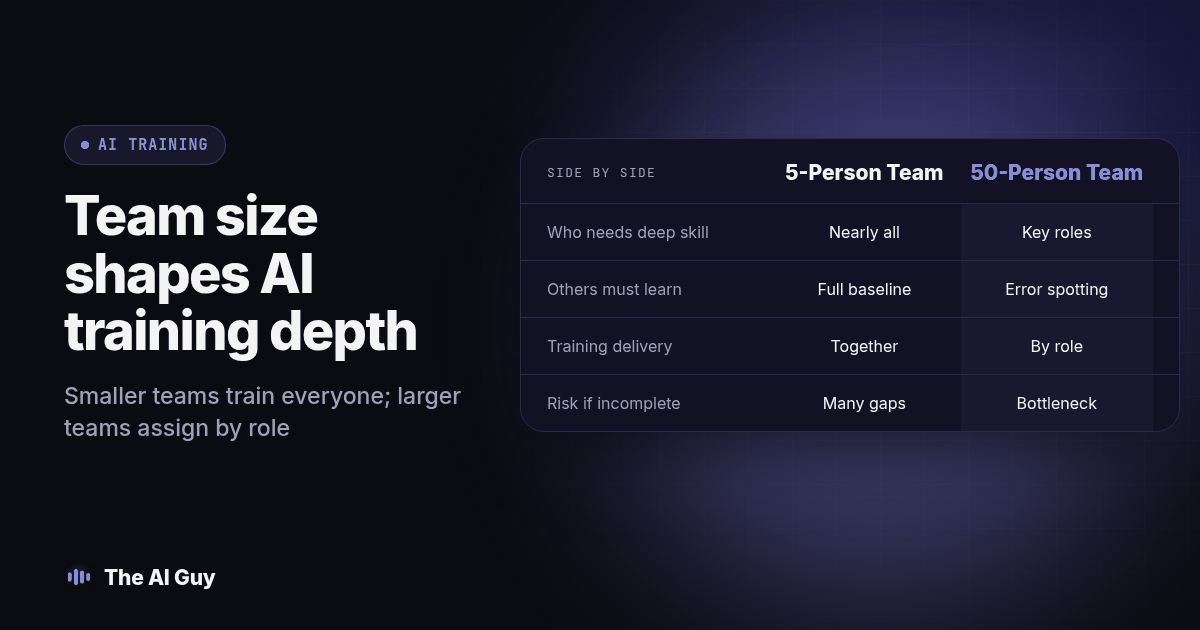
Short answer: A five-person team should teach nearly everyone to use AI for several tasks and check its work, because roles overlap. A fifty-person team can give deeper training to people whose work affects customers, money, or consequential decisions, while teaching everyone else how to spot a questionable answer and escalate it. The same core judgment matters at either size, but the audience and depth change.
AI literacy advice often describes skills without saying who on a real team needs them. Headcount changes how you assign practice, review, and responsibility. A five-person company may not have room for dedicated AI roles. A fifty-person company can assign people to own review, but must make those responsibilities clear enough for the rest of the team to use.
This guide compares the two team sizes, gives you a repeatable placement procedure, and shows how to turn the result into a training schedule. It is a planning method, not a claim that every company at a given headcount needs an identical program. Your workflows, data, customer commitments, and consequences of error should determine the final depth.
Why Does One Training Plan Not Fit Every Headcount?
A generic plan can miss the staffing reality at either end. In a small business, one person may handle customer email, scheduling, invoices, and hiring. Training that assumes a separate specialist for every task will not fit. In a larger company, teaching all fifty people the same advanced material can consume time without preparing the people who actually review high impact output.
The useful distinction is not simply small versus large. It is whether the work is shared or concentrated, and what happens if an AI answer is wrong. The National Institute of Standards and Technology's AI Risk Management Framework Playbook recommends ongoing training tailored to personnel roles. This is guidance for risk management, not a company specific staffing formula. Use its role focus as a reason to map responsibility, then fit the training to your own work. (NIST AI RMF Playbook)
Our four week AI training plan for a small team provides a practice rhythm, and the AI literacy assessment gives you scenarios for checking judgment. This article adds the missing assignment step: deciding who should follow the full plan first and what others need to practice.
What Should a Five-Person Team Learn?
In a five-person team, most employees benefit from a shared baseline because work shifts between people. The person who writes a customer reply today may review a job description next week or summarize a supplier document later. Everyone who uses AI should be able to define the task, provide approved context, inspect the answer against source material, and stop when the output crosses a boundary they cannot review.
Start by listing recurring AI assisted tasks, not tools. For each task, write down what information may be used, what a correct result looks like, and who approves the result. Keep the rules short enough to follow during work. A task might allow AI to draft a response from approved service details, while a person checks names, dates, availability, and any promise before sending. Another task might allow summarization of a public document but prohibit entering customer records into an unapproved service.
At this size, a designated owner can coordinate practice without becoming the only person allowed to use AI. Each employee should demonstrate the checks relevant to their rotating duties. If one task has substantially greater consequence, assign a second reviewer or escalation contact even if that person also has other responsibilities.
There is an exception for a small firm that deploys or resells AI systems for clients. Client work can create additional responsibilities for setup, testing, escalation, and explaining system limits. Decide who owns those duties before delivery. For an example of a client-facing AI deployment context, see RizzDial's guide to a white label AI receptionist for agencies. That article covers the service context; it does not establish that every small team needs the same specialist structure.
What Can a Fifty-Person Team Concentrate by Role?
A team of fifty can assign deeper practice to a defined group, provided the boundaries are visible and someone covers each review duty. Identify roles where AI output reaches customers, informs financial records, affects hiring or other consequential decisions, or is used to make a commitment. Those employees need task level instruction, approved sources, examples of likely errors, and a clear point where human review is mandatory.
Everyone else still needs practical literacy. They should know which tools and data are approved, how to recognize unsupported or contradictory output, and where to send it for help. A shorter scenario exercise can test those abilities. Keep it tied to the person's work. A receptionist might identify a made-up appointment policy in a draft; a field manager might check a generated job summary against the original notes.
Do not let expertise become a single point of failure. Name a primary reviewer and a backup for each high consequence workflow. Store the approved procedure where people can find it. If only one person knows how to verify a particular output, training has not made the process resilient. A role based AI literacy assessment can help surface whether people know how to catch an error and how to escalate it.
How Do Five-Person and Fifty-Person Plans Compare?
Use this comparison as a starting point. It describes a reasonable way to assign practice, not a universal standard or a measured result.
| Training question | Five-person team | Fifty-person team |
|---|---|---|
| Who gets deeper practice? | Nearly everyone who uses AI, because duties often overlap | Named roles where AI output affects customers, money, or consequential decisions |
| What does the rest of the team need? | A shared baseline with task specific checks | Tool and data boundaries, error recognition, and a known escalation route |
| How is training delivered? | Practice together using recurring tasks and shared examples | Role sessions for deeper skills plus short scenarios for other users |
| Who maintains the rules? | One coordinator with named backup reviewers for sensitive work | Workflow owners, reviewers, and backups listed by role |
| What should be checked? | Each person's ability to review the tasks they perform | Specialist demonstrations and sample checks across other roles |
| What can go wrong? | A gap in one person's knowledge affects several workflows | Review responsibility can bottleneck around a few specialists |
Avoid assigning depth based on job title alone. A small team's office manager may handle more consequential workflows than a larger company's AI coordinator. Look at the actual task, information, and decision that follow the AI output.
What Is the Role-Depth Placement Procedure?
Use these steps with your current staff list. The result should be a training roster, not a permanent label attached to an employee.
- List each person and the recurring tasks where they use AI or expect to use it. Include duties they cover for someone else.
- For each task, note the information involved, who sees the output, and what decision or action may follow it.
- Mark tasks that can affect a customer commitment, a financial record, a legal or compliance decision, or another consequential outcome. Describe the specific consequence rather than labeling the task “high risk” without explanation.
- Name the person who checks each marked task, then identify a backup. If no one can check it using available evidence or expertise, keep AI out of that decision until you define a safe review path.
- Assign deeper practice to every person who prepares or reviews those outputs. Include the evidence they should consult, common failure examples, and the point where work must stop and go to a qualified person.
- Give other AI users a short scenario exercise based on their actual work. Ask them to flag an unsupported claim, identify a data boundary, and state who they would contact.
- Record the approved tools, allowed inputs, required review, escalation contact, and date for revisiting the procedure. Review it when a workflow or tool changes, or when a caught error reveals a gap.
For a small team, this process may assign the deeper practice to almost everyone. For a larger team, it may produce a smaller role group plus broad scenario practice. Do not set a fixed specialist percentage from this example. The work map should determine the assignment.
What Should You Record in the Training Plan?
Put the result in a simple table that employees can use during work. Each row can represent a workflow, with these fields:
- Workflow and the AI tool approved for it
- Information that may be entered and information that must stay out
- Person who prepares the output, reviewer, and backup
- Evidence the reviewer checks before approval
- What to do if the answer is missing evidence, conflicts with a source, or exceeds the user's authority
- Practice date and the next review trigger
This record connects policy to action. A policy that says “check AI output” leaves employees guessing about what to inspect and who has authority to approve it. A usable instruction names the source, the fields to compare, the reviewer, and the route for an unresolved discrepancy. For a broader look at employee skills, approved tools, and supervised practice, see the AI training for employees guide.
Keep the procedure current. When a software feature changes, a team member leaves, or a new use case appears, revisit the relevant row. For businesses operating within the EU AI Act's scope, Article 4 addresses AI literacy. The European Commission's AI literacy questions and answers provides information about that obligation. Check the current rules and how they apply to your organization; this training guide is not legal advice.
How Can You Test Whether the Training Worked?
Use a task the employee actually performs, but choose a fictional or safely de-identified example. Give the person a representative AI output with one meaningful problem, such as an unsupported policy statement, a wrong date, a missing exception, or a calculation that does not match its source. Ask them to explain what they would check before using it.
Record whether the person can locate the source, identify the mismatch, correct or reject the output, and route the decision to the right reviewer. Do not score how polished their prompt sounds if the skill you need is verification. When several roles share a process, compare the steps they take and update the written instruction where answers diverge. This makes the exercise useful for improving the workflow, not just rating the trainee.
Repeat the exercise after a process change or a real incident shows a gap. Keep examples free of sensitive customer data. If an answer cannot be safely checked by the employee, the correct result may be to pause and ask the designated reviewer, rather than to improvise.
What Should You Do Before Your Next Training Session?
Start with a roster and a task map. If you have five people, schedule shared practice and let each person demonstrate checks for the work they cover. If you have fifty, identify the roles that prepare or approve consequential output, train those people deeply, and give the remaining users a scenario based check and a clear escalation route.
Then write the training record while the assignments are fresh. Add the approved tool, information boundary, evidence check, reviewer, and backup for each workflow. Use the four week training plan to schedule practice after you know who needs which level. If you want help mapping a small business AI workflow, contact AI Guy with your team size and the tasks where AI output reaches customers or business records.
What Are the FAQs About AI Literacy Training by Team Size?
Does a 5-person team need the same AI training as a 50-person team?
No. A 5-person team needs most people trained as general AI users who can draft, check, and fix output across several kinds of tasks, because there usually is not a spare person to specialize. A 50-person team can concentrate deep AI skill in a handful of specific roles and give everyone else a thinner layer built around spotting a wrong answer before it reaches a customer or a decision.
How long does AI literacy training take for a small team versus a larger one?
There is no single duration that fits every team. A small team can schedule shared practice together, while a fifty person team can train specialist roles first and give others shorter scenario exercises. Set the time from the workflow, practice tasks, and review capacity, then check that employees can demonstrate the required checks.
Do all fifty people on a larger team need to learn the same AI tools?
No. Concentrate deep tool skill, prompt writing, and output review in the roles where AI output reaches a customer, a financial record, or a consequential decision. Everyone else needs a narrower skill: recognizing when an AI answer looks confident but unsupported, and knowing who to ask before acting on it.
Does our written AI use policy need to change based on team size?
The policy can stay focused on tools, allowed inputs, review, and escalation at either size. A 5-person team may find it practical to name each person responsible for a task. A 50-person team may organize those responsibilities by role and name a reviewer and backup for each workflow. Choose a format employees can keep current and follow.
What changes if our 5-person team grows to 50 people?
The shared skill is the same: checking AI output before relying on it. What changes is how practice is assigned. At five people, overlapping duties often make broad practice useful. At fifty people, deeper practice can follow named workflows and reviewers, while other users learn boundaries, error recognition, and escalation.