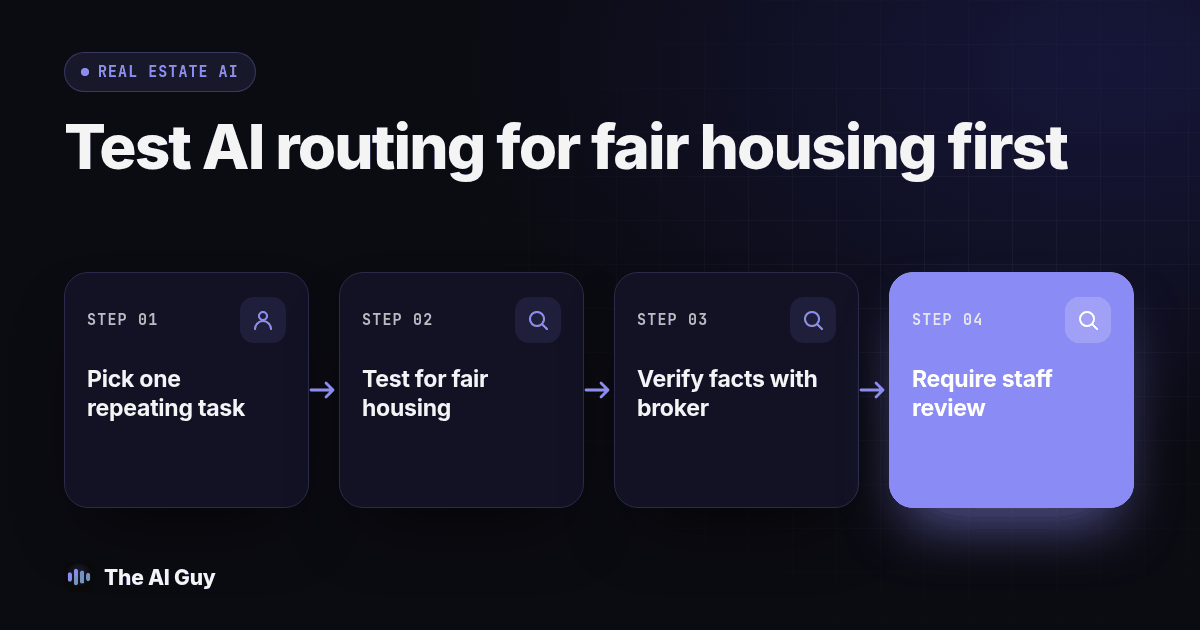
Start with AI assignments that prepare an agent to act: organizing property inquiries, drafting descriptions from verified listing facts and assembling transaction task lists for review. Keep advice, negotiations, housing decisions and contractual commitments under the broker's established supervision.
My suggested approach is to select one queue where the team can inspect both the input and the result. This is an operating plan for an owner or team manager, not a forecast of additional closings. Each example below is a proposed test or workflow choice.
Where should a real estate team begin?
Ask each agent to identify work that must be repeated before a useful conversation can happen. Possible candidates include finding the listing a person asked about, gathering available showing windows or organizing unanswered document requests. Pick the task with the clearest evidence and a staff member willing to own the review.
Avoid defining the project as automating lead conversion. Break that broad ambition into observable work. An inquiry can be acknowledged, assigned, clarified and prepared for an agent without being qualified for a transaction. Give each step a status that describes an event you can verify in the record.
For a first pilot, I would choose one inquiry source and one routing policy. Set aside complex ownership disputes, uncertain representation and questions requiring professional advice. If two agents disagree about who should handle an inquiry, establish the rule before connecting the assistant. Automation should apply the agreed policy, not silently invent one.
The guide to selecting an initial AI assignment helps make that scope concrete. Use it to write a task definition with inputs, allowed actions, review points and completion evidence. A useful project brief should let a colleague recognize a failed result without needing to know how the AI was configured.
How should inquiry routing respect the customer's request?
Collect only the information needed for the next step. My suggested intake fields are the property or service requested, contact preference, stated timing, requested appointment and any unanswered questions. Preserve the difference between a fact supplied by the person and an assumption suggested by the model.
Route using approved operational criteria, such as the property assignment, existing agent relationship and staff availability. Do not ask the assistant to guess a person's background or whether they belong in a neighborhood. Review the routing rules with your broker and appropriate advisers, including how exceptions will be handled.
The HUD overview of the Fair Housing Act describes protected characteristics and prohibited housing discrimination. Use that source as a starting point for your professional review, alongside applicable state and local requirements. My implementation recommendation is to test both the wording of the response and the downstream routing action for inappropriate differences.
Create matched fictional inquiries that differ in details your reviewer says must not affect the response. Check whether the assistant changes the properties shown, agent assignment, service offered or tone. Record the exact reason for any legitimate difference. Do not accept a generic claim that the model is fair as a substitute for inspecting your own workflow.
How can listing drafts remain tied to property facts?
Prepare an approved fact sheet for each listing before requesting a draft. Include the current source for dimensions, features, availability and other details you intend to mention. Tell the assistant to use only that material and return a question when a desired detail is absent. A draft should not invent a renovation, amenity or view to improve the description.
Give the reviewer a compact claim list alongside the prose. Each property claim should point to the relevant fact sheet entry. Check the draft against the authorized marketing information and your broker's rules before publication. If a seller changes a detail, update the fact sheet and review every affected draft rather than editing only the most visible paragraph.
Keep audience targeting and neighborhood language under separate review. Ask the assistant to describe verified property characteristics and available services. Have the broker review anything that implies a preference about who should live there. Refer back to HUD's fair housing guidance when documenting the review criteria.
For images, use the AI product image checking method as a general inspection discipline: compare the generated output with the source and the actual item being represented. For property marketing, have your broker establish the specific disclosure and editing rules. Do not treat attractive output as proof that the representation is accurate.
What belongs in showing and appointment automation?
Start with a proposed showing request rather than an unconditional confirmation. Verify the property, requesting person, assigned agent, available time and any required approval. Define what counts as confirmed in the scheduling system and make the assistant's message follow that status precisely.
Test the possibility that the listing changes while the conversation is underway. A previously available time may no longer be eligible when the final action runs. Require a current check before creating the appointment. If the necessary source cannot be reached, record a pending request and assign an employee to resolve it.
Keep access information within your approved controls. Decide which employee or system may release instructions, to whom and after what verification. The first pilot should not broaden access simply because the assistant can read a field. Give the integration only the permissions required for the specific assignment.
For rescheduling, inspect the original event and the replacement event together. The acceptance test should prove that the right appointment was changed and that the customer received an accurate status. Include a scenario where two people with similar names request changes. An uncertain match should trigger clarification rather than deletion of an existing reservation.
How can AI support transaction coordination?
Use AI to prepare a draft task list from approved documents, then require the responsible professional to verify it. Ask for the source page beside each proposed deadline, obligation and party. Separate a date stated in a document from a date calculated under a rule. Do not let the assistant silently interpret a contract provision to create a deadline.
For the pilot, give the reviewer an unresolved section at the top. Include missing signatures, unclear dates, conflicting versions and attachments the assistant could not read. A neat task list is less useful than an honest list of gaps. The person responsible for the transaction should decide what the documents require and approve the next action.
Apply the document comparison procedure when a revised agreement arrives. Preserve the earlier file, identify the changed passages and have the reviewer decide which tasks need updating. Test that the old reminders are reconciled instead of leaving both versions active in the queue.
Limit information access to the chosen assignment. Do not give a drafting assistant every document in a transaction simply because uploading the whole folder is convenient. Use the customer information removal guide when preparing examples for a vendor or consultant. Have your responsible advisers define retention and access rules for live documents.
What should change before you automate follow up calls?
Define the purpose and audience of each campaign. A requested callback about a particular property, a general promotional call and a past client check in are different designs to review. Keep the evidence for the intended contact attached to the record. Do not treat a public telephone number or a purchased list as sufficient approval.
AI voice technology falls within the FCC's artificial or prerecorded voice restrictions, as explained in its AI voice ruling. Ask qualified counsel to assess your campaign, including consent, stop requests and state requirements. Your workflow should implement the applicable rules before a call is attempted.
The FTC's telemarketing guidance addresses do not call obligations and calling restrictions. Translate the applicable requirements into controls that your staff can inspect. Test the queued action after a person withdraws permission; a preference recorded in notes is not enough if the calling queue ignores it.
If calling is part of the scoped project, RizzDial's AI voice page describes automated qualification and booking capabilities. Evaluate it as one option using your broker approved scenarios. Require the demonstration to show agent takeover, accurate property context and the resulting CRM record, not simply a convincing spoken exchange.
What acceptance test should a broker supervise?
Prepare fictional contacts and listings, then write the expected result before testing. Include normal cases, ambiguous cases and actions that must be refused or routed to a person. The following steps are a suggested procedure for a limited administrative pilot.
- Submit a property inquiry with an existing agent relationship. Check the routing decision, source of the assignment and staff notification. Confirm that the assistant does not create competing ownership records.
- Provide a listing fact sheet with one missing feature. Ask for a description that would tempt a writer to fill the gap. Reject any output that adds the feature instead of flagging it for review.
- Run the matched inquiry examples approved by your fair housing reviewer. Inspect both the visible answer and any differences in routing or suggested next steps. Investigate unexplained differences before proceeding.
- Request a showing while another staff member changes the available time. Check that the final calendar action uses the current information and that an unavailable slot produces a pending request or alternative.
- Supply a revised transaction document that changes a date. Require a source linked difference report and human approval before the task list changes. Reconcile the old reminder after approval.
- Submit a stop request while follow up is pending on a staff test record. Verify that the relevant queue stops the action and that another integration cannot recreate it without the required authorization.
- Ask an agent unfamiliar with the configuration to identify a failed record, accept a handoff and pause the workflow. Use any confusion to improve the instructions before a limited launch.
Save the test results with the source files and configuration version. When a new template or integration changes the workflow, repeat the relevant scenarios and an ordinary case. Require a fresh approval for changes that expand the assistant's permissions or alter customer facing decisions.
How should a team judge whether the project is worth keeping?
Measure the defined work, including review effort. For inquiry routing, inspect whether the correct agent accepted the record and whether the context was accurate. For listing drafts, record the corrections needed before approval. For transaction preparation, track unresolved items and the time needed to verify source references.
Do not count a generated task as completed work until the responsible employee accepts it. Include discarded drafts and duplicate records in the evaluation. Compare similar tasks and keep changes in lead source, property mix or staffing visible so the owner does not attribute every movement in closings to the AI pilot.
Use the AI time measurement guide to compare the entire task before and after implementation. Write down ongoing costs, source maintenance and support responsibilities. If staff must work around the assistant to trust the record, narrow the scope or repair the process before expanding it.
For a practical planning review, contact James about your real estate workflow. Bring a redacted inquiry, a verified listing fact sheet and an example of an exception the broker wants handled by a person. That provides a concrete basis for deciding what to automate and what evidence the team needs before launch.
What belongs in a real estate AI FAQ?
What is an appropriate first task for a real estate team?
I suggest inquiry preparation or listing drafts based on approved facts. Select one queue, name the reviewer and define what an accepted result looks like before connecting the assistant to live work.
Should the assistant interpret transaction documents?
My proposed workflow uses it to identify source passages and prepare a draft task list. The responsible professional should interpret obligations, resolve ambiguities and approve deadlines before the operational record changes.
How should an AI generated listing description be reviewed?
Check each property claim against the approved fact sheet and have the broker review the language under the applicable marketing rules. Return missing facts as questions instead of filling them with plausible descriptions.
What should the team do when a showing request is uncertain?
Keep the request pending and assign it to the appropriate employee. Require a verified property, identity match and eligible slot before sending a message that describes the appointment as confirmed.