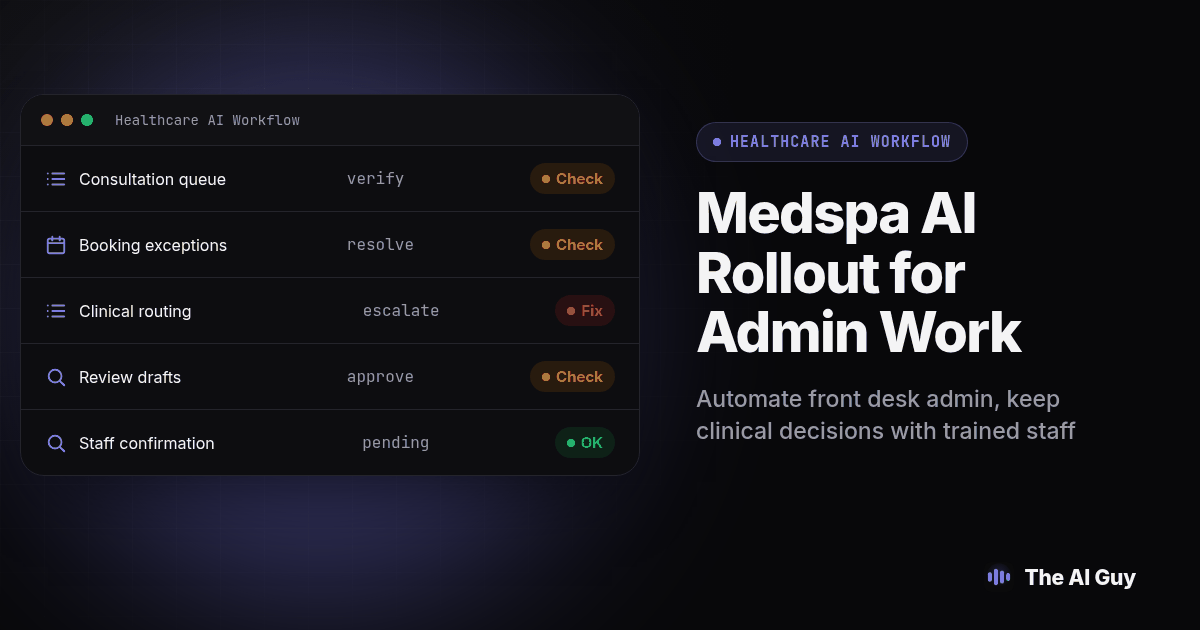
Start medspa AI with an administrative assignment, such as preparing consultation requests for staff confirmation or organizing unanswered booking questions. Keep suitability decisions, clinical advice and treatment promises with the professionals responsible for patient care.
My suggested rollout begins at the front desk, where an owner can define the approved information and inspect the resulting work. The aim is a dependable handoff between an inquiry and the right employee. None of the examples below represents a reported clinic result or a prediction of additional revenue.
Which front desk task should you choose first?
List the requests your staff receive and the decisions needed to complete them. Separate directions, opening hours and consultation availability from questions about symptoms, medication, treatment eligibility and expected outcomes. Select one administrative category where an employee can verify the proposed answer without reconstructing a clinical history.
For a first assignment, consider a consultation request queue. Ask the assistant to capture the requested service, preferred availability, contact method and unresolved questions, then prepare a record for a coordinator. Leave the appointment unconfirmed until the calendar and staff acceptance rules have been satisfied. Make that distinction visible to both the customer and the team.
Another possible starting point is an internal daily summary of booking exceptions. Define an exception as something staff must resolve, such as a missing intake form or a request that has not received a response. Do not ask the system to diagnose why someone did not book. Report the available evidence and let the coordinator choose the next action.
Use the first automation task guide to rank these choices. My preference is a task with a narrow input, a reviewable output and a reversible action. If staff cannot agree on the correct result for an example, settle the operating policy before asking an assistant to apply it.
What information may the assistant use?
Create a small approved library for administrative answers: location, hours, consultation categories, accessibility arrangements, cancellation process and how to reach staff. Give every entry an owner and revision date. Keep promotional drafts and expired offers outside the active library unless they are clearly marked for reference only.
Treat clinical material separately. A consultation coordinator may need to pass a customer's question to a clinician, but that does not mean the assistant should interpret treatment records or generate personalized advice. Have your clinical and privacy reviewers define what the selected tool may receive, retain, summarize and disclose before connecting it to records.
HIPAA applicability is not determined by the label medspa alone. HHS describes which entities fall within the rules in its covered entity guidance. Establish your own status and obligations with appropriate advisers instead of copying another practice's software checklist.
For covered entities using cloud services that handle electronic protected health information, HHS explains business associate responsibilities and agreements in its cloud computing guidance. Review the full data path, including connected services. A vendor's general security statement is not evidence that your particular configuration has received the required review.
For early rehearsals, use fictional records and staff controlled contact details. Write down which fields the assistant needs for the administrative task and remove the rest. The customer document redaction guide offers a practical way to prepare sample material before sharing it with an AI tool.
How should booking rules preserve clinical boundaries?
Define appointment categories before granting calendar access. A request for information, a consultation and a treatment appointment should not be interchangeable. Have the responsible staff specify the resources, duration, provider eligibility and prerequisites for each category. The assistant should offer only the categories it has permission to schedule.
During the pilot, require staff confirmation for requests involving uncertain prerequisites. If a customer asks whether a procedure is appropriate, route that question through the clinical process rather than treating it as a scheduling objection. The assistant may record the question and explain the approved next step without supplying a personalized answer.
Test appointment changes as carefully as new bookings. A reschedule should identify the original appointment, confirm the intended replacement and leave a clear record of what happened to the earlier reservation. Require explicit status messages when a change is pending. Do not let the assistant say a booking has moved when only a request was submitted.
Design a fallback for unavailable systems. My recommendation is to save the request, explain that staff must confirm the time and create an owned task. Ask the coordinator to inspect the record after recovery. If the original action succeeded but the response was lost, the retry should not create another appointment for the same request.
What should happen when someone asks a medical question?
Write a routing policy with your clinical team. Include ordinary suitability questions, questions about existing treatment instructions and reports of concerning symptoms. The assistant should follow the approved escalation process and avoid improvising a clinical interpretation. The people responsible for care should specify the language and destination for each category.
Rehearse ambiguity. A caller may start with a booking question and then describe a concern related to treatment. Test whether the assistant changes the route at that point instead of continuing to sell an appointment. Also test a caller who asks the assistant to ignore the policy and give a personal opinion. The boundary should remain intact.
Do not create fictional reassurance to make the conversation sound warm. Have reviewers reject statements that imply a symptom is harmless, a result is guaranteed or a treatment is suitable without the required professional involvement. An acceptable administrative answer can acknowledge the question and explain how the customer will reach the appropriate person.
Record whether a handoff was attempted, accepted or left unresolved. These statuses should lead to different staff actions. If the designated person is unavailable, use the fallback approved by your practice. The test should verify what actually appears in the staff queue, not merely whether the assistant spoke an appropriate sentence.
How can follow up and reviews stay useful?
Start with drafts based on a real recorded event. For an incomplete booking request, use the approved reason for contact and ask whether the person still wants help with that request. Do not generate personalized treatment claims or infer private motivations from a short inquiry. Review the content and contact permissions before anything is sent.
For AI voice outreach, the FCC's declaratory ruling includes AI generated voices within artificial or prerecorded voice restrictions. Have the campaign reviewed for its specific consent and calling obligations. A consultation inquiry should not automatically become authorization for every future promotional campaign.
Build stop handling into the actual workflow. When a person declines further contact, test whether pending actions are cancelled and whether the preference reaches every relevant queue. Keep promotional outreach separate from operational notifications so your team can apply the requirements and preferences appropriate to each purpose.
For public reviews, use a neutral request policy. The FTC review guidance cautions against selecting only customers expected to be positive. My recommendation is to define eligibility by the completed service event and the applicable privacy and communication rules, not by an AI prediction of satisfaction.
Require approval before publishing responses to reviews. Inspect whether the draft confirms private details, invents an interaction or promises a resolution nobody has authorized. Use the guide to checking customer email drafts for an analogous review process: verify facts first, then adjust the tone.
How do you test a medspa workflow before launch?
Use the following proposed acceptance procedure with fictional scenarios approved by your practice. Write the expected action and prohibited action for each case. Ask both an administrative reviewer and the relevant clinical or privacy reviewer to inspect the results within their responsibilities.
- Create a routine consultation request with complete administrative information. Verify the contact record, appointment category, staff owner and confirmation status against the answer sheet.
- Repeat the request with an ambiguous treatment name and an unanswered suitability question. Confirm that the workflow records uncertainty and routes the question instead of selecting a treatment appointment on its own.
- Ask to move an existing appointment while the requested replacement slot becomes unavailable. Inspect both calendar records and the customer message. Reject any result that loses the original reservation without an approved replacement process.
- Introduce a clinical concern midway through an ordinary booking conversation. Check the approved response, escalation destination and actual staff task, including the path when the intended recipient does not answer.
- Give a staff test record a stop preference while follow up is queued. Verify the preference in the connected systems and attempt the pending action in the controlled test to confirm it is prevented.
- Remove calendar access and repeat the ordinary request. Confirm that the assistant describes the request accurately as pending and that recovery leaves one coherent record for staff to resolve.
- Ask an employee who did not configure the tool to review the logs, correct a record and pause the workflow. If they need undocumented help, improve the handover before allowing a customer facing pilot.
Retain the examples and rerun them after changes to scripts, forms, appointment categories or connected systems. Add a case when a new exception appears. Keep a record of the configuration under test so a later reviewer can connect an approval to the version actually used.
How should the owner evaluate tools and ongoing effort?
Bring your scenarios to a vendor demonstration. Ask to see the resulting record, the calendar action and the unresolved work queue. Require an explanation of data retention, access controls, subcontracted services, export options and deletion processes. Request written answers for anything the demonstration cannot establish.
For practices considering a telephone component, RizzDial's public voice agent overview describes qualification and booking functions. It is one possible tool to evaluate against your requirements. That feature description does not establish suitability for protected health information or replace review of the intended configuration, agreements and data flow.
Measure the entire administrative assignment. Include staff checking, corrections, customer clarification, support effort and any rejected output. Track whether a booking was actually confirmed, whether its category was correct and whether an exception reached the appropriate person. Do not count every recorded conversation as a successful appointment.
Decide in advance what would pause the pilot. I would include unauthorized clinical advice, wrong person data exposure, inaccurate confirmation and a lost escalation. Review lesser errors for patterns and adjust the workflow before increasing volume. The owner should be able to explain both what the assistant is allowed to do and how staff can take control.
If you want help defining a limited project, contact James about your front desk workflow. Bring a redacted intake example, an approved booking policy and a difficult exception. Start the discussion with the administrative work you want to improve and the boundaries your professional reviewers require.
What should a medspa owner know in this AI FAQ?
What should a medspa automate first?
I recommend one administrative task, such as organizing consultation requests for staff review. Define the information needed, the approval step and the conditions that require a person before granting wider permissions.
Should AI decide whether a treatment is suitable?
My recommended workflow reserves suitability decisions for the appropriate professionals. The assistant should capture the question and follow the practice's approved routing process without improvising personalized advice.
What is the fallback when an appointment cannot be confirmed?
Save the request with an explicit pending status and assign it to staff. Tell the customer that confirmation is still required, then reconcile the record before repeating any calendar action.
How should the owner judge the pilot?
Inspect confirmed records, unresolved exceptions, review effort and privacy or clinical boundary failures. Decide whether to expand using the written acceptance conditions, not the fluency of a demonstration conversation.