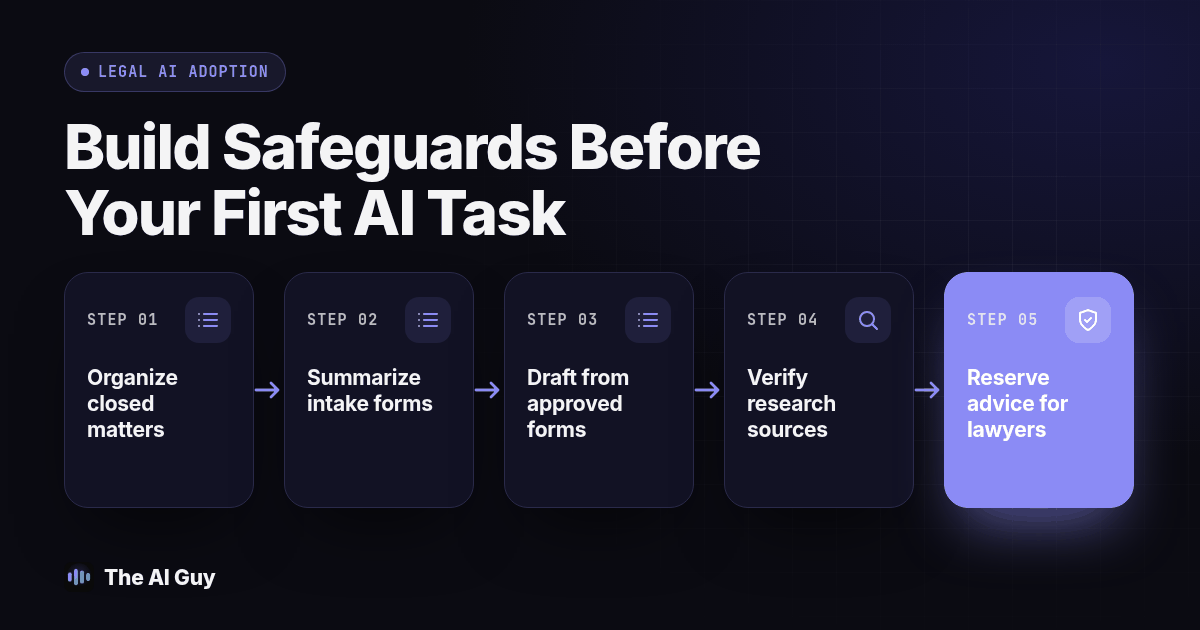
Start with a contained task whose output a person can compare against a source record, such as organizing closed matter documents or drafting an internal intake summary. Keep legal research, client advice, and anything using confidential information behind attorney review and your firm's data rules. Before a tool touches live work, check its data terms, your court's rules, and your own state bar's current guidance.
A small practice may be balancing unanswered intake, routine drafting, and research that takes time to verify. A useful first question is not which product has the most convincing demonstration. It is which recurring task can be bounded, tested against known records, and reviewed by a named person before a client or court relies on it. The rollout below starts with internal work and moves toward higher consequence tasks only when the firm has written its safeguards and checked the relevant professional rules.
Which AI Task Should a Small Law Firm Try First?
Choose work with a known source and a clear reviewer. A sensible starting order is:
- Closed matter organization. Ask AI to label a copied set of closed matter documents by date or topic. A staff member compares the labels with the original files; the output is a finding aid, not a substitute for reading evidence.
- Internal intake summaries. Turn a test transcript or approved form into a structured note listing only what the person said. A human decides fit, conflicts, urgency, and next contact. Do not let a bot assess legal rights or promise a response time the firm has not confirmed.
- Routine first drafts. Use a firm approved template to prepare an internal draft from facts a lawyer has selected. Compare names, dates, defined terms, and every factual statement with the matter record before sending or filing.
- Research support. Ask for search terms, issue outlines, or candidate authorities, then verify each authority and proposition in a trusted legal source. Never treat a generated citation as verified research.
- Advice, strategy, or autonomous decisions. Keep legal judgment, advice to a client, settlement positions, and decisions that affect a person's rights with the responsible lawyer.
This order is a workflow recommendation, not a claim that every firm or jurisdiction has the same rules. The ABA's Formal Opinion 512 on generative AI discusses competence, confidentiality, communication, supervision, candor, and fees. Apply your own professional obligations to the exact task and tool.
How Can AI Help With Intake Without Giving Legal Advice?
Treat intake as collecting and routing information, not answering a caller's legal question. A bounded assistant can place a supplied transcript or form into fields such as contact details, matter type, key dates, and the person's own description of the issue. It should preserve uncertainty, mark unanswered questions, and pass the summary to a person for review.
Write the handoff rules first. Name who reviews every summary, who performs the conflict process, and what should happen when a person mentions a deadline, hearing, immediate safety concern, or another urgent event. Route those cases to prompt human review under the firm's policy. Do not invite detailed confidential information through a public bot before the firm has determined what warnings, collection limits, and safeguards apply.
Phone intake also needs a clear boundary between routine routing and a conversation that requires staff. Our sister site has a practical guide to what an AI answering service should and should not handle for a law firm, including examples of calls that should reach a person.
How Should a Firm Review AI Drafting?
Drafting assistance is easier to bound when the firm supplies an approved form and a limited set of verified facts. The tool can prepare an internal first draft of a routine letter or status update. A lawyer who knows the matter remains responsible for whether the document is accurate, appropriate, and allowed by applicable rules.
Review for plausible mistakes, not only obvious nonsense. A polished draft may have a wrong date, party, defined term, quoted provision, or factual assertion. Compare each claim against the source record, open the source clause for quotations, and verify that the draft has not added a promise or legal conclusion the lawyer did not authorize. Our guide on using AI to review a contract before signing describes a related source checking discipline. In either direction, a summary or draft can miss context outside the document supplied to the tool.
How Can a Lawyer Check AI Legal Research?
Generative tools can return citations that look complete but are inaccurate or fabricated. The Texas Center for Legal Ethics explains in Professional Ethics Committee Opinion 705 that lawyers remain responsible for work produced with AI and should verify its accuracy. The federal court record in Mata v. Avianca documents sanctions after attorneys filed a brief containing nonexistent cases attributed to ChatGPT (court order).
Use this procedure before any AI assisted authority appears in a memo, client communication, or filing:
- Copy each proposed authority into a verification list, keeping the tool's description separate from the citation.
- Search the citation in the firm's legal research database or an official court source. Confirm the case name, court, date, docket or reporter information, and that the authority exists.
- Open the opinion itself. Read the relevant passage and confirm it supports the proposition attributed to it.
- Check subsequent history and treatment in the database's citator or another reliable legal research service.
- Review applicable court rules and orders for requirements about AI use or disclosure in filings.
- Remove unsupported authorities and rewrite any sentence that overstates the holding. Do not keep a weak citation because it resembles a plausible case.
- Have the responsible attorney review the sources and final analysis, then record the reviewer and date in the firm's ordinary matter process.
This procedure reduces a specific research risk; it does not replace legal research or professional judgment. The Texas opinion notes that court requirements can vary, so check the court that will receive the work.
What Should a Firm Check Before Client Information Enters an AI Tool?
The data path and the tool's terms matter. Review whether prompts and uploaded files are retained, used to train or improve a service, accessible to vendor personnel, shared with subprocessors, or covered by security and deletion terms. Check the plan actually used by the firm because product settings and terms can differ. A label such as "for law firms" does not answer those questions.
The Florida Bar's Opinion 24-1 discusses confidentiality, data retention, verification, and client consent considerations for third party AI. The State Bar of California's updated 2026 practical guidance says lawyers should assess confidentiality protections, review terms, and critically examine inputs and outputs. These are examples of guidance; they are not a substitute for rules binding the lawyer in another jurisdiction.
Until the firm has approved a tool and workflow, use fictional or properly deidentified test material. If the task needs only one clause, do not send an entire file. Redaction needs care because document properties, comments, tracked changes, and other hidden content may remain. Our guide to removing customer details from a PDF before using AI covers a practical document review sequence. A human should confirm what can be shared under the firm's duties, client instructions, applicable law, and tool agreement before real matter data is used.
How Does State Bar AI Guidance Differ?
There is no single state rule to apply nationwide. Jurisdictions may publish ethics opinions, practical guidance, court orders, or local rules, and those materials can address different issues. The comparison below gives examples of official materials checked for this guide. Read the complete source and confirm its current status before using it for a firm's policy.
| Source | What the cited material addresses | What a firm should verify |
|---|---|---|
| American Bar Association, Formal Opinion 512 (2024) | Model rule duties including competence, confidentiality, communication, supervision, candor, and fees | Whether the relevant state adopted or interprets comparable rules differently |
| Florida Bar, Opinion 24-1 (2024) | Confidentiality, program terms, review of output, consent considerations, and billing | The facts of the proposed disclosure and the current Florida rules and opinion |
| State Bar of California, Practical Guidance (2026) | Updated guidance including agentic AI, confidentiality, review, supervision, communication, and fees | Whether California's current guidance or local court requirements apply to the work |
| Texas Center for Legal Ethics, Opinion 705 (2025) | Technological competence, confidentiality, output verification, court requirements, and billing | Texas rules, the receiving court's orders, and any later ethics guidance |
For instance, Florida Opinion 24-1 recommends informed consent before using a third party generative AI program when that use would disclose confidential information. That is a jurisdiction specific discussion, not a universal statement that every AI task everywhere always requires the same consent. California's 2026 guidance replaced its earlier 2023 document, which is why checking publication dates matters. Use the ethics opinions page for your state and the court's current rules, then ask qualified ethics counsel when the answer is uncertain.
How Should a Firm Test a Workflow Before Live Use?
Test a narrow workflow on closed or fictional material before a person relies on it in an active matter. Decide the pass conditions before reviewing results so the team does not excuse errors after seeing a polished answer.
- Pick one repetitive task, such as organizing closed documents or preparing an internal intake summary, and write down its intended use and exclusions.
- Name the person who approves the tool, the reviewer for each output, and the person responsible for exceptions.
- Confirm the tool's data terms, access controls, retention settings, and any client or court restrictions. Use fictional or approved closed matter data for the first run.
- Prepare a small set of examples with known answers, including an incomplete record and a confusing name or date. Keep the source files available for comparison.
- Run the same task on each example and compare every material name, date, citation, and factual statement with its source. Record errors rather than silently correcting them.
- Set task specific pass conditions in advance. A fabricated citation, wrong party, or missed urgent handoff should stop a workflow that could expose a client or filing to that error.
- If the test passes, start with a limited supervised pilot and log review time, corrections, and escalations. Expand only after the responsible lawyer approves the results.
- Repeat the test after changing the model, prompt, connected matter system, permissions, or vendor terms, and review it when relevant bar or court guidance changes.
If the workflow fails, narrow its task or add a review step, then test again. A useful pilot is one where staff can explain what it is allowed to do, what it cannot decide, and who handles an exception.
What FAQs do small law firms ask about AI?
Does using ChatGPT or another AI tool risk attorney client privilege?
It can create confidentiality or privilege concerns if matter information is disclosed to a service without suitable protections or permission. Review the tool's terms, retention, training, access, and security settings, and apply the rules and client instructions for the jurisdiction and matter. When uncertain, use fictional or properly deidentified information until the firm approves the workflow.
How long does it take to set up a safe AI intake or drafting workflow?
A contained internal test can begin once the firm selects one task, approves a tool, names a reviewer, and writes its stop conditions. The time to expand depends on the workflow, integrations, data review, and applicable professional requirements. Test beside the current process before relying on it for live client work.
Will AI research and drafting tools work with the case management software we already use?
That depends on the specific products and plan. Ask each vendor whether the tool can read from or write to the firm's system, what permissions it needs, and how it handles matter data. Test the connection on approved material and check the resulting record before routing client files through it.
What does it cost to start using AI in a small law practice?
Begin by checking tools the firm already has access to and the terms that apply to that account. A dedicated research, drafting, or intake product may add a separate cost. Compare its full cost, including review and setup time, with the task results from a supervised pilot before expanding use.
What happens if our state bar updates its AI guidance after we already built a workflow?
Assign someone to check the relevant state bar and court sources periodically, and review the firm's policy and test procedure when guidance changes. Record what changed, whether the tool or workflow is affected, and who approved any revision before the firm resumes or expands use.
What Should a Small Law Firm Do This Week?
Choose one internal, checkable task, name its reviewer, and run the numbered test procedure on fictional or approved closed matter material. Before any real client information enters a tool, verify the terms and protections, then check your own state bar guidance, client instructions, and court requirements. Keep advice, legal judgment, and final verification with the responsible lawyer.
If you want help identifying a bounded AI pilot for your firm's operations, contact our team with the repetitive task you are considering. We can discuss the workflow and where human review belongs.