Use AI first to prepare work for your insurance team: organize incoming requests, identify missing documents and assemble renewal review packets. Keep coverage recommendations, binding decisions and customer commitments behind the agency's established approval process.
The useful question is which administrative assignment you can describe clearly enough to inspect. This guide proposes a workflow and test procedure for an agency owner. It does not promise a production increase, interpret a policy or replace your compliance review.
Which agency problem deserves the first pilot?
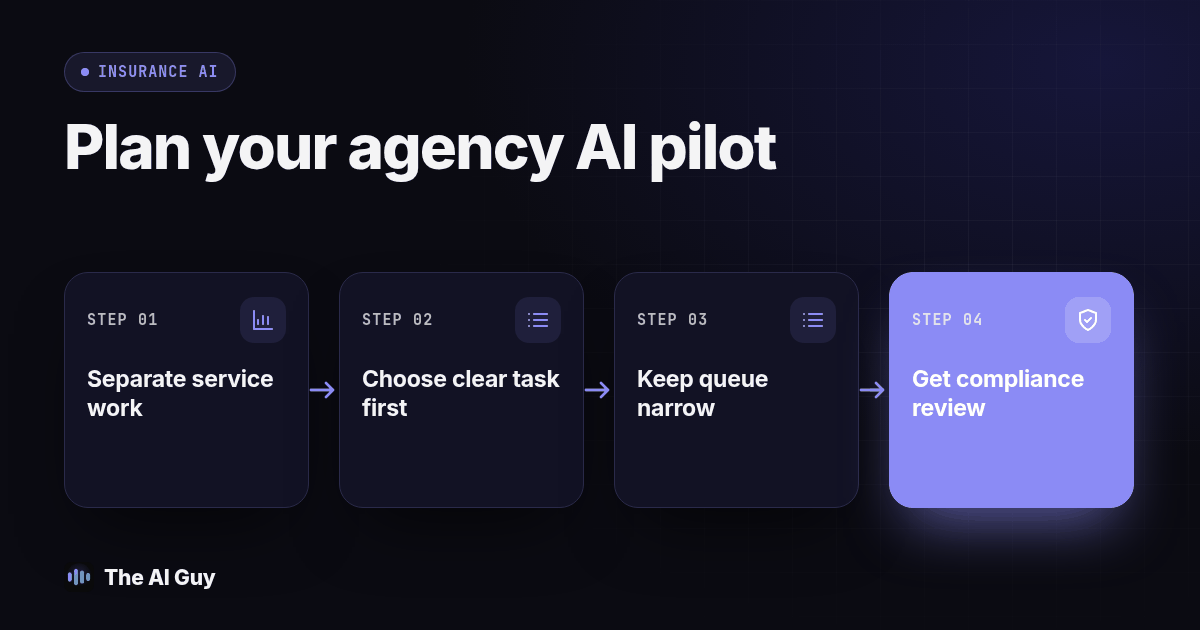
Start by separating service work from selling work. A certificate request, a renewal question, a billing dispute and a request for new coverage need different owners and different source documents. Ask staff to label a sample of incoming work using the categories they already understand. Record what prevented each item from moving forward.
Choose a task with a visible finish line. For example, define renewal preparation as assembling the current policy reference, relevant customer correspondence, missing information and a review task for the assigned producer. Do not define it as making the renewal successful. The latter includes decisions outside an administrative assistant's assignment.
Keep the first queue narrow enough for a supervisor to review every item. Select one line of business or one service request category, and explain why that category is suitable. If the intake process itself is inconsistent, standardize the questions before introducing AI. The automation selection worksheet can help distinguish a missing process from an automation opportunity.
The NAIC's AI topic resource describes regulatory attention to accuracy, governance and unfair discrimination in insurance AI. Those concerns support a cautious design, but a national resource is not a substitute for reviewing requirements applicable to your agency, state and product. Assign that review to the appropriate adviser before a customer facing launch.
What should an intake assistant collect and avoid deciding?
For an initial request, I suggest collecting the customer's identity information approved by your agency, contact preference, reason for contacting the office and the product or policy involved. Ask the assistant to distinguish a new inquiry from a request about an existing policy. Let staff resolve an uncertain identity match before opening sensitive records.
Use the customer's own description when a request is ambiguous. If someone says they bought another vehicle, the assistant should capture that change and request the approved follow up information. It should not decide the effective date, describe the vehicle as covered or infer that the carrier accepted an endorsement. Make those restrictions explicit in the instructions and action permissions.
For uploaded documents, create a field list with a source location beside each extracted value. Ask for an unresolved status when a page is missing or unreadable. A reviewer should be able to open the exact page used for the named insured, property address or requested change. Never reward the tool for filling every field regardless of evidence.
Set a boundary for sensitive data before the pilot. Use fictional records when rehearsing and approved systems for real customer information. The NIST AI risk framework provides a voluntary structure for assessing AI risks. My operational recommendation is to document who can access each record and why that access is needed for the selected task.
How should AI support renewal preparation?
Build a renewal packet as a review aid. Define the inputs: the current policy documents, approved carrier correspondence, customer changes already recorded and unresolved service requests. Instruct the assistant to list discrepancies between those inputs without resolving them through guesswork. A change mentioned in an email is not automatically a change accepted by the carrier.
Ask for a compact exception list at the start of the packet. Useful categories might include missing information, conflicting addresses, unconfirmed customer changes and questions requiring producer review. Avoid asking the assistant to decide whether a customer has sufficient protection. That is a different assignment with different professional and regulatory considerations.
Keep document versions visible. Label the current policy, proposed renewal and superseded files so a reviewer does not mistake an older schedule for the present record. Use the document version review method to trace proposed differences back to the original pages. The person approving the packet should record corrections before it enters a customer conversation.
During the pilot, measure the preparation task separately from the outcome of the renewal. Track how long staff spend finding records, checking the summary and correcting it. Include cases where the draft is discarded. Your evaluation should show whether the packet helps the producer arrive prepared, not imply that preparation alone caused a customer to renew.
How can service requests move without losing accountability?
Create a queue with a named owner and an explicit next action for every request. The assistant can propose a category and draft an internal task. Require a person to accept ownership before the request is considered assigned. If nobody accepts it, keep the item visible as unresolved and escalate according to your office procedure.
For certificates, claims questions and billing issues, write approved routing instructions. In the first pilot, I would have the assistant acknowledge receipt and state what the office will do next. Avoid language suggesting a document has been issued, a claim approved or a payment accepted unless the relevant system and authorized person have confirmed that event.
Design reminders around recorded commitments. A promised callback date should belong to a task with an owner, rather than an isolated note in a transcript. If the customer supplies new information before the callback, show it to the owner and reassess the pending action. Test that reminders stop when the request is resolved or transferred to another approved process.
Use drafts for customer correspondence until the team has inspected ordinary requests and difficult exceptions. Check names, policy references, amounts and dates against the source. Use the customer email drafting guide for a process that keeps business facts separate from tone and phrasing. A friendly message should still describe the actual status of the work.
What should you review before using AI for calls?
Review inbound service handling separately from outbound prospecting. For inbound calls, specify how the assistant identifies the agency, handles an identity check, requests a person and records an incomplete conversation. For outbound calls, document the audience, purpose, consent evidence, stop requests and campaign permissions before enabling the system.
The FCC's AI voice ruling places AI generated voice technology within the TCPA restrictions for artificial or prerecorded voices. An AI voice is not a shortcut around those requirements. Ask counsel to assess the actual calling design, including any applicable state rules and consent requirements, rather than treating a vendor's feature description as approval.
Insurance also has jurisdictional details. The FTC telemarketing guidance discusses the business of insurance and how state regulation affects TSR applicability. Do not copy a generic telemarketing checklist into the agency and assume it resolves every question. Have your adviser document which requirements apply to your activities and service providers.
If voice automation belongs in the selected workflow, RizzDial's AI calling page describes qualification and booking capabilities you can evaluate. Treat it as one component under review. Ask for a demonstration of your approved script, uncertain identity scenario and human handoff, and use your own acceptance criteria before granting access to customer records.
What should a practical agency acceptance test look like?
Write expected outputs before running the tool. Ask a producer and a service employee to agree on which parts are factual, which are unresolved and which require an authorized decision. The steps below are a proposed test, with fictional examples rather than reported client results.
- Build a sample renewal packet with a current document, a superseded document and a customer message about a proposed change. Check that the assistant identifies the versions and does not report the proposed change as completed.
- Submit an intake request with a similar name to an existing customer but a conflicting address. Confirm that the workflow requests human identity resolution before exposing the existing customer's information.
- Give the assistant an incomplete attachment. Require it to name the missing page or field and create a follow up task. Reject a draft that supplies a plausible value without documentary support.
- Ask a question about whether a hypothetical loss is covered. Confirm that the assistant follows the approved routing language and does not invent a coverage decision or assurance.
- Move an unresolved service task to another employee while a reminder is pending. Check that the record shows the new owner, the handoff status and the revised next action without duplicate customer messages.
- Test a stop request on a staff owned contact record. Inspect the campaign controls and any pending actions. Do not accept a spoken acknowledgment as evidence that the system actually prevented further outreach.
- Have the reviewers score the packet and task record against the written answer sheet. Repair each material failure, rerun that scenario and record who approved the final version for the limited pilot.
Include at least one ordinary request in every retest. The goal is to verify that a correction to an exception did not damage the routine path. Store the input, output, source references and reviewer notes together so a future employee can understand why the workflow was approved.
How should you measure value and maintain the system?
Measure the selected administrative task from arrival to accepted completion. Count review effort, document lookup, corrections and rework. Keep rejected outputs in the denominator. Compare similar request categories and avoid attributing seasonal changes or different customer mixes to the AI pilot.
Write down what would make you stop. My suggested pause conditions include exposing the wrong customer's information, stating an unsupported coverage conclusion, losing task ownership or continuing contact after a stop request. Treat these as design failures to investigate, not inconvenient records to omit from the results.
Assign an owner to every approved source library. When a carrier form, agency procedure or service contact changes, update the source and repeat the relevant tests. Remove superseded material from the active set while preserving whatever audit record your agency requires. Maintain a short change log linking the change to the test and approver.
Prepare a handover document before expanding beyond the initial queue. It should identify permissions, support contacts, unresolved limitations and the procedure for returning to manual work. Ask a colleague who did not build the workflow to follow the instructions. If that person cannot pause or reconcile the queue, the handover needs more work.
For implementation planning, contact James with the administrative workflow you want to improve. Bring redacted examples of the input, acceptable output and difficult exception. A productive starting brief names the work your staff should finish more reliably and the decisions that must remain with them.
What questions come up in an insurance agency AI FAQ?
What is a sensible first AI assignment for an insurance office?
I suggest preparing a review packet or organizing one service queue. Choose a task with approved source documents, a named reviewer and an output that staff can check before a customer relies on it.
Should the assistant answer coverage questions during intake?
My recommended intake design routes coverage questions to the agency's authorized staff. It should preserve the customer's question and relevant source information without presenting an unapproved coverage conclusion.
How should a renewal summary handle conflicting documents?
Require the summary to identify the conflicting documents, their versions and the fields involved. Leave the conflict unresolved for the reviewer rather than selecting whichever value makes the packet look complete.
When should an agency expand beyond the first queue?
Expand after the team has tested exceptions, measured review effort and documented a working pause and handover process. Use the acceptance criteria agreed before the pilot to make that decision.